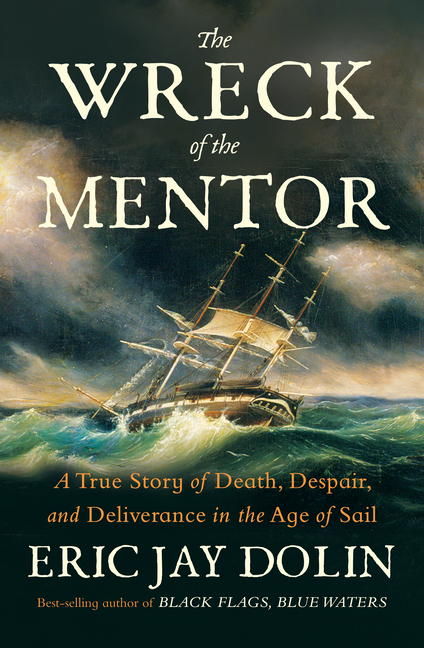
The story of the American whaleship Mentor, wrecked in 1832 on a remote reef in the western Pacific. With supplies dwindling, the eleven surviving crewmen face not only the miseries of shipwreck in unfamiliar territory but also the profound uncertainty of contact with the Indigenous people of the Micronesian archipelago of Palau, who within days approach the deserted men brandishing axes, clubs, and spears.
A complex and intriguing tale that involves multiple years, islands, and groups of Pacific Islanders ... The book hits all the points that make stories about sailors in peril so compelling. Danger is a constant. So is fear. They are isolated in a remote corner of the Pacific far from the trade routes where they might be discovered. Moral choices abound, such as: Should a captain stay with his crew or leave when he has the chance in hopes of organizing a rescue? ... The Wreck of the Mentor reminds us about the unimaginable challenges many early Americans faced and the tenacity they demonstrated in overcoming them.
Despite his efforts, Indigenous perspectives rarely come through in the text, which reads as if it could have been based entirely off Western accounts ... The book is at its strongest when Dolin turns an anthropologist’s eye not only on the Palauans, but also on the desperate sailors and the whaling societies whence they came. I wish he’d gone even further ... Can, at times, feel more like a catalog than a story, presenting as it does — for pages at a stretch — sequential timelines of events ... A work of serious research and clean prose, and contains plenty of interesting illustrations that keep the pages turning fast. In presenting a detailed and respectful account of the encounters between Western sailors and the Indigenous residents of Palau, it excels — but doesn’t transcend.
In addition to recounting an exciting and at times almost unbelievably dramatic story, the author helps readers appreciate how Western visitors affected the delicate balance of power among indigenous cultures—sometimes forcefully, but often unwittingly ... Many books about Western encounters with indigenous people in the 18th and 19th centuries are necessarily one-sided affairs haunted by genocide, disease and cruel warfare. The Wreck of the Mentor makes for less-guilty adventure reading, depicting a scenario where the odds were leveled by circumstance