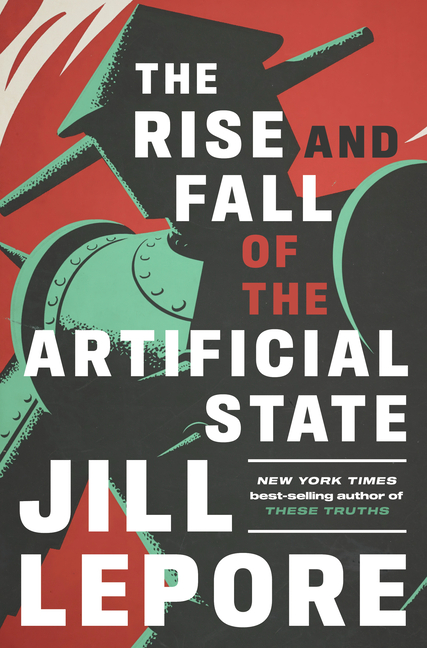
Even as she elegantly conveys the nightmare of the Artificial State, her wistful treatment of what it’s replacing can verge on sentimental ... Parts...read like an elegy for a vanishing world. But Lepore says it isn’t too late. We humans know how to make a mess of things; we also know how to imagine a different future.
After reading Jill Lepore’s The Rise and Fall of the Artificial State, I have a new destination for a time machine, should I ever finally get my hands on one. I’d set the dial to some night in the late 1970s or ’80s and visit the boyhood rooms of the Silicon Valley titans Elon Musk, Peter Thiel, and Sam Altman. Then I’d confiscate all of their science fiction ... Lepore wants to understand some strange turns in our world, such as our embrace of a technology that might just lead to our elimination, and the blitheness with which powerful entrepreneurs like Altman imagine much of our planet’s surface covered in data centers. In seeking the source of all these dark fantasies, she reveals something else: the power and stubborn persistence of the adolescent mind.
The book is urgent and wide-ranging, but it replaces the handpicked case study with selective narrative history ... Lepore is undoubtedly more interested in tracing the intellectual history of machine rule than in explaining its institutional underpinnings. The result is an often vivid and at times unsettling account ... Lepore has written an entertaining exploration tracing Silicon Valley’s self- image to the science fiction on which its architects grew up. Yet her narrative history often comes at the expense of the institutional questions her argument raises. She concludes by stating that knowledge of the past is essential, with which it is hard to disagree, but what exactly does the past teach us to do? The lessons she draws come down to: do not surrender judgement to machines. As counsel, this has appeal. As a guide to explaining or reversing institutional decay, environmental damage and democratic decline, it is less satisfying.