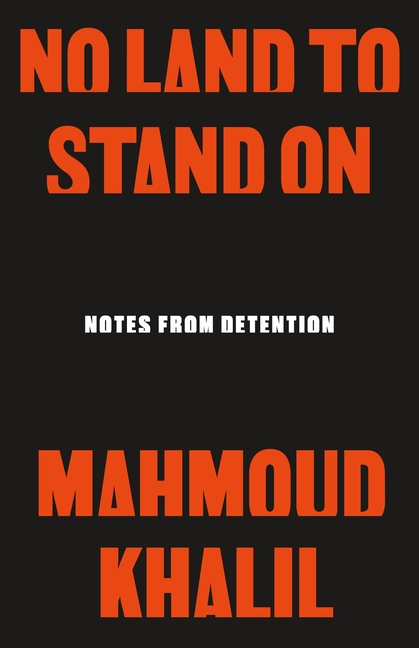
Drawing on his prison diary and writing, Mahmoud Khalil conjures the despair and cruelty of ICE detention, where prisoners can vanish overnight and visiting families risk their own deportation. There is humanity, too, in the men’s acts of care—their mutual help with documents, the prison cake they make after Mahmoud can only follow the birth of his son on the public payphone. In tandem, he tells the multi-generational story of a family expelled from Palestine to a Syrian refugee camp, of flight from Assad’s regime to Lebanon, of arrival in an America that promised permanence and protection, and of the enduring struggle for Palestine.
Khalil recounts in stark detail the terrifying experience of being surrounded by men in the lobby of his Manhattan apartment building, handcuffed in front of his pregnant wife, pushed into an unmarked car and flown to a detention camp in Louisiana ... The prose in this prison memoir is matter-of-fact and unadorned, noticeably free of self-pity. Especially striking is Khalil’s account of being caged in a camp apparently designed to get people to give up hope and self-deport by wearing them down ... This is a frightening, important book. But there is also a measure of hope.
Kafkaesque ... Khalil spends the book jumping around, mixing the chronology of his detention with memories of his upbringing and young adulthood. This never feels disorienting because the narrative is cemented around the core idea that, regardless of place and circumstance, he is defined by being Palestinian ... This is not a story of stoic heroism but of constant estimation (and sometimes underestimation) of risk and the decision to accept it as the price of doing the right thing in a world of despots and cowards.
Mahmoud Khalil was completing a master’s degree at Columbia University when, in March 2025, plain-clothed officers from the Department of Homeland Security snatched him from his home in New York and took him to an immigration detention centre; he was then transferred to another facility in Louisiana, more than 1,000 miles away ... Khalil recounts this Kafkaesque ordeal with a quiet fury in his memoir, No Land to Stand On. The episode is a damning snapshot of the Trump administration’s creeping authoritarianism and the cruelty of its immigration enforcement policy.