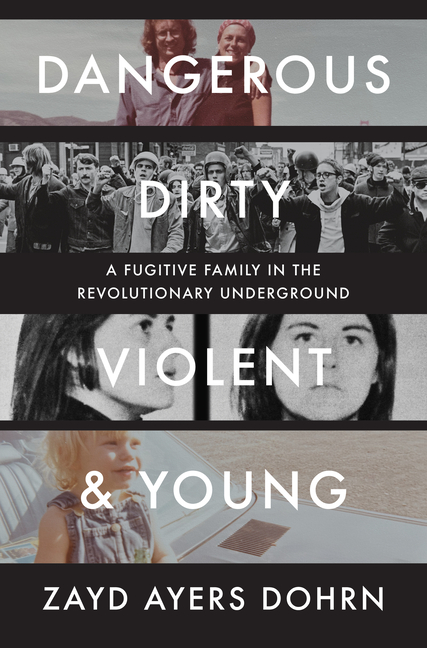
Zayd Ayers Dohrn was born underground. His parents were fugitives after a decade fighting the US government; his mother was on the FBI's Ten Most Wanted list. All his life, Dohrn's parents said his birth marked a clean break with violent revolutionary struggle, but in this memoir, he discovers that story wasn't entirely true.
There have been numerous novels, films and memoirs inspired by the American radical left of the late 1960s and early ’70s, but Zayd Ayers Dohrn’s fascinating and affecting memoir, Dangerous, Dirty, Violent, and Young, stands out as definitive ... A meticulously researched history of an explosive time as well as a deeply felt, intimate portrait of a very unusual family.
Dangerous, Dirty, Violent, and Young (the title derives from a Jefferson Airplane song) is ultimately an account of being brought up by parents who rarely put him and his brothers ahead of their radical left-wing politics ... While Dangerous, Dirty, Violent, and Young provides a minihistory of radical activity, both black and white, from the middle 1960s until the end of the Vietnam War in 1975, the book’s most interesting passages take up its author’s reaction to his parents’ radicalism as a child and then an adolescent ... I concluded Dangerous, Dirty, Violent, and Young struck by how much better it is not to feel the need to fight full time against the world but to feel instead reasonably contented, indeed privileged, to live in it as it is. Or at least to have parents who do.
Might have contributed to a deeper understanding of childhood on the left as it was lived ... Ayers Dohrn isn’t trying to analyze his parents on the couch of this double genre, but he does want to make sense of what he experienced as a fundamental betrayal: his parents’ dual loyalty to their children and to the revolution. Ayers Dohrn wonders if this duality is even possible to negotiate. Often, it seems the answer is no ... The focus remains decidedly on what he and his brothers went through in its specificities ... Is about struggling to understand how his mother and her friends could love the struggle as much as or more than their kin.