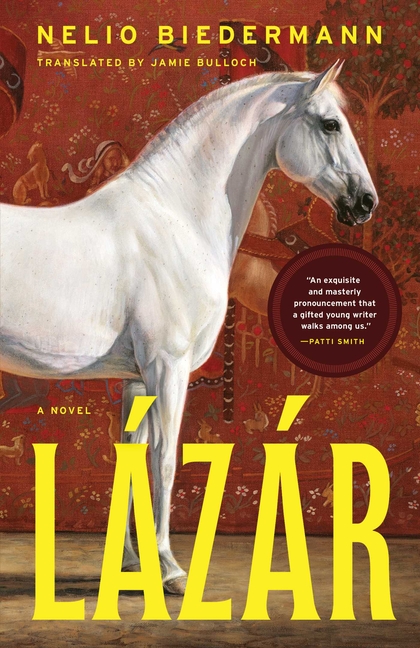
Inspired by the author’s own family story, Lázár is a gothic, inter-generational family saga capturing the rise and fall of an aristocratic Hungarian family against the backdrop of the two world wars.
Sweeping, unruly ... A gothic fable, rich with sensory description, gems of historical detail and surreal twists ... Biedermann aims for a grand European saga in the mode of The Leopard or Buddenbrooks, and at its best, the novel achieves a powerful rhyming between daily life and the demise of an epoch. At other times, world-historical events are shoveled in with heavy hands ... Overall, though, Lázár is thrillingly unburdened by conventional stylistic constraints ... Biedermann grasps at the edges of coherence, and some pieces flitter away in the wind. But he usually regains control by reining in the narrative, reinforcing core motifs and returning to the riveting scene-based storytelling that displays his true gifts.
Reading Lázár is like visiting a museum of older novels ... Outfitted with all the accoutrements of the traditional novel. Lázár has a plot (a luxury that many of the meandering autobiographical meditations of recent years have dispensed with), a cast of fractious characters, and an ambitious frame of reference ... When Biedermann is at his least flashy and most meticulously observant, he can write scenes that seethe with reality ... But these quiet intimacies are overwhelmed by fussy images that make little sense ... Reading Lázár is like running on a treadmill. There is a great deal of frantic activity, but no progress, and we end up exactly where we began.
History is the most formidable character in Lázár; the family members, evoked in brief, time-hopping chapters, are stretched very thinly across it ... To drive home the Lázárs’ fatuity, Mr. Biedermann coats them in lurid layers of shame and degradation. The scenes lurk in the shadows of these lives, poring over the characters’ sexual deviancies and psychological terrors. ... Somewhat suffocating.