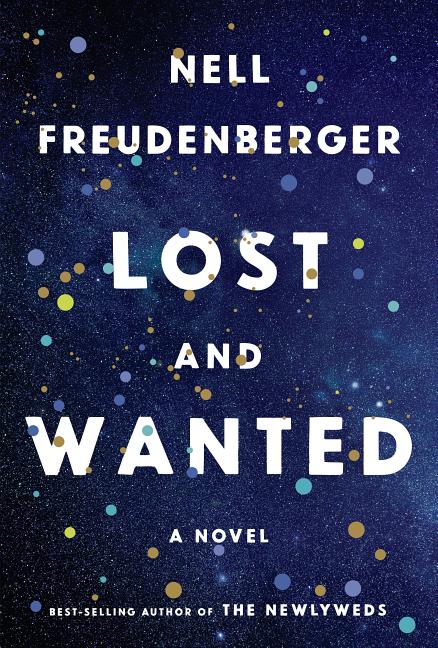
PositiveThe New York Times Book ReviewWizardly ... The novel fairly cackles with glee at its capacity to summon excitement from all corners of time and space ... Does what few time-travel fantasies do: It laughs about the pleasure that can be had once we grant ourselves the power to change history. At the same time, however, it asks questions, as all time-travel novels do, about who gets to tinker with time, and who lives at its mercy ... And yet, in the midst of this novel’s happy freedom, I still felt constraint ... Is Iris a woman, or is she a type? ... Iris may be a heroine who has figured out how to travel in time, but somehow here we all are, face to face again with history.
Nell Freudenberger
RaveThe New York Times Book Review\"In Lost and Wanted... Nell Freudenberger joins this august tradition [of integrating sceitific concepts into literature], expanding her stock of metaphors with the language of quantum physics. The effect is beautiful. Freudenberger navigates complicated concepts from physics with admirable clarity, and those concepts — entanglement, uncertainty, gravitational waves — help us feel in new ways the ongoing influence of dormant friendships, the difficulties involved with believing in attachments that can’t be observed, the enduring pull of discarded hopes. In Freudenberger’s hands, long scientific digressions — about the search for the Higgs boson, the existence of dark matter, the collisions of black holes — never feel unnecessary. For one thing, they’re described in splendidly accessible language. For another, our narrator, Helen, is a professor of physics, and this is how she understands the world ... Lost and Wanted is a novel of female friendship without the furious intimacy of, say, Elena Ferrante’s Neapolitan novels ... Reading [this novel], I was moved by intimacies near and far, real and imagined, lost and found in all the echoing corners of the expanding universe.\
Liz Moore
PositiveThe New York Times Book Review...[a] fiercely intelligent new novel ... Moore beautifully depicts a child’s impulse to collect the details of her fading parent ... Moore evocatively renders the remoteness of even our closest loved ones, so it comes as a disappointment when, partway through the novel, she offers a complete back story to explain David’s indirections ... The novel is more enticing when it treats its characters as complicated and ultimately indecipherable puzzles.