Bob Dylan’s The Philosophy of Modern Song, Bono’s Surrender, Claire Keegan’s Foster, and Louise Kennedy’s Trespasses all feature among the Best Reviewed Books of the Month.
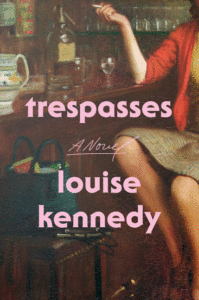
1. Trespasses by Louise Kennedy
(Riverhead)
12 Rave • 3 Positive
Read an essay by Louise Kennedy here
“Brilliant, beautiful, heartbreaking … Kennedy deftly reveals how violence in a conflict zone can more accurately be described as intertwined with and inseparable from daily life … In Trespasses,as in life, humor provides an antidote to the darkest times … Kennedy gives us children who are funny and surprising and uplifting in exactly the ways real children are, with none of the treacle that sometimes sneaks into fictional depictions of young people … Kennedy writes beautifully about love … As the novel progresses, it picks up a propulsive energy, the kind that compels you to keep reading straight through to the end. A rising sense of tension throughout comes to a shocking head. I am not a crier, but by the final pages of Trespasses, I was in tears. It’s a testament to Kennedy’s talents that we come to love and care so much about her characters.”
–J. Courtney Sullivan (The New York Times Book Review)
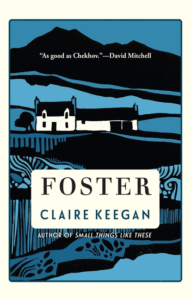
2. Foster by Claire Keegan
(Grove)
10 Rave • 3 Positive
“Keegan’s beautiful new novella, Foster, is no less likely to move you than any heaping 400-page tome you’ll read this year … Keegan’s novella is a master class in child narration. The voice resists the default precociousness, and walks the perfect balance between naïveté and acute emotional intelligence … Keegan averts expectations in the couple’s portrayal, which brings Foster some welcome levity … Like a great, long Ishiguro novel, Keegan makes us complicit in what her characters want, setting us up for utter heartbreak when they don’t get it.”
–Alex Gilvarry (The New York Times Book Review)
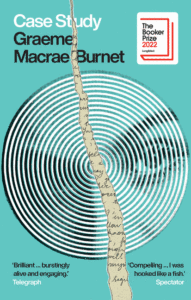
3. Case Study by Graeme Macrae Burnet
(Biblioasis)
10 Rave • 2 Positive • 1 Mixed
Read an excerpt from Case Study here
“An interest in exploring complex psychological dramas through intricate narrative structures takes centre stage … The defining essence of Burnet’s work to date is to be found in…literary gamesmanship, a brand of metatextuality that is as much about exploiting the possibilities of the novel form as it is about blurring the boundaries between appearance and reality. In throwing us into doubt about which—and more crucially whose—story we are supposed to be following, Burnet encourages us to look more closely at the inherent instability of fiction itself … Case Study is above all a very funny book, a wry look back at 60s counterculture in which Burnet’s inventions rub shoulders with real personalities. But much as Braithwaite’s outlandish behaviour and performative rudeness might raise a knowing smile, his theories on identity and selfhood, appearance and reality are never as bonkers as we pretend they are. If Burnet’s aim in writing Case Study was to force us up against the contradictions of our conflicted selves, he has surely succeeded. This is a novel that is entertaining and mindfully engrossing in equal measure.”
–Nina Allan (The Guardian)
**
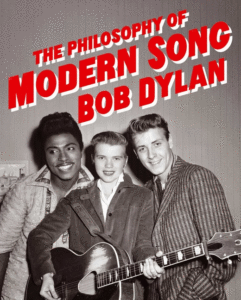
1. The Philosophy of Modern Song by Bob Dylan
(Simon & Schuster)
11 Rave • 14 Positive • 6 Mixed • 3 Pan
“It is filled with songs and hyperbole and views on love and lust even darker than Blood on the Tracks … There are 66 songs discussed here … Only four are by women, which is ridiculous, but he never asked us … Nothing is proved, but everything is experienced—one really weird and brilliant person’s experience, someone who changed the world many times … Part of the pleasure of the book, even exceeding the delectable Chronicles: Volume One, is that you feel liberated from Being Bob Dylan. He’s not telling you what you got wrong about him. The prose is so vivid and fecund, it was useless to underline, because I just would have underlined the whole book. Dylan’s pulpy, noir imagination is not always for the squeamish. If your idea of art is affirmation of acceptable values, Bob Dylan doesn’t need you … The writing here is at turns vivid, hilarious, and will awaken you to songs you thought you knew … The prose brims everywhere you turn. It is almost disturbing. Bob Dylan got his Nobel and all the other accolades, and now he’s doing my job, and he’s so damn good at it.”
–David Yaffe (AirMail)
2. A Line in the World: A Year on the Sea Coast by Dorthe Nors
(Graywolf)
11 Rave • 1 Positive
Read an excerpt from A Line in the World here
“Nors, known primarily as a fiction writer, here embarks on a languorous and evocative tour of her native Denmark … The dramas of the past are evoked not so much through individual characters as through their traces—buildings, ruins, shipwrecks—and this westerly Denmark is less the land of Hans Christian Andersen fairy tales and sleek Georg Jensen designs than a place of ancient landscapes steeped in myth … People aren’t wholly incidental to the narrative. Nors introduces us to a variety of colorful characters, and shares vivid memories of her family’s time in a cabin on the coast south of Thyborøn. But in a way that recalls the work of Barry Lopez, nature is at the heart of this beautiful book, framed in essay-like chapters, superbly translated by Caroline Waight.”
–Claire Messud (Harper’s)
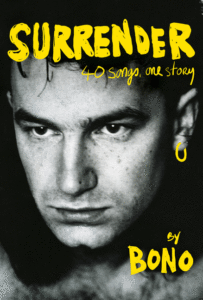
3. Surrender: 40 Songs, One Story by Bono
(Knopf)
5 Rave • 10 Positive • 1 Mixed
“Defined largely by humility. This is an introspective story written by a man whose spirit is never far removed from the sadness and grief of his childhood … Honest and direct … Surrender is more a van of a book than a private plane. It shrinks more ego than it inflates. Bono makes no bones about his outsized ambitions, but there’s always a fallible human being behind the big plans and then the superstardom … By no means operatic. There’s a casual charm to the memoir, a feeling of being led through caverns of story by a guide with some things to get off his chest … This is the rare rock star memoir written by a rock star who, you get the impression, could have been a writer … U2 fanatics might already know much of the material in Surrender. For the rest of us, there’s something to discover in every chapter. Bono has a gift for making even the unattainable seem relatable … He’s humble, even self-effacing. He might be fun to have a beer with. He is very much of this Earth.”
–Chris Vognar (The Los Angeles Times)

Michelle Obama’s The Light We Carry, Steve Martin’s Number One is Walking, and Meg Howrey’s They’re Going to Love You all feature among the Best Reviewed Books of the Week.
1. They’re Going to Love You by Meg Howrey
(Doubleday)
3 Rave • 2 Positive
Read an essay by Meg Howrey here
“[Howrey] deftly arranges her characters’ betrayals, fidelities and accumulated disappointments to portray a family stymied by its own silences … Carlisle’s first-person narration remains chilled for much of the book. We are privy to her feelings only insofar as she is … The controlled performance is as grueling and gorgeous as a dance en pointe … If the novel stumbles, it’s only as the denouement nears, when its steps can seem a bit too rehearsed … But these become minor quibbles by the end, when Carlisle heartbreakingly articulates to herself a truth that is fully her own, no inheritance. In the way of the best endings, it has been thrumming beneath the surface all along, and now ricochets back over the rest of the novel, snapping it into sharper focus.”
–Alex Marzano-Lesnevich (The New York Times Book Review)
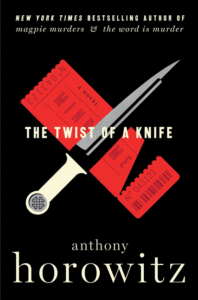
=2. The Twist of a Knife by Anthony Horowitz
(Harper)
2 Rave • 2 Positive
“Horowitz continues to delight in mixing real life…as nebbish against the always-three-steps-ahead Hawthorne. Not to worry, their relationship isn’t over quite yet. There’s much more to discover, and readers will be waiting eagerly for more from one of the best mystery writers around.”
–Ilene Cooper (Booklist)
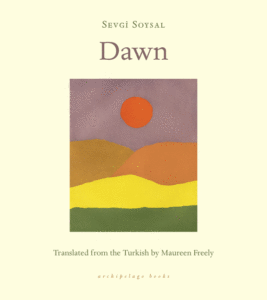
=2. Dawn by Sevgi Soysal, trans. by Maureen Freely
(Archipelago)
2 Rave • 2 Positive
“More relevant than ever … The tension between how the outside world views liberated, intellectual women and how they view themselves is often the driving force of such novels, and hence their writing is often turned inwards, with sharp observations of situations and characters. Dawn is a visceral and cinematic example of this kind of writing: where the embodied social experience of women takes central stage … The brilliance of the novel might be traced to the formal structure … Dawn is surely ahead of its time in laying bare all the facets of discrimination and privilege; Soysal’s writing is captivating, reflective, and thrilling.”
–Irmak Ertuna Howison (Asymptote)
**
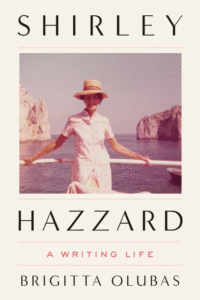
1. Shirley Hazzard: A Writing Life by Brigitta Olubas
(Farrar, Straus and Giroux)
4 Rave • 4 Positive • 1 Mixed
Read an excerpt from Shirley Hazzard: A Writing Life here
“… an impeccably researched and deeply incisive account of Hazzard’s life and work, and the intriguing interplay between the two … Olubas is not in the business of hagiography. She is in pursuit of the truth. She tells it straight and we trust her … Her letters and diaries, and the biography itself, become a long list of writers and artists whom they saw in New York, Paris, London, Rome, Naples or Capri. For the reader, the onslaught is exhausting, even if it does mean hanging with Robert Penn Warren or Elizabeth Bowen or Saul Bellow. Hazzard’s diary entries during this time, Olubas writes, reveal the seriousness with which she approached these social occasions and her effort to learn how to carry herself in these circles … Hazzard’s own books arrive in this biography whole and as mysteriously as immaculate conceptions, without a sense of having been wrestled into creation. The writer in A Writing Life is elusive. Olubas acknowledges that apart from occasional complaints about not finding time to work, Hazzard said little about her experience of writing.”
–Lily King (The New York Times Book Review)
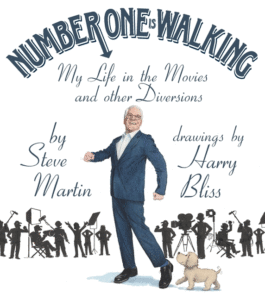
2. Number One Is Walking: My Life in the Movies and Other Diversions by Steve Martin
(Celedon Books)
3 Rave • 2 Positive • 1 Mixed
“An illustrated romp … Depicted in multi-panel comic vignettes—plus the occasional full-page spread—Martin’s words marry perfectly with Bliss’ signature pen strokes to provide a coffee-table compendium of funny yet sincere reflections from a star who has truly seen it all … Martin’s warm reminiscences, complemented by Bliss’ engaging artwork, succeed in creating a book that offers chuckles and insights in equal measure.”
–Zack Ruskin (The San Francisco Chronicle)
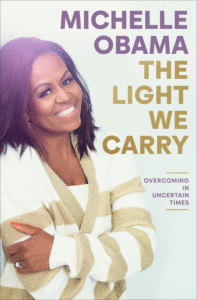
3. The Light We Carry by Michelle Obama
(Crown)
2 Rave • 3 Positive • 1 Mixed
“Obama’s road map for uncertain times resonates in ways that other self-help books do not … I want to hear from Michelle Obama, who doesn’t always like the way she looks, who felt like an outsider after becoming the ultimate insider; the one who easily becomes lonely … Through her stories, experiences and thoughts, we’re finding the light with her. Lucky us … Relatable … We are perfectly aware of how carefully she chooses her words and the stories she tells. But she reveals herself, subtly and endearingly, in a dozen different ways … Her thoughts are nuanced and never prescriptive.”
–Judith Newman (The New York Times Book Review)
Our basket of brilliant reviews this week includes Hermione Hoby on Katherine Dunn’s Toad, Justin Taylor on Cormac McCarthy’s The Passenger and Stella Maris, Jennifer Szalai on Mike Pence’s So Help Me God, Anthony Domestico on Brigitta Olubas’ Shirley Hazzard: A Writing Life, and Margaret Talbot on Beverly Gage’s G-Man.
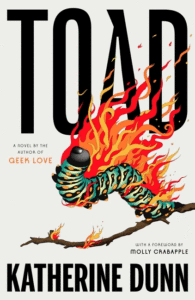
“… a remarkable, disquieting, and judiciously revolting posthumous novel about, among other things, unrequited love … succeeds not by being incredible, but by being so credible. It is, definitively, a novel for grown-ups, not just because of the advanced age of its narrator—the ornery Sally Gunnar—but because a thrilling, subtle, and wholly persuasive adult anger animates the book. I believed every word … Despite its jumbled chronology, Toad tells a brutally straightforward story … beneath the bite and verve of its prose, Toad is attuned to the quietly tectonic nature of intimate relations, and things between these frenemies shift in strata and run deep … What a peculiar experience it is, then, both galling and gratifying, to read this book decades later, now that Roe v. Wade has been overturned. It’s not that Toad is exactly prescient—assaults on female autonomy are of course ongoing (the galling part), and concomitant female rage remains their warranted result (which explains much of what is gratifying.) But I wonder if Dunn had any idea how much her strange, savage, tender book would come to be protesting.”
–Hermione Hoby on Katherine Dunn’s Toad (4Columns)
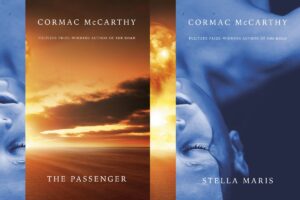
“Is Cormac McCarthy our most minor major novelist or is he our most major minor novelist? The new books, unequal though they are in terms of quality, are his most ambitious and challenging work in decades. They do not readily yield a definitive answer to my question, but they do suggest that it may be as much on his mind as it has been on mine … After Blood Meridian he simplified the language and softened the violence in his books; his subsequent novels still boast sizable body counts, but there’s less glee in the killing, and corpses are radically less likely than heretofore to get scalped and/or fucked … McCarthy is hunting big game and he’s brought out the big guns to hunt with. What he has not done is provide anything resembling a plot through which to reify and explore these ideas in narrative. There is indeed, as the jacket of my galley copy promises in big bold letters, ‘A SUNKEN JET. NINE PASSENGERS. A MISSING BODY.’ And Bobby is indeed caught up in ‘a conspiracy beyond his understanding,’ but it’s hard to convey just how utterly vestigial, even irrelevant, this material is to anything resembling the novel’s real concerns. If Twin Peaks: The Return had you screaming at your TV to get Agent Cooper off the sidelines, or if you think late DeLillo has gotten elliptical to the point of incoherence, you’re going to end up throwing these books across the room … The truth is that The Passenger only fails to satisfy when it vamps as a thriller. That’s a promise that just won’t ever be made good. When the novel follows its Lynchian instincts—setting a long scene on a deserted oil rig off the coast of Pensacola, for instance, or allowing Bobby to encounter the Kid (or to dream that he did) on a stormy beach—then its power and pleasures are considerable. It is a novel of set pieces and soliloquies, images and ideas, at its best when refusing to be anything other than its moody, freaky self. Above all, it is a book of evocative surfaces, like a John Ashbery poem, where things we take at first to be windows turn out to be mirrors, and the radical alterity glimpsed in dark glass turns out to be ourselves … There’s no reason for Stella Maris to be this boring; but then, there’s no reason for it to beat all. Rather than punctuate The Passenger, Stella Maris made me second-guess the things I liked best about it, and left me dwelling rather more darkly than I otherwise might have on its lacunae and flaws, because elusiveness and opacity are one thing, but any writer who would publish these two books together on equal footing must just be throwing shit at the wall and hoping for the best.”
–Justin Taylor on Cormac McCarthy’s The Passenger and Stella Maris (Bookforum)
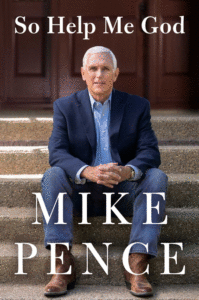
“The bulk of So Help Me God is given over to tracing his relationship with Trump, much of it in minute yet obfuscating detail … Not that Pence’s explanations amount to much more than self-serving spin … Some of Pence’s contortions are so elaborate that they’re worthy of Cirque du Soleil. A chapter on Covid gets especially creative. Trump’s bumbling, combative Covid briefings are depicted as wonderfully comforting, instead of utterly confounding … Pence, who presided over the White House’s troubled coronavirus task force, is relentlessly upbeat, despite a pandemic death toll of more than 377,000 Americans by the end of 2020 … The most obvious conclusion to draw from So Help Me God is that Pence continues to have political—perhaps presidential—ambitions and so finds himself in bit of a pickle. If he had refused to certify the vote, that would have been it for him—no matter what happened after that, he would forever be seen as Trump’s lackey. But since he did certify the election, he has to find a way to placate the Trump supporters he’ll inevitably need … Threading such a tiny needle seems impossible on the face of it, but if anybody has had the miraculous experience of failing upward, it’s Pence.”
–Jennifer Szalai on Mike Pence’s So Help Me God (The New York Times)
“To be sure, Hazzard knew the world in all its mineral coarseness. She grounded her exquisite style in earthly plots: petty jealousies; romantic betrayals; boring office jobs. Her fiction has an awareness of place and exhibits impressive geographical range, appropriate for a woman who was born in Australia but lived all over … Yet her writing is at its most characteristic when at its highest pitch, when her prose and the details it includes approach the condition of music, or poetry, or sculpture … This was one of Hazzard’s greatest gifts as a writer: to show how life, when seen through the prism of style, partakes of the monumentality of art. For Hazzard, to see life aesthetically was to see life as it really was. Her four novels and two collections of stories are filled with details distilled to perfection … if ever there were a writer who required a biographer of style and sensibility, it’s Shirley Hazzard. Everyone who knew her commented on her elegance and charm, her sense that beauty—beautiful books, beautiful conversations, beautiful landscapes—mattered more than anything…Lucky for Hazzard, she has found an ideal chronicler in Brigitta Olubas, whose Shirley Hazzard: A Writing Life is an exemplary work of biographical criticism … Olubas notes that Hazzard saw poetry as ‘a way of being human.’ She believed that how you read shaped how you encountered the world, and how you wrote emerged from how you had lived. As one character says in The Bay of Noon, ‘They had a notice, Please do not touch the paintings; they should forbid the paintings to touch you.’ In Hazzard’s life and work, the real and the aesthetic reach out to touch one another, always.”
–Anthony Domestico on Brigitta Olubas’ Shirley Hazzard: A Writing Life (The Baffler)
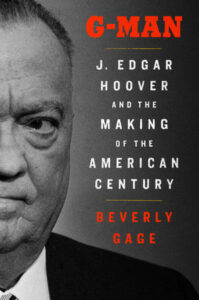
“…crisply written, prodigiously researched, and frequently astonishing … Hoover’s F.B.I., as the files established, had engineered a clandestine campaign aimed at ‘disrupting’ and ‘neutralizing’ left-wing and civil-rights organizations through the use of informants, smear campaigns, and callous, cunning plots to break up marriages, get people fired, and exacerbate political divisions … Previous accounts of how Hoover clung to his position for so long have tended to stress his capacity to intimidate, and even blackmail, Presidents. Gage certainly does not deny Hoover’s talent and taste for these dark arts, but she wants to emphasize a simpler explanation, one less flattering to America’s self-regard. For a very long time, most Americans admired Hoover … Hoover’s crepuscular hold over Presidents was tenacious. He served under eight of them, four Republicans and four Democrats, and, Gage makes clear, most were either beholden to him or scared of him, or both … There have been other big, ambitious biographies of Hoover, but G-Man is the first in nearly three decades. One advantage to writing about him now is that, in the realm of national security, revelations burble up over time, files get declassified, foia requests haul out unexpected specimens in their nets. But some of Gage’s freshest takes concern Hoover’s upbringing in a respectably middle-class but emotionally beleaguered family, and the formation of his racial attitudes in a college fraternity with a sentimental attachment to the Jim Crow South. Many of the book’s other sharp assessments come not from secret documents but from generally available historical sources that the author has read with close attention or particular nuance … Gage concludes, ‘Hoover did as much as any individual in government to contain and cripple movements seeking social justice, and thus to limit the forms of democracy and governance that might have been possible.’ That is a devastating assessment.”
–Margaret Talbot on Beverly Gage’s G-Man: J. Edgar Hoover and the Making of the American Century (The New Yorker)
Kevin Wilson’s Now is Not the Time to Panic, Lynn Steger Strong’s Flight, and Hugh Bonneville’s Playing Under the Piano all feature among the Best Reviewed Books of the Week.
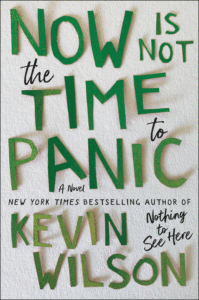
1. Now is Not the Time to Panic by Kevin Wilson
(Ecco)
7 Rave • 3 Positive • 1 Mixed
“If you have any interest in joy-reading, then run out today and pick up Now Is Not the Time to Panic, the latest glorious novel from Kevin Wilson … Frankie’s voice is so clear and compelling, her inner life so well-drawn, that I don’t doubt her existence for a second … I was hooked,…adult Frankie’s voice is just as compelling as her teen voice.”
–Jessica Anya Blau (Oprah Daily)
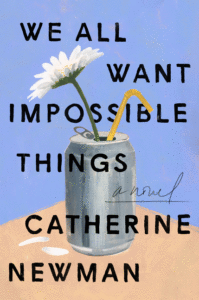
2. We All Want Impossible Things by Catherine Newman
(Harper)
5 Rave • 2 Positive • 1 Mixed
“Compulsively readable and tenderly hilarious … We All Want Impossible Things is one more reminder of Newman’s characteristic blend of self-deprecation and openheartedness … The book doesn’t pretend or indeed attempt to resolve grief but watches it with warm eyes, invites its readers into grief’s impossibilities without false comfort but with unremitting gentleness … I wasn’t sure I could read another book about another woman besieged by cancer, another unspeakable loss … But the novel buoyed me up instead.”
–Cynthia R. Wallace (Ploughshares)

3. Flight by Lynn Steger Strong
(Mariner)
3 Rave • 4 Positive • 1 Mixed
“Lynn Steger Strong employs winter’s bounty to great effect, laying the groundwork for a plot that is decidedly, deliberately old-fashioned—in the best way … it’s her facility with the details of habit and personality that breathe life and plot into this novel … Like the birds that form the book’s leitmotif, Strong’s writing soars effortlessly from characters’ histories into their present situations … the toughest lesson Strong shares in Flight is that not every story can have a satisfying conclusion. True reconciliation, safety, stability, fulfillment: These are destinations along a flight path forever uncertain—though shot through, like this novel, with moments of transcendence.”
–Bethanne Patrick (The Los Angeles Times)
**
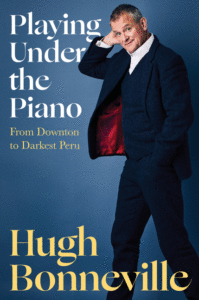
1. Playing Under the Piano: From Downton to Darkest Peru by Hugh Bonneville
(Other Press)
5 Rave • 2 Positive
“His account is intriguing, breezy and full of intellect and humor. It’s also a delicious stroll down a red carpet lined with big names … There’s no mean-spirited gossip in this memoir, just plenty of humorous self-deprecation and some laugh-out-loud anecdotes … A must-read for Bonneville fans.”
–Alice Cary (BookPage)
=2. The Hyacinth Girl: T.S. Eliot’s Hidden Muse by Lyndall Gordon
(W. W. Norton & Company)
5 Rave • 1 Positive
“Exquisitely nuanced … Careful not to judge either Eliot or his women. While the reader longs to scream at Hale and Trevelyan to just walk away, you are also left with the sneaking suspicion that being present at the making of work that shook the 20th century was probably—just—worth the humiliation and heartache.”
–Kathryn Hughes (The Sunday Times)
=2. The Grimkes: The Legacy of Slavery in an American Family by Kerri K. Greenidge
(Liveright)
5 Rave • 1 Positive
“Greenidge skillfully contrasts the simpering piety of the Grimkes with the fierce determination of leaders in the free Black community, notably the descendants of legendary Black entrepreneur James Forten … A sobering and timely look at how self-centered ‘benevolence’ can become complicity.”
–Lesley Williams (Booklist)
Our quintet of quality reviews this week includes Molly Young on Katherine Dunn’s Toad, Richard Brody on Quentin Tarantino’s Cinema Speculation, Jennifer Wilson on Percival Everett’s Dr. No, Sloane Crosley on Kevin Wilson’s Now is Not the Time to Panic, and Pricilla Gilman on Haruki Murakami’s Novelist as a Vocation.
“Toad is a curious specimen: a novel written in the 1970s that remained dormant until this year not because it was lost or unfinished or dreadful but because it was spurned … If Geek Love was a misfit anthem, Toad is a misfit ballad—a quieter and more modest offering. It concerns the consciousness of a single marginal eccentric rather than the maelstrom of an entire family … In both timelines, past and present, Sally spends a lot of time hating her appetite, which she considers a source of intolerable degradation. Her yearnings for food and sex mortify her; she is endlessly pained by what she perceives as a monstrous inability to restrain herself from indulging in both … One of Dunn’s running themes is the nature of disgust. As with her other novels, Toad brims with grime … Reading Toad is like rummaging through the junk drawer of a fascinating person. It is chaotic, intimate and unruly. There’s not much of a structure or a plot. Still, it’s impossible not to share Naomi Huffman’s bewilderment at the book’s burial. Dunn’s style is unlike that of anyone living or dead: simultaneously practical and bonkers; lovely and nasty. If the story of Sam and Carlotta is slightly dated—a tragedy of misdirected ’60s radicalism—it comes to us by way of a narrator whose psychological pain is horrifyingly timeless.”
–Molly Young on Katherine Dunn’s Toad (The New York Times)
“There’s something in the middle of Quentin Tarantino’s new book, Cinema Speculation, that made me want to kiss it on both the front and back covers … Tarantino ranges widely through the movies of the nineteen-seventies that captivated him in his youth and that still inspire, fascinate, and haunt him. It’s a book of cinema-centricity and Tarantino-centricity that is nonetheless populated by a vivid array of characters—whether real-life ones, such as Brown, or ones seen in the movies—to whom Tarantino offers alluring moments in the spotlight … Cinema Speculation is the work of a filmmaker whose knowledge of movies is prodigious, and who, by dint of his professional experience, can add the insights he has gained from inside the industry, along with interview access to many of the people whose work he writes about. That’s the perspective that informs the book and that raises it above what would in any case be an engagingly garrulous memoir … The extended portraiture of Brian De Palma stands out for the idiosyncrasy of its insights … Above all, Cinema Speculation is a vision, in motion, of a Hollywood-centric mind. It’s like seeing a watchmaker take apart other craftsmen’s watches and show how they function and why they have marketplace appeal, but never looks at chronometry over all, its place in the world, the existence of other kinds of timepieces, or whether and why people even need such watches anymore … If, as Tarantino has said, he’s going to make just one more film, this book may well be the clearing of the ground before his great escape—the reckoning of his lifetime on the inside before breaking out.”
–Richard Brody on Quentin Tarantino’s Cinema Speculation (The New Yorker)
“Like Everett’s previous novel, The Trees, Dr. No is an experimental work of genre fiction nestled within a distinctly African American revenge tale. In The Trees, someone is murdering the descendants of Carolyn Bryant, the white woman who accused Emmett Till of accosting her in a grocery store in 1955. In that novel, the thirst for vengeance is sincere, if misguided. In Dr. No, our revenge seeker would seem to be both misguided and insincere. Over time, he degrades his sympathetic origin story…by treating it as little more than plot filler, trauma that needs to be there to set up the kinds of melodramatic one-liners that we expect from our movie villains … This is a novel about opposites, which is to say this is a novel about identity … No one understands the slippery nature of identity like a spy, and Everett relishes the devices of the spy thriller, wielding Bond tropes as if they were flame-throwing bagpipes or cigarettes laced with cyanide … Fleming’s Dr. No thought he could turn Bond, shift his loyalties, but instead he found someone whole, indivisible in his fealty. Everett’s villain prefers his closest accomplices be Black. Sill feeds on their trust, their hope that, to borrow Kitu’s words, ‘sameness of reference’ will count for something, or at least not nothing. This is the fantasy of Black capitalism, and in Dr. No, Everett has given us an antagonist up to the task of representing its delusions—a villain who thinks he is a hero, a savior who shows up empty-handed.”
–Jennifer Wilson on Percival Everett’s Dr. No (The Atlantic)
“A buoyant tribute to small-town life, a book about creativity and creation in a world before ‘send’ buttons … Wilson adeptly evokes what it was like to be a creative kid in the 1990s … Wilson shines when detailing the domino effect and the dissemination of images before social media … Now Is Not the Time to Panic reads like a movie. By which I don’t mean ‘cinematic,’ I mean like a movie. Strings of dialogue, more predictable than verisimilar, are linked with episodes of brief action … Here is a charming story with enough pockets of pathos to keep the novel from feeling weightless. The only issue is that it seems to want more for itself. A lot more. And it becomes increasingly vocal about asking for it … The grand themes (art, friendship, memory) sit like Vaseline on the surface of a pool, with repetition too often standing in for insight … The novel becomes dominated by the author’s valiant attempts to make a case for adult Frankie’s conundrum, for her poster-adjacent compulsions. But our heroine did not commit an act of political terrorism … If you focus on…the more sentimental aspects of Now Is Not the Time to Panic, if you take it as a spirited PG-13 tale of summer mischief, you’ll enjoy yourself. But this is not [a] high-stakes or interior evocation of storytelling, friendship and ambition.”
–Sloane Crosley on Kevin Wilson’s Now is Not the Time to Panic (The New York Times Book Review)
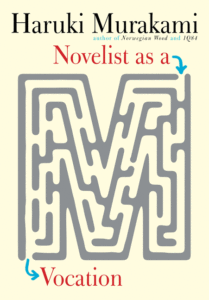
“The collection is eccentric, meandering, self-deprecating. This is no bombastic tome or loftily impassioned defense of fiction; it’s a generally charming excursion through the mind of one of the world’s most beloved novelists … Murakami traffics in rather weakly analyzed platitudes about writers and their personalities … The strongest essays are those that bring us into Murakami’s own idiosyncratic disposition, his unlikely career path, and his odd routines and requirements as a writer … It isn’t a book that I’d assign to my writing students or use myself as a source of tips and tricks. It works best as a fascinating backstage pass to Murakami’s process and approach to creating fiction.”
–Pricilla Gilman on Haruki Murakami’s Novelist as a Vocation (The Boston Globe)
Bono’s Surrender, Bob Dylan’s The Philosophy of Modern Song, Claire Keegan’s Foster, and Graeme Macrae Burnet’s Case Study all feature among the Best Reviewed Books of the Week.
1. Foster by Claire Keegan
(Grove)
9 Rave • 3 Positive
“Keegan’s beautiful new novella, Foster, is no less likely to move you than any heaping 400-page tome you’ll read this year … Keegan’s novella is a master class in child narration. The voice resists the default precociousness, and walks the perfect balance between naïveté and acute emotional intelligence … Keegan averts expectations in the couple’s portrayal, which brings Foster some welcome levity … Like a great, long Ishiguro novel, Keegan makes us complicit in what her characters want, setting us up for utter heartbreak when they don’t get it.”
–Alex Gilvarry (The New York Times Book Review)
2. Case Study by Graeme Macrae Burnett
(Biblioasis)
9 Rave • 2 Positive • 1 Mixed
Read an excerpt from Case Study here
“An interest in exploring complex psychological dramas through intricate narrative structures takes centre stage … The defining essence of Burnet’s work to date is to be found in…literary gamesmanship, a brand of metatextuality that is as much about exploiting the possibilities of the novel form as it is about blurring the boundaries between appearance and reality. In throwing us into doubt about which—and more crucially whose—story we are supposed to be following, Burnet encourages us to look more closely at the inherent instability of fiction itself … Case Study is above all a very funny book, a wry look back at 60s counterculture in which Burnet’s inventions rub shoulders with real personalities. But much as Braithwaite’s outlandish behaviour and performative rudeness might raise a knowing smile, his theories on identity and selfhood, appearance and reality are never as bonkers as we pretend they are. If Burnet’s aim in writing Case Study was to force us up against the contradictions of our conflicted selves, he has surely succeeded. This is a novel that is entertaining and mindfully engrossing in equal measure.”
–Nina Allan (The Guardian)
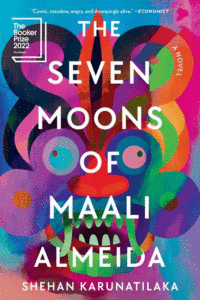
3. The Seven Moons of Maali Almeida by Shehan Karunatilaka
(W. W. Norton & Company)
4 Rave • 4 Positive • 1 Mixed
“Written in the second person, which gives the narrative a slightly distancing effect, but it’s compensated for by the sardonic humour … The obvious literary comparisons are with the magical realism of Salman Rushdie and Gabriel García Márquez. But the novel also recalls the mordant wit and surrealism of Nikolai Gogol’s Dead Souls or Mikhail Bulgakov’s The Master and Margarita. The scenarios are often absurd—dead bodies bicker with each other—but executed with a humour and pathos that ground the reader. Beneath the literary flourishes is a true and terrifying reality: the carnage of Sri Lanka’s civil wars. Karunatilaka has done artistic justice to a terrible period in his country’s history.”
–Tomiwa Owolade (The Guardian)
**
1. The Philosophy of Modern Song by Bob Dylan
(Simon & Schuster)
8 Rave • 7 Positive • 5 Mixed • 1 Pan
“It is filled with songs and hyperbole and views on love and lust even darker than Blood on the Tracks … There are 66 songs discussed here … Only four are by women, which is ridiculous, but he never asked us … Nothing is proved, but everything is experienced—one really weird and brilliant person’s experience, someone who changed the world many times … Part of the pleasure of the book, even exceeding the delectable Chronicles: Volume One, is that you feel liberated from Being Bob Dylan. He’s not telling you what you got wrong about him. The prose is so vivid and fecund, it was useless to underline, because I just would have underlined the whole book. Dylan’s pulpy, noir imagination is not always for the squeamish. If your idea of art is affirmation of acceptable values, Bob Dylan doesn’t need you … The writing here is at turns vivid, hilarious, and will awaken you to songs you thought you knew … The prose brims everywhere you turn. It is almost disturbing. Bob Dylan got his Nobel and all the other accolades, and now he’s doing my job, and he’s so damn good at it.”
–David Yaffe (AirMail)
2. Surrender: 40 Songs, One Story by Bono
(Knopf)
4 Rave • 7 Positive • 1 Mixed
“Defined largely by humility. This is an introspective story written by a man whose spirit is never far removed from the sadness and grief of his childhood … Honest and direct … Surrender is more a van of a book than a private plane. It shrinks more ego than it inflates. Bono makes no bones about his outsized ambitions, but there’s always a fallible human being behind the big plans and then the superstardom … By no means operatic. There’s a casual charm to the memoir, a feeling of being led through caverns of story by a guide with some things to get off his chest … This is the rare rock star memoir written by a rock star who, you get the impression, could have been a writer … U2 fanatics might already know much of the material in Surrender. For the rest of us, there’s something to discover in every chapter. Bono has a gift for making even the unattainable seem relatable … He’s humble, even self-effacing. He might be fun to have a beer with. He is very much of this Earth.”
–Chris Vognar (The Los Angeles Times)
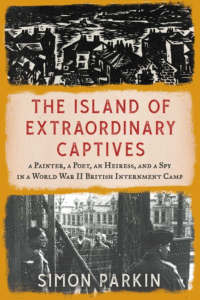
3. The Island of Extraordinary Captives: A Painter, a Poet, an Heiress, and a Spy in a World War II British Internment Camp by Simon Parkin
(Scribner)
5 Rave • 4 Positive
“A truly shocking story…electrifyingly told by the journalist and historian Simon Parkin, whose breadth and depth of original research has produced an account of cinematic vividness … Parkin skillfully draws the reader into the serendipitously rich environment in which Fleischmann, along with a constellation of some of the most brilliant artistic, philosophical and scientific minds of the day, suddenly found themselves.”
–Juliet Nicholson (The New York Times Book Review)
Our treasure chest of terrific reviews this week includes Colm Tóibín on Bono’s Surrender, Lynn Steger Strong on Claire Keegan’s Foster, Adrienne Raphel on Katherine Dunn’s Toad, Jody Rosen on Bob Dylan’s The Philosophy of Modern Song, Christian Lorentzen on Graham Macrae Burnet’s Case Study.
“The loss of his mother goes through Bono’s book as an undercurrent … Surrender is, especially in the first half, introspective, raw, self-deprecating, oddly earnest, almost self-accusing. The scores Bono settles are against himself. Others he describes with affection and accuracy, without falling into saccharine tones … What is strange, and what makes much of this book so exciting and interesting, is that the sadness is overwhelmed by a desperate, frenzied desire to use life more richly since it has proved to be so fragile … Bono is careful not to try to explain the songs too easily or glibly. He leaves much to mystery and resorts often to self-doubt … Surrender is, in its own generous way, a book written by an Irishman to tell his mother how much he misses her, to tell his mates how much he rates them, and to let his wife and children know how much he loves them … Alison Stewart, whom Bono first met when he was sixteen, remains elusive in the book. It is clear that Bono is still trying to figure her out.”
–Colm Tóibín on Bono’s Surrender (The Irish Times)
“[A] writer of sparse, assured sentences that burrow into something ineffable about what it is to be alive and then hold it up with care for our examination and pleasure … It is even tighter—and better for that, I would argue—than the equally slim Small Things Like These … The structure of the story is crystalline, unfussed: We begin at the start of something; we move almost completely linearly through the present tense; we finish when what started on the first page comes to an end. There is a clear and jarring rupture in the second half…followed by a devastatingly earnest and heartbreaking denouement … This is not to say any of Foster is predictable—which in itself is remarkable … Foster is exactly as sad as you imagine it would be, but more stunningly alive than you have any right to expect. Its language settles in your belly and then your bones only seconds after it has passed your eyes … Foster is a small story, but it is not minimalist … Keegan’s world is lush and full, the details delicately made, ever more rewarding and engaging with every read … Keegan takes care to etch out for us this world’s particularity, to let us see,feel and hear it, to enlist us in helping bring it to life. While the scale of her story is modest…the scope of what Keegan can hold inside of it…is as big, brash and ambitious as a story might be.”
–Lynn Steger Strong on Claire Keegan’s Foster (The Los Angeles Times)
“If Geek Love is, as the French say, jolie laide (ugly-pretty), then Toad is just ugly. Yet that doesn’t make it any less mesmerizing … When tragedy hits with a wallop at the end, you’ve been so mired in melancholy you almost don’t realize how huge the punch is. Toad is sad, funny and, most of all, deeply, unapologetically, ordinary … Which is not to say that Toad is an ordinary book. It’s as weird as anything you’d expect from a writer this good at describing animal functions. Fluids and fats and flesh smack throughout … Dunn never lets us get comfortable: Just when the lyrical sentences begin to soar, she yanks up the mellifluous prose and thuds down squat subject-verb-object clunkers … She lays on vulgarities thick as butter … Toad, with its single narrator speaking alone in her living room, lacks that kind of choral power. Yet Geek Love exists only because Dunn figured out how to feel through Toad. What Toad provides is a subtler embedding in an embodied life.”
–Adrienne Raphel on Katherine Dunn’s Toad (The New York Times Book Review)
“The Philosophy of Modern Song is a mouthful, a phrase that puts on airs. It asserts that the book is an important work, a tome that merits a place on your loftiest library shelf, up in the thin air where you keep the leather-bound, gilt-edged stuff … But the title is also a wisecrack, too puffed up and self-important to be taken at face value … As a work of prose, The Philosophy of Modern Song is relentless. It rip-snorts along, charging from song to song, idea to idea. Dylan can write what journalists call a great lede: a first sentence that detonates like a hand grenade … What does all this add up to? Not quite a philosophy of modern song, or at least not a coherent one. But coherence isn’t what you want from Bob Dylan … You have to plow through 46 chapters before encountering a song by a female artist … Yet women loom large in his consciousness and are omnipresent in his pages—appearing in such monstrous form, evoked in language so marinated in misogyny, that, reading The Philosophy of Modern Song, I began to feel like a therapist, sneaking glances at my watch while the crackpot on the couch blurts one creepy fantasy after another … It’s a bummer, to put it mildly, to find a Nobel laureate…mixing metaphors and spouting nonsense like an elderly uncle who bulk-emails links to Fox News segments.”
–Jody Rosen on Bob Dylan’s The Philosophy of Modern Song (The Los Angeles Times)
“The elegant nested structure is one of the novel’s chief appeals. So is the contrast between Rebecca’s narrative voice, characterized by what GMB calls ‘a certain kooky élan,’ and the cool tone of GMB’s Life of Braithwaite. What emerges is a comedy of identities tried on and discarded. Given the number of suicides that mark the story, it’s a comedy with dark underpinnings … Case Study has a lot in common with the novels of Vladimir Nabokov and Roberto Bolaño, in which invented characters pass through tumultuous episodes of literary history that never quite happened, though it seems as if they should have … Case Study is a diverting novel, overflowing with clever plays on and inversions of tropes of English intellectual and social life during the postwar decades. As such, it is not exactly an excursion into undiscovered literary terrain. Reading Burnet’s doubly mediated metafiction of North London neurotics and decadents, I often longed to turn back to the shelf for the real thing: fictions by Doris Lessing, Kingsley and Martin Amis, Muriel Spark, Jenny Diski, Julian Barnes, Alan Hollinghurst, Zadie Smith or Rachel Cusk; biographies of Plath and Hughes; films of kitchen-sink realism starring Bogarde and Laurence Harvey, with scripts by Harold Pinter; or even the documentaries of Adam Curtis, in which Laing often makes a cameo. It’s a compliment to put Case Study in that company and no insult to say that Burnet must have done his homework to get there. I imagine he lives in a flat full of piles of yellowing copies of The Times Literary Supplement, every issue a catalog of obscurities from across time. Humble children from the provinces who want to reinvent themselves have to get the stuff of their daydreams from somewhere.”
–Christian Lorentzen on Graham Macrae Burnet’s Case Study (The New York Times Book Review)
I can’t be the only one excited to feast twice on Thanksgiving, right? Obviously the food spread, complete with your own personal traditions and specific dishes, but also the time to catch up on reading! This month’s TBR is a cornucopia of delights in the form of several SFF collections, ranging from individual authors’ bodies of work to anthologies looking back on 2022 and reexamining fairy tales through queer and otherwise diverse lenses. But of course, there are also plenty of wonderful novels coming out this month. And if you’re hankering for the personal accomplishment of finishing a series, N.K. Jemisin has got you covered…
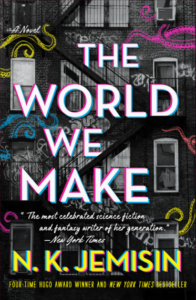
The World We Make by N.K. Jemisin
(Orbit Books, November 1)
The Great Cities duology concludes with New York City’s human avatars (each representing a borough made flesh) mounting a stand against the Woman in White, who represents the encroaching Lovecraftian interdimensional city of R’lyeh. But as the avatars face deportation (because they are still only human) or the temptation to become the avatar for another great city (Chicago is knocking), they must figure out the best way to save the Big Apple from getting literally wiped off the map.
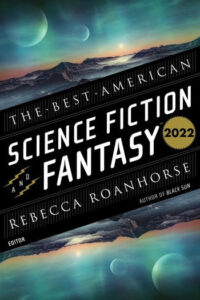
The Best American Science Fiction and Fantasy 2022 edited by Rebecca Roanhorse
(Mariner Books, November 1)
As guest editor Rebecca Roanhorse shares in her introduction, she selected many of this year’s 20 SFF stories for how they depict human connection, albeit in speculative ways, during the physical and figurative isolation of covid. But what’s even better is that these moments and stakes don’t have to be fate-of-humanity levels. Kel Coleman’s “Delete Your First Memory for Free” teases how utterly freeing our existence would be if we weren’t weighing ourselves down with reliving cringey moments. Karen Russell conjures a mythical creature on Garbage Thursday, of all days, in “The Cloud Lake Unicorn.” And in Maria Dong’s “The Frankly Impossible Weight of Han,” the ineffable contagion racing from person to person is grief. The collection also includes works by P. Djèli Clark, Nalo Hopkinson, José Pablo Iriarte, Stephen Graham Jones, and many more.
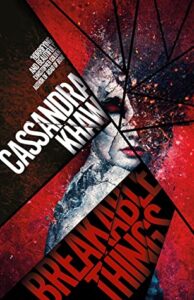
Breakable Things by Cassandra Khaw
(Undertow Publications, November 8)
Chances are you keep hearing about author and game writer Cassandra Khaw’s work, with recent novels in the sci-fi (The All-Consuming World) and horror (Nothing But Blackened Teeth) realms, and a dark fantasy out next year (The Salt Grows Heavy). If you’re not sure which of their books to pick up first, start with this debut short fiction collection: The 23 selections are all short but in a taut, lush way; Khaw establishes motifs of water and foxes, eldritch realms and folkloric weavings, all with more than a touch of the macabre and hooks that get under readers’ skin.
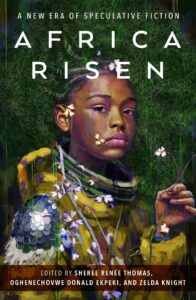
Africa Risen: A New Era of Speculative Fiction edited by Sheree Renée Thomas, Oghenechovwe Donald Ekpeki, and Zelda Knight
(Tordotcom Publishing, November 15)
This superb collection of stories connects SFF writers from Africa and the African Diaspora, from greats like Tananarive Due, Stephen Barnes, and Maurice Broaddus to newer voices like Wole Talabi, Chinelo Onwualu, and Dilman Dila. (This excellent review from Lightspeed contextualizes these many voices and stories better than I can.) Among the 32 tales are an android having an existential crisis over whether she’s technically dead or alive; a deceased grandmother’s mysterious cookbook and the magic it imparts; and a supercomputer that collects all of the memories and lore of the ancestors.
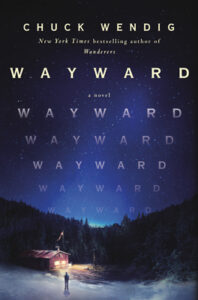
Wayward by Chuck Wendig
(Del Rey, November 15)
Chuck Wendig’s Wanderers predicted a global crisis which would come to be known, in the world it reshapes, as the White Mask pandemic. The first book in this series also came out in summer 2019. Now, several years into our time with covid, the sequel Wayward examines the past five years in its own reality through the eyes of survivors in the town of Ouray, Colorado: The people who were compelled by a sleepwalking epidemic to leave their homes; the shepherds, or loved ones, who made sure they arrived without harm; and Black Swan, the AI that both predicted White Mask and initiated the slumber to bring these strangers together. When Black Swan makes another executive decision without clueing in the humans, they will trek from the CDC to the Rock’n’Roll Hall of Fame, and cross paths with the brutal, bigoted President Ed Creel.
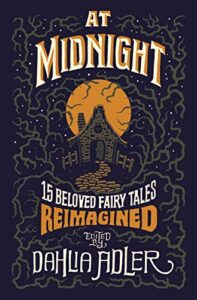
At Midnight: 15 Beloved Fairy Tales Reimagined edited by Dahlia Adler
(Flatiron Books, November 22)
This young adult anthology brings on acclaimed authors including Melissa Albert, Tracy Deonn, Malinda Lo, Darcie Little Badger, and many more to retell fairy tales in clever new fashions that tap into that familiar magic. There’s a Native American take on “Puss in Boots” in “Coyote in High-Top Sneakers”; “Mother’s Mirror,” or Snow White with a trans teenage protagonist pushing back against their parent’s vision of them; and an update to Rumpelstiltskin by way of coding in “Say My Name.”
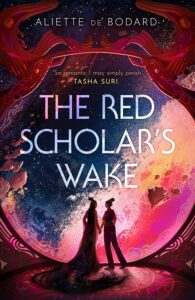
The Red Scholar’s Wake by Aliette de Bodard
(Gollancz, November 24)
The latest installment in Aliette de Bodard’s Xuya series of space opera adventures takes the familiar romance trope of the marriage of convenience… but in this case, it’s between a scavenger and a recently widowed sentient spaceship, matchmade by way of space pirates! When the Red Banner fleet picks up Xích Si, she expects to be thrown into indentured servitude—until she receives a fascinating business proposition from the pirates’ leader, Rice Fish. A mindship grieving the recent loss (or murder?!) of her wife, Red Scholar, Rice Fish proposes that Xích Si become her new wife so that she can help investigate her suspicions of foul play. There’s been a bunch of excellent fantasy romance this year, but I am jazzed to see a sci-fi romance with such a fascinating premise.

If you buy books linked on our site, Lit Hub may earn a commission from Bookshop.org, whose fees support independent bookstores.