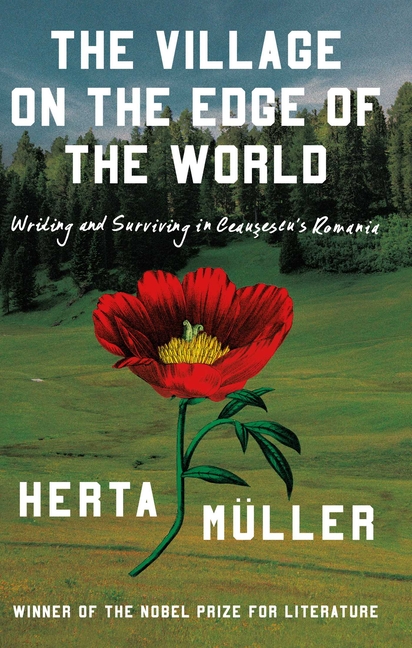
From her childhood in Romania, in a village 'as small as a thimble on the edge of the world,' through to life in exile in Germany, Herta Müller's story unspools against the tumultuous history of Romania in the latter half of the twentieth century. Here, she reflects on cultural history, memory, and trauma, and on what it was to live and write under Ceausescu's regime.
Ms. Müller in this concise, spare work describes in the most tactile terms what totalitarianism meant for the individual and his interior, mental life ... Critical both as a work of art and as a firsthand document.
Superb ... Comprehensive ... Conducted by Müller’s editor, Angelika Klammer, and skilfully translated by Kate McNaughton, these interviews trace a compelling trajectory. I was rapt, following a child who eats mouldy plums and plants, has laughing fits and feels desperate to belong, watching her grow into a defiant and resilient woman determined to break free.
What emerges in her memoir is the complex relationship between two realities ... Thinking, Müller concludes, must then be ‘an actual place,’ perhaps an ‘overly long street’ or an ‘unfamiliar room’. But the village as small as a thimble on the edge of the world is not a place for just any thinking; it is a place where thinking must do gymnastics. We cannot escape the image of Müller looking back on her village, both as a child standing in the fields and an adult casting her eye East, in this memoir. She is thinking where she shouldn’t; she is thinking where she must.