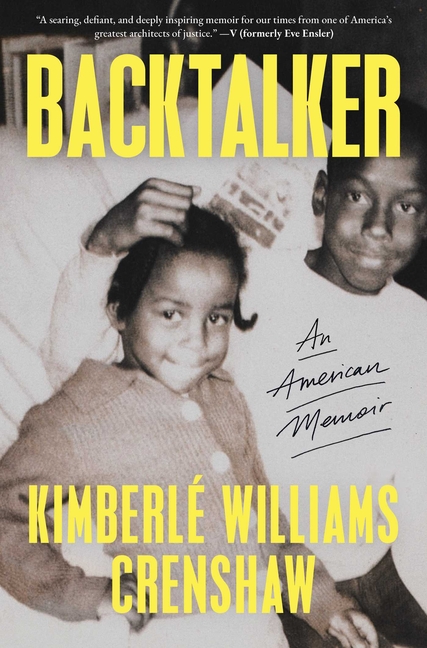
Backtalker is the story of how a little girl from Canton, Ohio came up with a new way to look at the world. Crenshaw’s memoir traces the way her lived experience made her see things others didn’t, eventually leading to her articulate two concepts that would forever change national and global debates about equality: intersectionality and critical race theory.
Charts Crenshaw’s extraordinary journey from precocious child to renowned public intellectual ... Rich ... That the precise prose of this account, and numerous other anecdotes, is written with the kind of titanic certainty that would sway a jury is expected; what’s surprising, however, is Crenshaw’s candor in revealing her vulnerability and disappointments ... Ends with the author finding strength in the sounds she remembers from her childhood — her father’s singing, her mother’s piano — and a rousing call to see the story of the future as one in which 'the spirit of freedom was nurtured by talking back.'
Kimberlé Crenshaw gave us the terms 'intersectionality' and 'critical race theory.' Her new memoir shows that she isn’t done fighting over what they mean ... Plenty of scholars and journalists have written histories of these contentious terms ... Now Crenshaw has written something different: a history of herself ... She frames her life and her remarkably influential career as one long fight against various forms of exclusion and unfairness ... Neither of the movements she named was designed for mainstream acceptance. C.R.T. was born as an insurgent project, and intersectionality was once a critique of the civil-rights movement. What are they now?
Crenshaw’s memoir is a personal, passionate reminder that sustained freedom to think, communicate, and protest is the best defense against the backslide of progress.