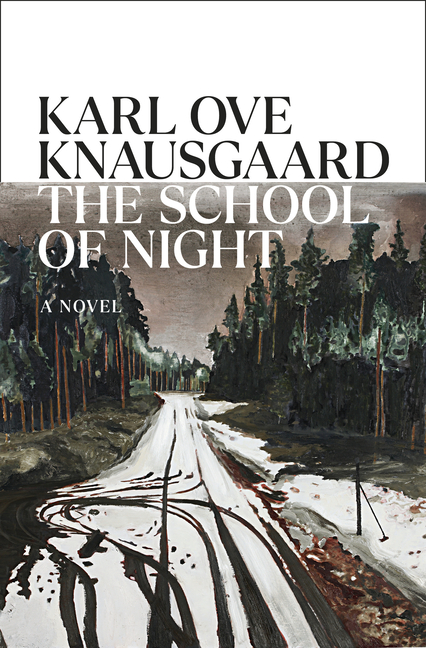
Kristian Hadeland, young and ambitious, has moved to London to study photography; he knows that he and his art are destined for more. His family never understood him, and his fellow photography students bore him. But when he meets Hans, an eccentric Dutch artist, the future he yearns for becomes possible—as long as he is willing to sacrifice everything and stop at nothing. Twenty-four years later, Kristian sees his dreams come to fruition when a major retrospective of his work is held in New York City. As his past catches up to him, Kristian’s world begins to crumble. Success comes at a price, but is he prepared to pay it?
Christopher Marlowe’s Doctor Faustus is about a man of exceeding ambition who makes a deal with the Devil to gain the best of this world and pay for it in the next. This 16th-century play figures in many ways in Karl Ove Knausgaard’s new novel, The School of Night, primarily with regard to its protagonist, Kristian. ... My Struggle was near-defiant in its exclusive focus on the minute and mundane; the Morning Star books disclose a more expansive interest ... His storytelling in these new books is increasingly open to the metaphysical, fused with the macabre ... As much is evident from the opening page of The School of Night, translated into rich and readable English by Martin Aitken. Kristian describes a 'despair that night and day rips and tears at me, the bottomless darkness' that he has decided to put an end to, along with his life. 'But first,' he adds, 'I’m going to write this' ... If Knausgaard is trying to show us what happens when an artist wants it all and actually gets it, he didn’t need Marlowe’s literary-moral framing to do it ... Can you make a deal with the Devil if you don’t know you’re making a deal with the Devil? Knausgaard’s character takes hundreds of pages to deliver a dark yet inconclusive answer, even as he believes 'the powers were on my side.' The triumphs and tragedies of his vaulting, vaunted, voided life prove him right, then wrong.
His at times unwieldy prose, as if written in a frenzy, recalls Dostoevsky’s ... Strangely compelling ... Knausgaard, for all his obsession with death and the final stillness it imposes on us all, has produced yet another extraordinarily vital text. This seems justification enough for any work of art.