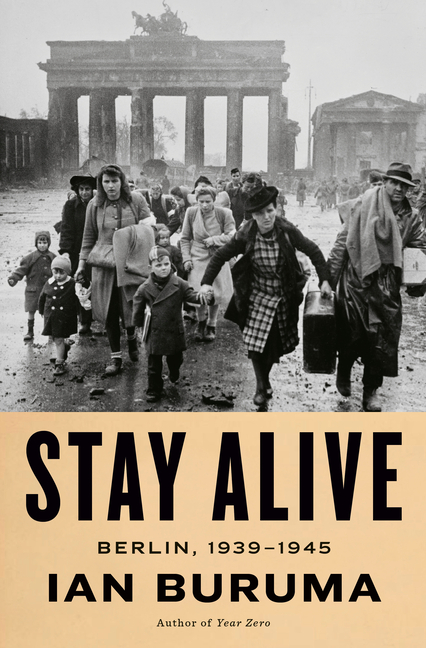
Mr. Buruma’s book, while triggered by old photos and letters from Leo’s time in Berlin, isn’t only about his father. It tells a broader story of how Berliners approached and coped with the war. ... Mr. Buruma resists glib post hoc censure, acknowledging that German civilians 'lived in constant fear of their own government' ... Exquisite.
Organized like a diary, with a section devoted to each year of the war. This structure lets Buruma incorporate a wide variety of viewpoints ... Every so often, Stay Alive provides a glimpse of Berliners facing the kinds of hard choices that my grandmother felt lucky to have avoided ... At the end of the book, Buruma characterizes his project as 'partly a love letter to Berlin.' This, he acknowledges, may sound perverse; the book is, explicitly and unrelentingly, about the Berlin of the war years, when, in his words, 'unspeakable crimes were planned and perpetrated there' ... Elsewhere in the book’s final pages, Buruma offers a different account of his purpose, more along the lines of a warning ... This is, or should be, the book’s claim to relevance, in which case not love but shame and terror would seem the pertinent emotions.
I'm always surprised when somebody offers a new angle on what the Nazis wrought. Ian Buruma does this in Stay Alive: Berlin, 1939-1945 ... Laced with nifty details ... As one who's written well for decades about historical guilt and denial, Buruma is too savvy to belabor familiar Nazi horrors.