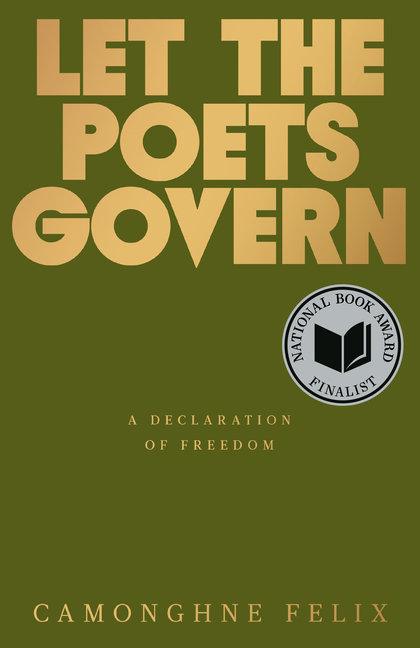
Over the past decade, Camonghne Felix has been at the center of American politics, working in strategy, communications, and as a speechwriter. Throughout it all, she has maintained her unwavering belief in language’s foundational revolutionary potential, outside of its deployment for legislative and political ends. In this work of nonfiction, she argues that Black radical poetic traditions model an ethical code and overcome entrenched structures of patriarchy and paternalism, inventing a new form that examines the historical and legislative, and the personal and poetic.
Felix melds Black activism with a zeal for poetic forms and the affirmations of free verse. She locates herself within a lineage of poets from Maya Angelou to Nikki Giovanni to Patricia Smith, revisiting the historical impacts of racism—papal bulls, the Caribbean slave trade, George W. Bush’s flawed No Child Left Behind—and amplifying the rhetoric of political dissent.
An evocative mix of literary analysis and memoir exploring language’s role in oppression and how it can be repurposed as a tool of liberation ... Though the central thesis gets a bit lost, Felix offers affecting insight into contemporary political disaffection. This is a moving testament to the power of words.
A poet, speechwriter, educator, political organizer, and activist, Felix melds memoir, history, and political critique to argue for the significance of poetry 'to mark the design of the world we see and the world we desire to conjure' ... An impassioned manifesto.