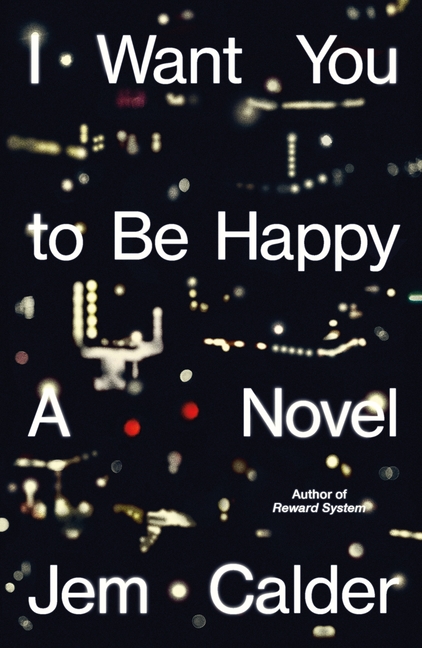
Chuck and Joey meet in a bar. He’s in his mid-thirties; she’s twelve years younger. He long ago abandoned his ambition of being a novelist and works as a copywriter at a big ad agency. "Lead copywriter," he corrects himself. Joey is living paycheck to paycheck on her barista wages and privately dreams of making it as a poet. They go back to Chuck’s luxury flat—a world away from Joey’s cramped house-share, the crumbs in her bed. Soon, Joey is imagining a future between them and Chuck is moving on from a mistake in his recent past. Amazing, how meeting a new person can make you feel so new.
English writer Jem Calder's debut novel, I Want You To Be Happy, reports from the frontlines of modern-day dating. His book is good – but the news is not ... Calder writes with precision, channeling his generation's activities with a mix of interiority and verbs fabricated to convey the mechanical rote of their daily activities ... I Want You to Be Happy would have packed more punch at novella-length. Yet readers of all generations should be able to relate to these characters' waves of disconsolate loneliness, if not how they deal with it.
Despite this somewhat gray world, I Want You to Be Happy’s charm is its magnetism and relatability ... Reading Calder’s fiction is just as easy as operating within the rhythms of life. His stories mirror existence; that alone is a talent, even if you’re looking for a gaudier narrative ... Even so, the book’s realism is sometimes a detriment ... On one hand, it’s interesting to read a straight-shot account of a relationship—no frills, just the facts. Even if its structure evades truly memorable moments, it is charming to think of Calder as the internet age’s chronicler-in-residence, almost as if he’s working off a transcript from an actual couple. A more bombastic novel might not be his thing, stylistically, but his astuteness here suggests the possibility for something more detailed and dramatic in the future.
Joins the dubious ranks of male anhedonia fiction, such as Bret Easton Ellis’s Less Than Zero (1985) and David Szalay’s Flesh (2025). Mr. Calder is a skillful transcriber of emotional numbness, but I struggled to find a meaning in this book beyond its admittedly important cautionary lesson.