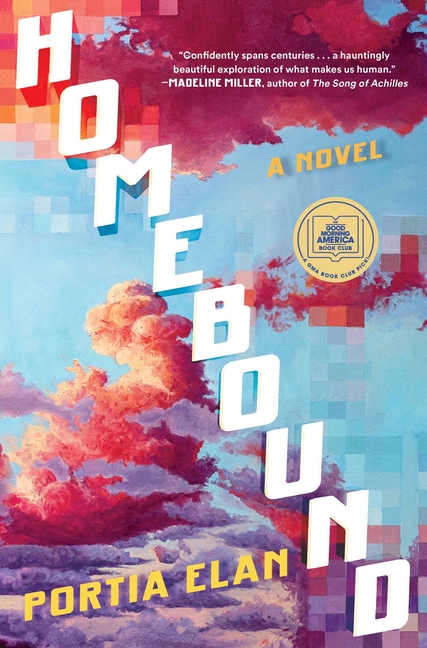
Four lives are entangled across time by one unfinished story, saved to a floppy disk in the 1980s and destined to ripple across the centuries. Linking these characters is a chain reaction of love, longing, and creativity that reveals our deep interconnectedness.
Homebound is sentimental, soft-hearted and guileless – the adjectives critics tend to use sneeringly, as though kindness were easy. It’s the sort of book that might have kept my younger self company. I’m glad this generation will have it.
If the marketing copy for Portia Elan’s Homebound seems opaque, it’s because even the briefest plot summary risks spoilers, and part of the pleasure of this book lies in the way its storylines come together ... The rare book to break through my multiple-timeline fatigue ... In a moment when I often find myself reading for escape—reading, in essence, to leave this reality for a little while—Homebound made me want to stay.
Even in its speculative reach, it keeps circling familiar Jewish concerns: how people endure, how tradition adapts, and how stories reverberate across time ... Readers drawn to structurally ambitious, multi-timeline fiction will likely be more fully in step with the novel’s rhythm, and more patient with its delayed convergence. Readers might wish they had more space to live inside each character and world, though the scale of a novel like this and the coordination it requires makes that understandably challenging ... Impressive in its specificity ... The future she imagines feels, unnervingly, less like invention than an extension — of the flooding, addiction, economic precarity, and fraying community in the present.