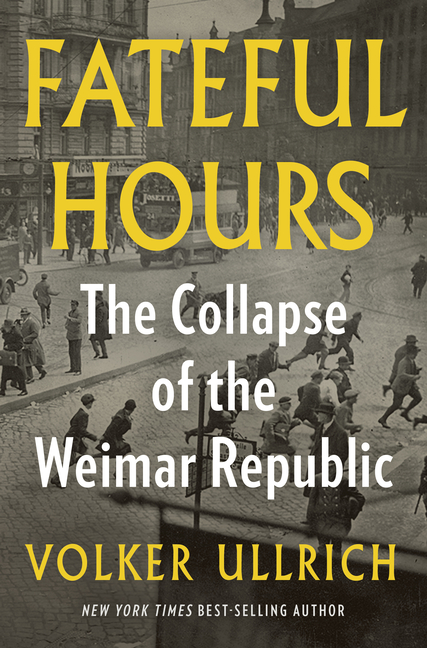
From the New York Times best-selling historian, the riveting story of the Weimar Republic--a fledgling democracy beset by chaos and extremism--and its dissolution into the Third Reich.
Ullrich breaks new ground, laying out his case in illuminating granularity, moving inch by inch through the political machinations that began with the establishment of Germany’s first democratically elected government, in 1919, and ended with the chancellorship of Hitler. And much more so than in any of his previous books, which include a two-volume biography of Hitler, Ullrich explicitly positions Fateful Hours as exemplar and warning for our own perilous, norm-shattering times. 'It’s in our hands to decide whether democracy fails or survives,' he writes ... By focusing so narrowly on Germany’s politics, he gives the reader an ominously clear view of the step-by-step buildup to Nazism, and all of the moments it could have been stopped, but wasn’t ... Though the main players may remain psychologically opaque, the road map to authoritarian disaster is laid out here in gleamingly sinister detail by a historian who knows the period as well as anyone could.
The book is suffused with Ullrich’s sense of unsettling but elusive parallels with the present ... In his hands, the death of the Weimar Republic is a parable of missed opportunities to save liberal democracy, right from the beginning ... If none of this sounds particularly original, that is because not much of it is. Ullrich’s method is to cleave closely to the most reputable secondary sources and leaven his narrative with sprinklings from letters and memoirs. The result is an elegant and sober account of the orthodox historiography by a master storyteller. But to what end? Ullrich does not follow through on the counterfactuals to show how democracy might have been rescued had this or that decision not been taken. He does not draw much of a distinction between the tactical mistakes that gave the Nazis a minor leg up and the big structural failures that were preconditions for their success ... Frankly, readers who still remember a fair chunk of their history GCSEs will get more out of playing Matthias Cramer’s recent board game Weimar: The Fight for Democracy, in which four players take on the roles of the main political parties and have to manoeuvre against each other and the rise of Hitler.
Volker Ullrich’s new book Fateful Hours, translated into English by Jefferson Chase, lines up the culprits in a fact-packed and conventional narrative sprinting from the concession of the Great War in 1918 to Hitler’s woeful promotion to Reich Chancellor in 1933. The current President of the United States, in all his slobbering vicious stupidity, also plays a hellish connotative cameo role ... Ullrich is at his most poignant when he explains how other participants on the Right believed their enemy's enemy was their friend, looking to spur on the Hitlerian horse, content to compartmentalise the warning signs as long as their ultimate aims were met ... Many sections in Fateful Hours will jolt and chill perceptive readers with their contemporaneity.