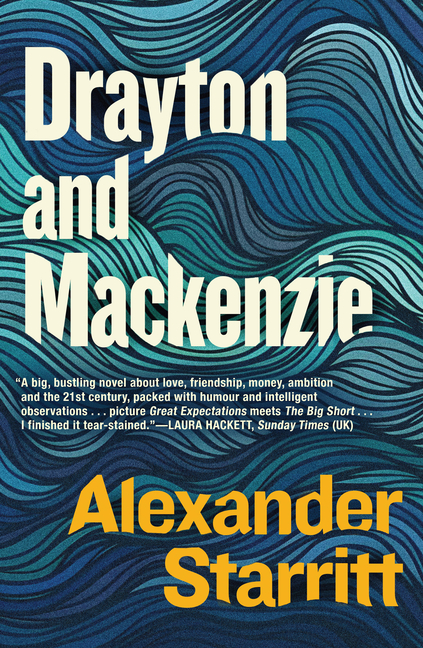
James Drayton has always found things too easy. Ambitious, brilliant, disciplined--he graduates with a top first from Oxford. His former classmate Roland Mackenzie, on the other hand, is an impulsive dreamer: charming and restless. When Roland takes a job at the same firm as James, the two men only vaguely remember one another. But as the financial crisis starts to unfold, a chance encounter sparks an idea, and an unlikely partnership begins to take shape.
Mr. Starritt packs a lot into his sweeping novel—from underwater turbines to hydrogen-powered rockets, financial meltdowns to renewable-energy startups, Japanese gangsters to Italian cuisine ... The novel’s two main characters could have gotten lost amid all this color and detail ... However, Mr. Starritt keeps his leads center stage and ensures that throughout their professional trials and personal ordeals they remain captivating presences and sympathetic enough to root for.
Starritt’s book treats business with seriousness and respect. This is not a satire for an age that is side-eyeing capitalism ... The book’s second half can be slightly bloated ... But the plot remains mostly aerodynamic and the relationship between James and Roland is richly developed ... Starritt’s book is not just for business readers who might feel too often ignored in the pages of literary fiction; it has all the pleasures of a traditional, decades-spanning tale about individuals both caught up in and influencing history. One might ponder, while reading it, some fruitful questions about the very nature of socially attuned novels, but only while Starritt does his job and then some.
It’s a mark of Starritt’s confidence that the quest to harness tidal power – the book’s main business – gets going only 200 pages in. We feel in safe hands from the start, reassured that he knows the story’s every last turn ... With a joyful knack for pithy analogy, the writing holds our attention as much as the events ... while there’s no shortage of chat about electrolysers and optimal blade rotation, Starritt keeps his focus on the human story of invention: dangling quietly over the action is the fact that James, lauded as a visionary, relies mostly for his ideas on other people. In the end, though, critique of disruptor-era genius is less important here than feeling and friendship.