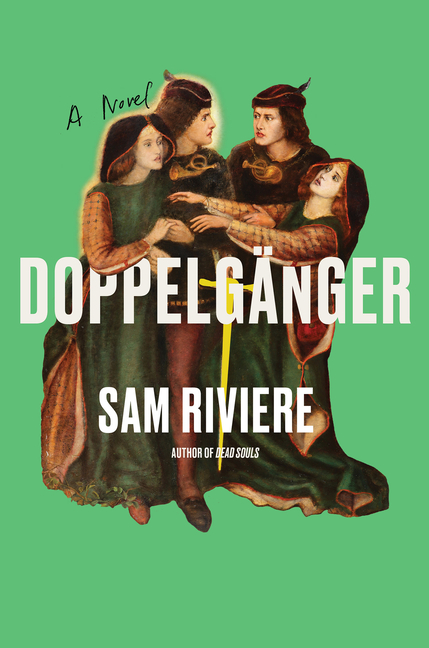
An absurdist critique of contemporary culture set in a fictional university town in the near future where a contagious 'twinning' trend has swept across the student body.
Tension between the absurd and the true is at the center of Doppelgänger, a novel about the impossibility of originality in literature when the systems built to support it become better at reproducing writers than writers are at distinguishing themselves ... Riviere’s themes are meaningful primarily to readers engaged in the business of writing and publishing. This book is not particularly interested in speaking to those outside of that world, and for the average reader, the looping digressions, page-long paragraphs, and esoteric theory may prove prohibitively arduous ... The horrible fear that Sam Riviere makes plausible in Doppelgänger is that, in a literary culture already organized around copying, the machines may prove better at being writers than we are.
Beyond Riviere’s genius dismantling of capital C 'Culture', there are also more general observations about society that you feel compelled to underline ... The danger with writing a book like Doppelgänger is that you end up perpetuating the very thing you’re warning against. But Riviere pulls it off; he has succeeded in making Doppelgänger undeniably singular.
Looks at the idea of a shared consciousness—its benefits and detriments, as well as how it can occur naturally or be engineered, and to what end ... What I found most interesting in Doppelgänger is the construction of doubles. Riviere shows us how, ostensibly out of greed, but really out of loneliness, one might create entire generations of people who think and talk and create like one another ... A fascinating novel.