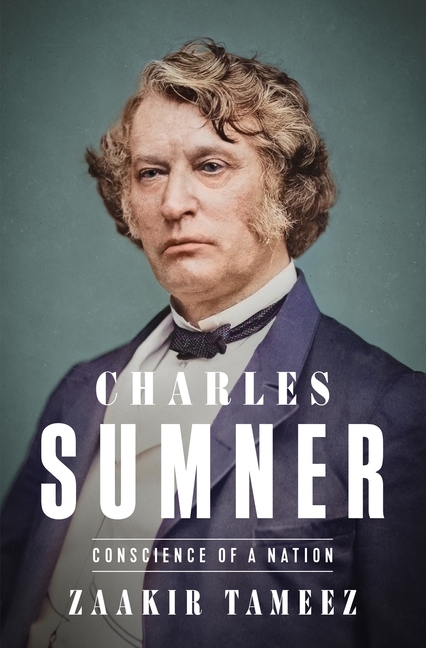
An even more thorough recounting of the great legislator’s life and deeds, one that, while not without its flaws, is unlikely to be bettered anytime soon ... A 600-plus-page biography is no mean feat. Copious footnotes evince a comprehensive grasp of the relevant historiography, and Tameez is expert at explaining Sumner’s legal thought. At times, however, the writing feels unpolished, rife with clichés and awkward, anachronistic phrasings ... And yet Tameez succeeds in giving us a richer understanding of Sumner’s private life than previous biographers.
Constitutional-law scholar Zaakir Tameez portrays his subject as the Martin Luther King Jr. of the 19th century, a man who originated key legal concepts behind civil-rights victories beyond his time. Twentieth-century historians tended to paint the senator as an ineffectual hothead, but Tameez maintains that Sumner’s in-your-face style helped shock a complacent nation into action ... Tameez credits him as a prime intellectual force behind the Emancipation Proclamation and the Thirteenth and Fourteenth Amendments. He wrote the Civil Rights Act of 1875, which was passed the year after his death and became the model for the Civil Rights Act of 1964. A school-integration case he argued in the 1840s inspired Brown v. Board of Education. The list goes on.
Zaakir Tameez’s sumptuous biography, Charles Sumner, captures, in rich detail, a life that connected the Revolutionary generation with the collapse of Reconstruction ...
Only a year out of Yale Law, the mortifyingly gifted Tameez sees in Sumner the modern birth of the constitutional order. Tameez has crafted a propulsive narrative around a visionary who put his stamp on our social compact. Charles Sumner reads like a work from a seasoned biographer rather than a debut—never has a Victorian-era legacy been more vital.