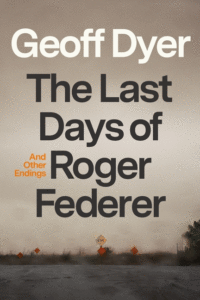
PositiveLos Angeles Review of BooksIt should come as no surprise to readers of Geoff Dyer that The Last Days of Roger Federer: And Other Endings isn’t actually about the Swiss tennis idol, nor is it about the sport he mastered. Federer shows up here and there, slipped in among its pages like inspirational bookmarks. But as one expects from the author of Yoga for People Who Can’t Be Bothered to Do It — which, spoiler, isn’t about yoga, but is, rather, a travelogue of sorts — Dyer’s latest effort ventures delightfully far afield from its conceit ... I confess it took me a long time to finish Last Days. The book, lacking much of Dyer’s “lyricism and romance,” left me a bit cold. Still, I persevered and recalibrated my expectations. In the end, I leaned into its deliberate tedium. There is a lot to digest on any given page, in any given sentence, and I decided I would take my precious time. It gets its hooks in you that way. It’s imbued with the languid spirit of COVID times, somehow infected with it: days turning into months into years, an end that is inevitable but somehow unimaginable.
Zachary Lazar
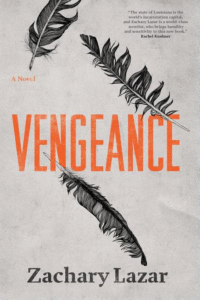
RaveVol. 1 BrooklynOne cannot help but get immersed in this man’s harrowing but compelling story ... reality and fiction are muddled up. Like the tragedy of Hamlet, we get a play within a work of fiction that could itself be real—layers upon layers of story ... It would be tempting to call Vengeance a protest novel, though that label wouldn’t be fair because it makes it seem like art is secondary to the work, and it isn’t. Zachary Lazar is gifted writer, and his sentences often sparkle as much as they surprise ... Vengeance presents a unique challenge to the reader. If the old adage for reading fiction is to 'suspend disbelief,' then one must take the opposite approach for this book: to suspend belief.
Andrés Neuman, Trans. by Nick Caistor and Lorenza Garcia
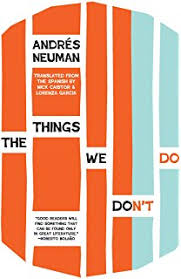
RaveWorld Literature TodaySome books demand a slow reading, requiring a period of acclimation. We pick them up in intervals, glimpse their interiors with trepidation. Such is the case with Andrés Neuman’s newly translated The Things We Don’t Do ... There are thirty-four of these experiments, most of them shorter than five pages, all more complicated than they first appear though not necessarily difficult to read. The best of them leave the reader lighter and amused ... Imagine if Lydia Davis, Jorge Luis Borges, and Donald Barthelme spawned a literary child; we might get musings such as these ...stories are grouped into six categories, most are in first person, and most are working out the sort of riddles already mentioned. But we also see stories about family legacies, identity, relationships, and loneliness. The tone ranges from silly to serious ...fresh and quirky stories.