Our feast of fabulous reviews this week includes Becca Rothfeld on Rachel Cusk’s Life of M, Emmet Fraizer on Jordy Rosenberg’s Night Night Fawn, Charlotte Wood on Dorthe Nors’ Range, Walton Muyumba on John Edgar Wideman’s Languages of Home, and Elizabeth Harper on JD Vance’s Communion.
*
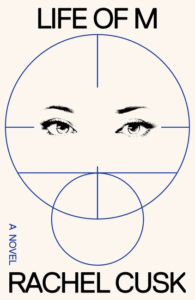
“In the end, the I, M, and We sections are never satisfactorily integrated. Cusk’s final affront to the novel is to disaggregate it into unreconciled elements without making any concession to cohesion. Despite her reputation for rigor, Life of M is not a disciplined dismantling; it is discombobulated and haphazard, a machine breaking down at random. As Cusk has become more disdainful of fiction and more insistent on the documentary function of art, her work has become vaguer and less concrete, fading like old ink into blurred indeterminacy. Her ambition for the style of her latest book is stated clearly enough in its narrator’s admiring description of a memoir about sexual abuse. The tone of this memoir ‘was neither personal nor impersonal, it possessed a deep and unmistakable authority, the authority of an object.’ But should a book be written with the authority of an object? The authority of objects derives from their imperviousness—but too total an imperviousness precludes writing and action altogether.
In light of her dream of disintegrating the particularities of selfhood into the warm liquid of universality, it is no surprise that Cusk has invented a new sort of novel that is nearly unidentifiable as such. After all, the novel as we know it concerns itself with people bound by the dictates of the social world, not people approximating the point of view of things. In interviews, Cusk has contrasted ‘seeing the world’ in a way that relates to ‘society’ with seeing it in a way that relates to ‘art,’ as if the highest instances of the novelistic art—Edith Wharton’s The Age of Innocence, Henry James’s The Ambassadors, Virginia Woolf’s Mrs. Dalloway—weren’t suffused with social observation. We is so antisocial as to be decidedly anti-novelistic: what results is less like fiction, with its vibrant evocations, than like undergraduate art theory.
…
If womanhood is an immutable fact, Cusk seems to conclude, she can at least do compensatory violence to her fiction. She can slash at that artifact of heteronormativity, the form that began with the marriage plot and has always essentially concerned the domestic indignities that most gall her: the novel. What we cannot do in life we are doomed to rehearse in fiction, even if we do so by attacking the very basis of fiction as a human practice.
Still, very much despite herself, Cusk has not succeeded in expunging character from her work. It obstinately intrudes, even in the books from which she has most arduously endeavored to exile it. Is she achieving kenosis by amalgamating the cacophony of competing voices that usually enrich a novel? Or is it the height of narcissistic self-magnification to suppose that the universal voice sounds so much like your own—and therefore that the universal voice speaks only from well-appointed rentals on the Mediterranean? In the trilogy, what masquerades as self-abnegation serves in practice to recast the world in the image of a particular kind of person: humorless, cosmopolitan, self-important. In Life of M, there is even less of a filter between the characters’ perspectives and that of the book. M sounds like I sounds like We, and the distance between the airy abstractions that they all repeat and the novel’s own commitments collapses entirely. In both cases, there is something at once magisterial and leadenly self-regarding about the melancholic rhythms of Cusk’s prose, with its stiff and stately syntax and its utter impatience with the real vagaries of difference.
Yet I would rather dislike Cusk’s voice than read a book—would it even be a book?—without a voice at all. Someone who had really divested herself of personhood would simply exist without intervening in the world, the way a rock does. That Cusk goes on writing is evidence that she cannot really envision the negation of self that she claims to desire. In Parade, she confesses that ‘a novel was a voice, and a voice had to belong to someone.’ If she ever succeeds in becoming no one, she will stop writing novels that wish they weren’t novels. Instead, there will be only a flash of white light, originating nowhere in particular, beaming out into the uneventful void.”
–Becca Rothfeld on Rachel Cusk’s Life of M (The New Yorker)
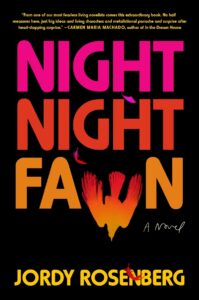
“Jordy Rosenberg’s novel Night Night Fawn traces the collapse of this fantasy and all of Barbara’s other thwarted ambitions. Said ambitions end up being displaced onto her only daughter, who turns out to be an incorrigible lesbian, an intractable Marxist—a Trotskyite!—and eventually, horror of horrors, not a daughter at all. In some sense, Night Night Fawn resembles the trans literature we know—it’s structured around the central tragedy of a parent tormenting a child for their gender expression—but the primary object of Rosenberg’s attention here is the parent, not the child. Rosenberg retains the ethnographic lens common to so much trans fiction and memoir but turns it on Barbara, on both her Zionist and gender dogmatism. The Rosenberg family, like any other nuclear family, is supposed to transmit these most precious values from parent to child. Night Night Fawn attests to the many ways that this transmission can go badly wrong, and hints at something further—at the political and relational changes that become possible when a parent fails.
…
“It’s bad enough that Barbara is fated to die under the care of J., ‘the specific individual I had successfully purged from the family decades ago.’ But worse yet, every day J. looks more and more like a bird: fingers edged in feathers, black beak and gray tongue, scabby claws. Rosenberg’s slip from satire into science fiction assumes that readers will need as much help as they can get to begin to comprehend a transphobic parent’s point of view: In order to fully evoke Barbara’s horror at her child’s transformation, it is necessary to show J. becoming an actual, life-size monster. After all, there would be nothing horrifying about a J. who, day by day, was just beginning to look like himself.
…
“In an essay from her 1998 collection Mourning Becomes the Law, the philosopher Gillian Rose called for a different kind of Holocaust film, one intended to work on the viewer in a different way altogether. Rather than portray the Nazi as a manifestation of ineffable evil, she argued, such a film should lure us in, should lead us to identify with the Nazi to such an extent that ‘we put our hands on the trigger with him, wanting him to get what he wants.’ Instead of leaving the theater feeling sentimental but politically intact, we should ’emerge with the dry eyes of a deep grief,’ newly aware of our past and present complicity in fascism.
Rosenberg selected a quote from that Gillian Rose essay as his epigraph, and you get the sense that, writing Night Night Fawn, he was never unaware of the work he was trying to do: to expose his mother’s full culpability in Zionism, while making it perfectly clear that she was not so different from our own mothers, friends, neighbors, colleagues. Besides being a biting portrait of Barbara Rosenberg and a drama about parent-child relationships, Night Night Fawn is also an exhaustive accounting of something else: how Barbara—and so many other ordinary people—incubated Zionism within the family and, as Rosenberg put it, ‘tried to make the mass murder and ethnic cleansing of Palestinians seem normal.'”
–Emmet Fraizer on Jordy Rosenberg’s Night Night Fawn (The Nation)
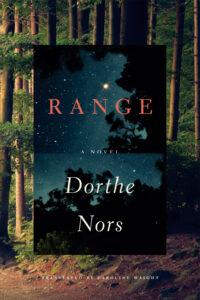
“In both her fiction (including the International Booker Prize finalist Mirror, Shoulder, Signal and the story collection Wild Swims) and her travel memoir, A Line in the World: A Year on the North Sea Coast, Nors writes characters—including herself—who sidestep convention and pay a price for doing so. They are observant, mordant and in various ways dislocated; “misfit” is the common descriptor. But Nors’s work is a sly rebuke to that word: Why must the individual be blamed for missing the fit? Why can’t society soften, open itself more generously to all of us?
…
“This is an obliquely composed novel of advances and withdrawals and buried clues, and the reader, like the astronomer, must patiently ‘observe, note, conclude.’ As you watch and wait you’re sometimes rewarded with a narrative burst of fiery activity, or a subtler, more beautiful afterglow of revelation. It is a novel whose language and structure delicately enact its wrenching themes, most of all the heartache of enduring one’s own chosen and carefully guarded loneliness.
In Waight’s translation, Nors’s prose is scrubbed clean and often luminously poetic (the ‘woollen darkness,’ a ‘quilt of light and rain’). Passages are often intriguingly structured, building chains of soothing descriptions only to end in a flare of some surprising, unbidden truth. If her protégé’s parents knew where he was at the moment, she imagines, ‘they’d be standing in their open-plan kitchen right now gazing anxiously at each other. They would adjust the light above the kitchen island with that dimmer switch his father had installed, and they would agree to direct their anger toward Gunn.’
…
“The ‘range’ in this novel is not only the grand stretch of the universe, but also the space between freedom and tether, the push and pull of distance and connection. But the kind of freedom Gunn desires can come at a terrible price, and there are reckonings to be made: not only with the monstrous Gable Woman but with Gunn’s deepest, most estranged self. In an era when all language is subject to relentless algorithmic flattening, when books are so often rewarded for easy comprehension and bland sentiment, Range is a rebellious celebration of the singularity, and mystery, of humankind. We need more fiction like Nors’s. Let the weird children come.”
–Charlotte Wood on Dorthe Nors’ Range (The New York Times Book Review)
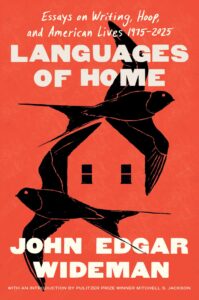
“Languages of Home is John Edgar Wideman’s first collection of essays, profiles, and creative nonfiction. Although it is a welcome addition to his oeuvre, its emergence might be surprising to Wideman’s closest readers. While a master novelist and memoirist, he tends not to be nostalgic or precious about his past work. He doesn’t like looking back, especially at his own literary record. Wideman may even greet Languages with some ambivalence. He seems to suggest as much in ‘Joe Wood,’ a gorgeous piece from his mesmeric, elegiac 2024 book of fiction and nonfiction, Slaveroad, in which the voice narrating ‘Joe Wood’ worries that collecting his nonfiction would only lead to ‘inevitable disappointment.’ That voice belongs to a writer—simultaneously Wideman-like and not Wideman at all—who, upon scanning his editor’s proposal for a book that sounds a lot like Languages, ponders the futility of such projects.
…
“In these pieces, you’ll find Wideman thinking through Black history and ethics, interrogating the legacies of violence in American life, and imagining how strong art can lead us to those elsewheres of dreams and possibility. In this way, Languages is an archival distillation of Wideman’s six-decade writing career, specifically in terms of his essays. But this compendium is also something more: It is a craft book about the African American literary tradition and Black vernacular practices, the aesthetic resources that both bestow, and the art of improvising in and on the essay form.
…
“Wideman’s reluctance to look backward seems to be motivated by his desire to keep his past labors from inhibiting his consistent creative output. Interviewed by Elias Rodriques for The Nation in 2021, Wideman explained: ‘I don’t want to look back. What’s in it for me? One of the scariest things is picking up a story and reading a line and thinking, “Why did I spend my time doing that?” or “I wish I had a red pencil to get this boy in better shape.”’ Yet what is striking is that although Wideman has long been ambivalent about history and biography playing a role in the critical appraisal of Black literature and art, both have also long haunted his literary works. After the completion and release of his third novel, The Lynchers, in 1973, Wideman entered a seven-year period of ‘“woodshedding,” as [jazz] musicians would say,’ a complex, experimental conversion of his own biographical circumstances and family history into the basic material of literary art.
Playing one-on-one with the Black tradition, Wideman recapitulated the lessons he’d learned from his criticism, recalibrated his approach to writing, rejuvenated his prose musically, and crystallized a new style that simultaneously embodied the tradition, renewed it, and moved it into the future. These adjustments served his art and production enormously. Among the innovations of these books is Wideman’s transposing a very real place, the Homewood section of Pittsburgh—what we might call, after Albert Murray, his ‘briar patch’—into a very special setting in American literature.
…
“One might argue that his impulse to improvise, to emulate the energy of a pickup game, informs the antiphonic nature of both the essays in Languages of Home and his frequent on-court sparring with the Black literary tradition. He may not need these essays, but we do. These pages communicate ideas for and questions about pursuing freedom. The process of reading them can feel like going one-on-one with the author, or better, rolling to an outdoor court with Wideman and calling out, ‘Who got next?'”
–Walton Muyumba on John Edgar Wideman’s Languages of Home: Essays on Writing, Hoop, and American Lives 1975-2025 (The Nation)
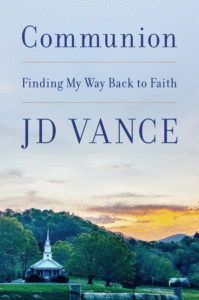
“Something is off in J. D. Vance’s new memoir, Communion: Finding My Way Back to Faith. To begin with, there seems to be some confusion over what faith we’re talking about. The book is presumably about Vance’s conversion to Catholicism but, as many have pointed out, there’s a Methodist church on the dust jacket. Finding a ‘way back’ is also an unusual way to talk about conversion, which is typically framed as discovering a way forward. Initially, I chalked these choices up to carelessness, the kind of missteps you’d expect of a book that’s meant to be written about more than read, but on the first page I realized these issues were coming from inside the house.
…
“If we believe Vance, Communion is a simple journey of personal faith—he is raised in various Protestant denominations, dabbles in atheism, and eventually becomes a Catholic. He never strays far from Christianity, and there’s not one big revelation that brings him back: it’s a slow realization. My own realization came as I read Vance’s description of his time at Yale Law School, when he and his classmates were vying for Supreme Court clerkships, all trying to become members of what he calls ‘the elect.’ Ultimately, he will not be admitted to this club, but that’s fine, he says; neither was Peter Thiel. What an odd thing to say.
…
“Vance later ties his introduction to [French philosopher René] Girard explicitly to Thiel, but he fails to disclose the extent of their relationship. No other mention will be made of the tech titan—not Vance’s job at his investment firm, not Thiel’s backing of Vance’s own firm, not Thiel’s record-breaking $15 million donation to Vance’s Senate race, and not the peace Thiel brokered between Vance and former president Donald Trump that led to Vance’s place on the 2024 ticket. To hear Vance tell it, Thiel was a kind of Christian motivational speaker who gave a lecture he happened to attend at Yale. In other interviews, Vance calls that lecture the single most impactful event during his time there. This might be true, and yet it is not that lecture that shapes Communion. Instead, it’s Thiel’s other lecture, ‘The Straussian Moment,’ that provides a critical framework for Vance’s otherwise puzzling book. Thiel originally delivered ‘The Straussian Moment’ at his 2004 self-funded conference Politics and the Apocalypse, and later published it as an essay. Ostensibly, it’s a response to the terrorist attacks on 9/11, but more accurately, it’s a series of philosophical loop the loops that weaves the work of René Girard, Leo Strauss, and Carl Schmitt into an argument for transforming the United States into an authoritarian Christian nation-state.
…
“To put it plainly, Thiel thinks that the United States has abandoned religion and the Enlightenment has failed. The world has become a globalized, godless place where all choices are equally valid and we have fallen into a live-and-let-live passivity. This has brought an empty-headed peace, fanatically protected by liberals under the guise of multiculturalism, though in reality they’re dazzled by cheap consumer goods and driven by envy to protect the system that supplied them. In this anti-society, intellectuals are punished for even mentioning that cultures used to have distinct differences and, in his opinion, echelons. In Thiel’s mind, the Christian West must remember who they are if they are to defeat Muslims from the Middle East. They must realize their culture and religion are superior in order to reinvigorate themselves to fight for it.
The title of Thiel’s lecture is never mentioned in Communion, but a professor would be within her rights to mark it as uncited source material. Early on, Vance introduces the exact same societal problem as Thiel with the same question about terrorism, attributing it to an unnamed Iraqi during his deployment as a US marine: ‘You’re the most powerful country in the world, but you can’t keep a crazy man from blowing up a market? What’s wrong with you?’ And Vance will come to the same conclusion, beat for beat…”
–Elizabeth Harper on JD Vance’s Communion (The Los Angeles Review of Books)

If you buy books linked on our site, Lit Hub may earn a commission from Bookshop.org, whose fees support independent bookstores.