Maggie O’Farrell’s Land, Thomas W. Laqueur’s The Dog’s Gaze, and Ann Patchett’s Whistler all feature among the best reviewed books of the week.
*
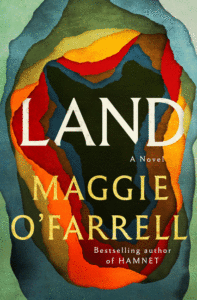
1. Land by Maggie O’Farrell
(Knopf)
14 Rave • 1 Positive • 3 Mixed • 1 Pan
“A soaring, visionary narrative that connects the known world to the misty realms of Celtic legend … As the struggling men and women in Land endure defeat and distrust victory, it is their frailty as much as their strength that wins our sympathy and holds our attention … Her lyrical descriptions bring fresh poignancy to well-worn scenes of exile.”
–Anna Mundow (The Wall Street Journal)
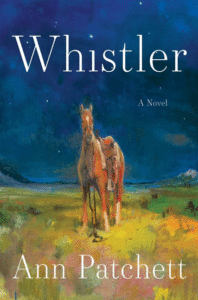
2. Whistler by Ann Patchett
(Harper)
11 Rave • 5 Positive • 2 Pan
Read an excerpt from Whistler here
“Is there a place in serious literature for kind, happy characters and kind, happy stories? This intimate and entertaining novel makes the strong case that there is; as demonstrated across her work, such sturdiness of spirit is part of Patchett’s generous worldview.”
–Helen Schulman (The New York Times Book Review)
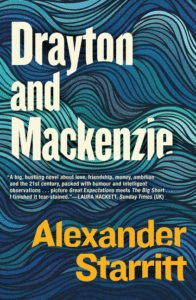
3. Drayton and Mackenzie by Alexander Starritt
(Atlantic Monthly Press)
9 Rave • 2 Mixed
“It’s a mark of Starritt’s confidence that the quest to harness tidal power—the book’s main business—gets going only 200 pages in. We feel in safe hands from the start, reassured that he knows the story’s every last turn … With a joyful knack for pithy analogy, the writing holds our attention as much as the events … while there’s no shortage of chat about electrolysers and optimal blade rotation, Starritt keeps his focus on the human story of invention: dangling quietly over the action is the fact that James, lauded as a visionary, relies mostly for his ideas on other people. In the end, though, critique of disruptor-era genius is less important here than feeling and friendship.”
–Anthony Cummins (The Guardian)
**
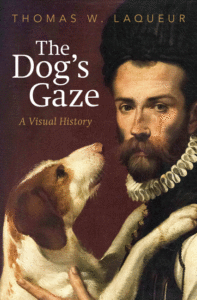
1. The Dog’s Gaze: A Visual History by Thomas W. Laqueur
(Penguin Press)
5 Rave • 3 Positive • 1 Mixed
“A clever and beautiful survey of dogs in painting, with a brilliant interpretation of their role at its heart … Luminous … Laqueur takes us on a wonderfully illustrated tour of dogs in art … By the end of this clever, beautiful book, Laqueur has persuasively made his point that the dog’s function in western art is to provide an entry-point or alter ego for viewers who might otherwise feel overwhelmed or outclassed.”
–Kathryn Hughes (The Guardian)
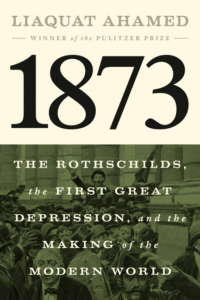
2. 1873: The Rothschilds, the First Great Depression, and the Making of the Modern World by Liaquat Ahamed
(Penguin Press)
4 Rave • 1 Positive • 1 Mixed
“A lively and compelling account … Without ever coming out and saying so, Ahamed presents a world-spanning financial system that was rotten to its core, a machine that ran on lies, bribes and greed, busily manufacturing its own political opponents … A longtime banker and hedge fund adviser, Ahamed knows what he’s doing … Ahamed tells his story with an easy fluency and a high velocity, while navigating less familiar terrain with great confidence.”
–Trevor Jackson (The New York Times Book Review)
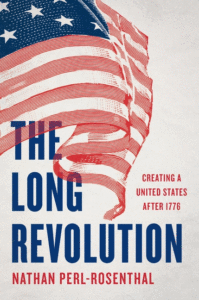
3. The Long Revolution: Creating a United States After 1776 by Nathan Perl-Rosenthal
(Basic Books)
4 Rave • 1 Positive
“Illuminating … Mr. Perl-Rosenthal is excellent on the Revolution’s interpretive flexibility—its capacity to be claimed and reshaped by groups far beyond the Founders’ original horizon … Widening of the Revolution’s meaning is one of the book’s most persuasive themes and gives substance to the author’s larger claim that the Revolution persists as an unfinished project … He writes with clarity and a welcome lack of cant, and he has an eye for the telling detail.”
–David S. Reynolds (The Wall Street Journal)
If you buy books linked on our site, Lit Hub may earn a commission from Bookshop.org, whose fees support independent bookstores.