Elizabeth Strout’s The Things We Never Say, Herta Müller’s The Village on the Edge of the World, Douglas Stuart’s John of John, and Siri Hustvedt’s Ghost Stories all feature among May’s best reviewed books.
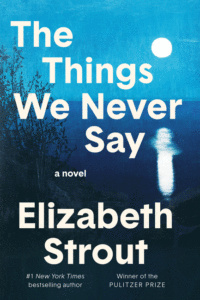
1. The Things We Never Say by Elizabeth Strout
(Random House)
10 Rave • 5 Positive • 4 Mixed
“As usual, Strout manages to create scenes of intense intimacy in prose that feels as casual and comfortable as your favorite flannel shirt. She’s just so damn good.”
–Ron Charles (Ron Charles Substack)
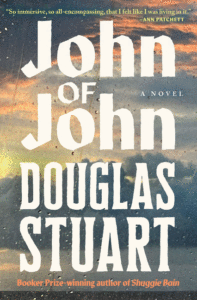
2. John of John by Douglas Stuart
(Grove Press)
11 Rave • 2 Positive • 1 Mixed
“A muscular narrative with scrupulous technique. It’s his finest work yet … Stuart’s prose is gorgeous and his plotting strategic; nothing is lost. A throwaway item in an early chapter loops back like a boomerang hundreds of pages later … [A] generational talent.”
–Hamilton Cain (The Boston Globe)
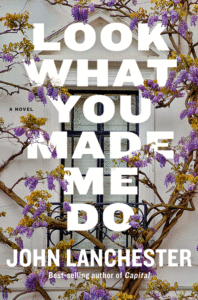
3. Look What You Made Me Do by John Lanchester
(W. W. Norton)
10 Rave • 3 Positive • 2 Mixed • 1 Pan
“A gleamingly accomplished black comedy … Skewed scenarios and retaliatory stratagems are craftily deployed in a novel that’s a kaleidoscope of tilting perspectives.”
–Peter Kemp (Literary Review)
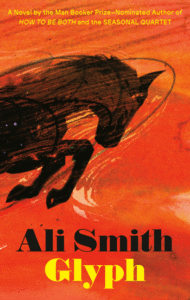
4. Glyph by Ali Smith
(Pantheon)
8 Rave • 6 Positive • 1 Mixed • 1 Pan
“Glyph’s primary power comes from its commitment to excavating the sediments of language; its etymological resonance and inference … It is a bold move to be so morally unflinching, especially in the face of a perceived aesthetic orthodoxy that so often privileges distance and irony, but in Glyph we see a major British writer answering the call of the day when so many others have equivocated or turned away.”
–Keiran Goddard (The Guardian)
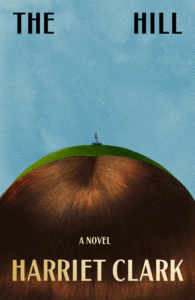
5. The Hill by Harriet Clark
(Farrar, Straus and Giroux)
7 Rave • 3 Positive
“Superb … Clark’s novel is a brilliantly deprived bildungsroman … From the novelist’s point of view, the story’s fatal glamour skews it toward memoir: Why fictionalize such remarkable facts? Clark’s wise remedy is to strip her fiction of most of those facts, reducing the local references so that the narrative shifts away from singular autobiography toward singular emblem.”
–James Wood (The New Yorker)
**
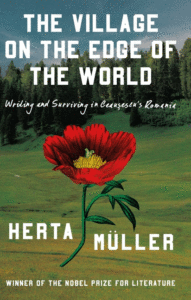
1. The Village on the Edge of the World: Writing and Surviving in Ceausescu’s Romania by Herta Müller
(Pegasus)
8 Rave • 1 Positive
“Superb … Conducted by Müller’s editor, Angelika Klammer, and skillfully translated by Kate McNaughton, these interviews trace a compelling trajectory. I was rapt, following a child who eats mouldy plums and plants, has laughing fits and feels desperate to belong, watching her grow into a defiant and resilient woman determined to break free.”
-Malcolm Forbes (The Telegraph)
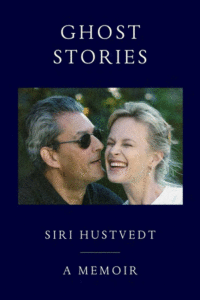
2. Ghost Stories by Siri Hustvedt
(Simon and Schuster)
6 Rave • 3 Positive
“Hustvedt writes so intimately about their physical and intellectual companionship that she makes you feel, in a way not all memoirists can, the dimensions of the crater he left behind.”
–Dwight Garner (The New York Times

3. Dog Days by Emily LaBarge
(Transit)
7 Rave • 1 Positive
“It’s a testament to LaBarge’s gifts as a writer that she can make even the most complex and cerebral ideas feel urgent and alive.”
–Jennifer Szalai (The New York Times)

4. Mighty Real: A History of LGBTQ Music, 1969-2000 Cover by Barry Walters
(Viking)
6 Rave • 1 Positive
“Meticulously researched and entertainingly written … Walters has written a wide-ranging, somewhat idiosyncratic—but thoroughly readable—slice of Americana that is absolutely not to be missed by pop culture mavens, LGBTQ+ readers, or anyone who wants to know how the music business finally came out of the closet.”
–Thane Tierney (BookPage)
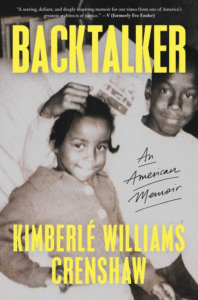
5. Backtalker by Kimberlé Williams Crenshaw
(Simon and Schuster)
5 Rave • 2 Positive
“Written with clarity and precision built by Williams Crenshaw’s deep expertise on race and gender politics, and sharpened by the constant defense for the need for both to be discussed, the memoir is both grounded and resolute.”
–Chanda Daniels (Hippocampus)

If you buy books linked on our site, Lit Hub may earn a commission from Bookshop.org, whose fees support independent bookstores.