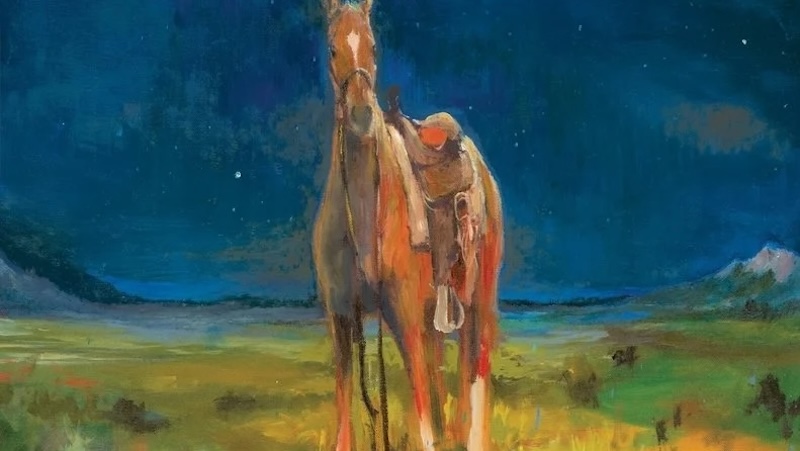
Maggie O’Farrell’s Land, Thomas W. Laqueur’s The Dog’s Gaze, and Ann Patchett’s Whistler all feature among June’s best reviewed books.
*
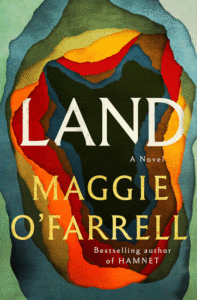
1. Land by Maggie O’Farrell
(Knopf)
14 Rave • 1 Positive • 3 Mixed • 1 Pan
“A soaring, visionary narrative that connects the known world to the misty realms of Celtic legend … As the struggling men and women in Land endure defeat and distrust victory, it is their frailty as much as their strength that wins our sympathy and holds our attention … Her lyrical descriptions bring fresh poignancy to well-worn scenes of exile.”
–Anna Mundow (The Wall Street Journal)
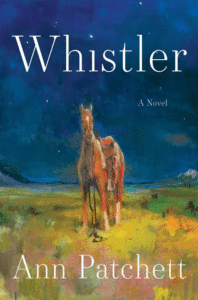
2. Whistler by Ann Patchett
(Harper)
11 Rave • 5 Positive • 2 Pan
Read an excerpt from Whistler here
“Is there a place in serious literature for kind, happy characters and kind, happy stories? This intimate and entertaining novel makes the strong case that there is; as demonstrated across her work, such sturdiness of spirit is part of Patchett’s generous worldview.”
–Helen Schulman (The New York Times Book Review)
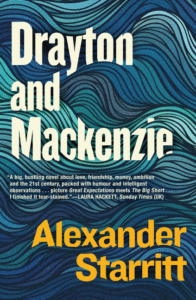
3. Drayton and Mackenzie by Alexander Starritt
(Atlantic Monthly Press)
9 Rave • 3 Positive
Read an essay by Alexander Starritt here
“It’s a mark of Starritt’s confidence that the quest to harness tidal power—the book’s main business—gets going only 200 pages in. We feel in safe hands from the start, reassured that he knows the story’s every last turn … With a joyful knack for pithy analogy, the writing holds our attention as much as the events … while there’s no shortage of chat about electrolysers and optimal blade rotation, Starritt keeps his focus on the human story of invention: dangling quietly over the action is the fact that James, lauded as a visionary, relies mostly for his ideas on other people. In the end, though, critique of disruptor-era genius is less important here than feeling and friendship.”
–Anthony Cummins (The Guardian)
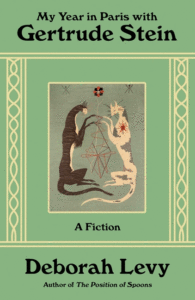
4. My Year in Paris with Gertrude Stein: A Fiction by Deborah Levy
(Farrar, Straus and Giroux)
7 Rave • 5 Positive
“A lighthearted, free-associative novel about female friendship and literary inspiration … If the combination of Levy’s light tone and the bookish details on Stein doesn’t always come together, all the parts of this novel are delightful in themselves: funny, wide-ranging, and worthy of their comma-challenged muse.”
–Julie Phillips (4Columns)
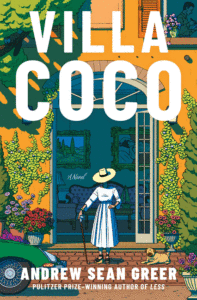
5. Villa Coco by Andrew Sean Greer
(Doubleday)
6 Rave • 5 Positive • 1 Mixed • 2 Pan
Read an excerpt from Villa Coco here
“If you’re looking for a work of fiction that’s charming from start to finish, Villa Coco is the book for you. It’s seductively entertaining from the get-go … Greer’s novel is a Tuscan romp that overflows with sunshine and surprises while providing a deep meditation on growing up, growing old and navigating the many crossroads in between.”
–Alice Cary (BookPage)
**
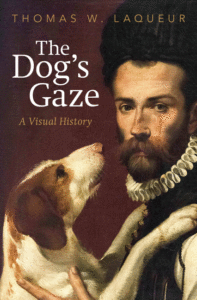
1. The Dog’s Gaze: A Visual History by Thomas W. Laqueur
(Penguin Press)
7 Rave • 3 Positive • 1 Mixed
Read an excerpt from The Dog’s Gaze here
“A clever and beautiful survey of dogs in painting, with a brilliant interpretation of their role at its heart … Luminous … Laqueur takes us on a wonderfully illustrated tour of dogs in art … By the end of this clever, beautiful book, Laqueur has persuasively made his point that the dog’s function in western art is to provide an entry-point or alter ego for viewers who might otherwise feel overwhelmed or outclassed.”
–Kathryn Hughes (The Guardian)
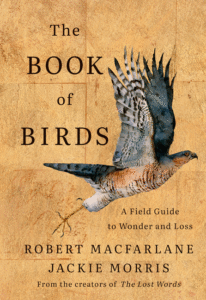
2. The Book of Birds: A Field Guide to Wonder and Loss by Robert MacFarlane and Jackie Morris
(W. W. Norton & Company)
7 Rave • 1 Positive
“Another beautiful, eminently giftable, clarion call to pay attention to the wonders of the natural world … The Book of Birds is no mere catalog of endangered species … Full-throated prose poems flag distinguishing habitats, habits, and character traits that make the birds come alive in a way that more traditional field guides do not … I had never before read a field guide from cover to cover, but after marveling at the wonders in The Book of Birds, I can well understand the authors’ profound admiration for their subjects.”
-Heller McAlpin (The Christian Science Monitor)
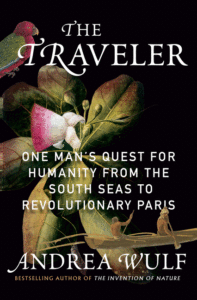
3. The Traveler: One Man’s Quest for Humanity from the South Seas to Revolutionary Paris by Andrea Wulf
(Knopf)
7 Rave • 1 Mixed
Read an excerpt from The Traveler here
“George Forster is one of the most fascinating figures you have probably never heard of … Forster is the vibrant subject of Andrea Wulf’s The Traveler, a lively new book that hums with her characteristic verve … It is invigorating, especially now, to read him observing, thinking and enthusing on the page.”
–Jennifer Szalai (The New York Times)
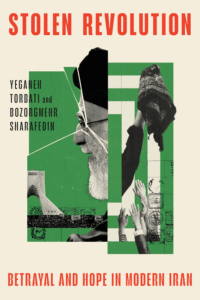
4. Stolen Revolution: Betrayal and Hope in Modern Iran by Yeganeh Torbati and Bozorgmehr Sharafedin
(Doubleday)
6 Rave
“Bozorgmehr Sharafedin and Yeganeh Torbati’s powerful history of the Islamic republic is a badly needed corrective because it is at once an engrossing story and a balanced, meticulously researched primer on modern Iran (the clearest I’ve ever read). And it is dramatic, personal and often heartbreaking … Stolen Revolution is a careful and unwavering account of the regime’s absurdities and crimes. It should be required reading for anyone who cares about human rights or justice in the Middle East.”
–Dina Nayeri (The Guardian)
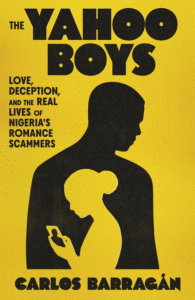
5. The Yahoo Boys: Love, Deception, and the Real Lives of Nigeria’s Romance Scammers by Carlos Barragán
(Farrar, Straus and Giroux)
5 Rave • 1 Positive
“Barragán brings a surprising depth and empathy to The Yahoo Boys, to the tin roofs and traffic jams of Lagos, the SIM cards and Apple IDs that buttress this edifice of deceit. He’s gone rappelling into the bottomless pit that surrounds desire. The result is a compassionate, elegant, unsettling book about some extremely shabby people. At least they’re still people, though.”
–Dan Piepenbring (Harper’s)
If you buy books linked on our site, Lit Hub may earn a commission from Bookshop.org, whose fees support independent bookstores.