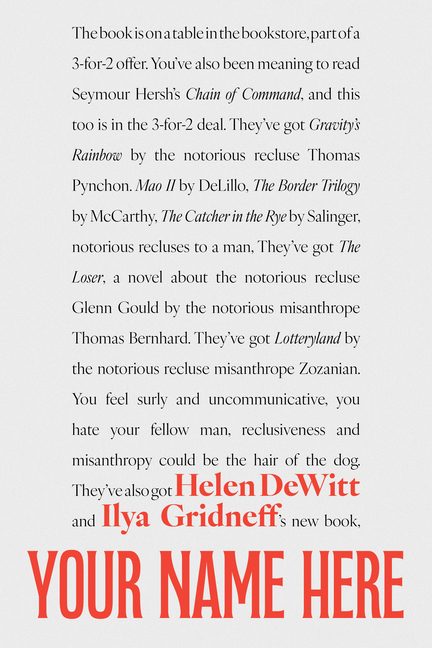
A honeycomb of books-within-books. Collaborators Helen DeWitt and Ilya Gridneff weave together America's "War on Terror," countless years of literary history, authorial sleight of hand, Scientology, dream analysis, multiple languages, emails, images, graphs, into something wondrous and unique.
Makes The Last Samurai look breezy ... A novel of permanent, persistent becoming, a story whose endings are multiple and essentially arbitrary, and it takes its own seeming unpublishability as a theme, or perhaps a promise ... In other words, Your Name Here is that dirty word in literary circles today: a challenge ... DeWitt has constructed not a maze so much as a garden, where many kinds of writing can thrive side by side. The results can be anarchic, even confusing, but they are never simple, blunt, or bland ... Whatever the limitations of the marketplace, great writing remains as capable as ever of breaking open your sense of the world and your place in it. Reading a novel like Your Name Here, you can come to see that there are no real limits in literature, and fewer in life than you’d expect.
Haunted and frustrated by whimsy ... Another interesting thing about Your Name Here is how relentlessly its structure works in the other direction, pushing the book outward toward diffusion, expansion, even drift ... Despite many vivid moments, Your Name Here never really achieves this kind of alchemy; on the contrary, it remains what it is: a quirky but ultimately untransfigured story.
It reads...as if its author were inventing the novel from scratch ... Ought to make for a miserable reading experience, but instead it’s strangely propulsive. DeWitt’s prose in Your Name Here deliberately eschews the beauty of her previous works: it’s plain, full of abbreviations and German loanwords and in-jokes.