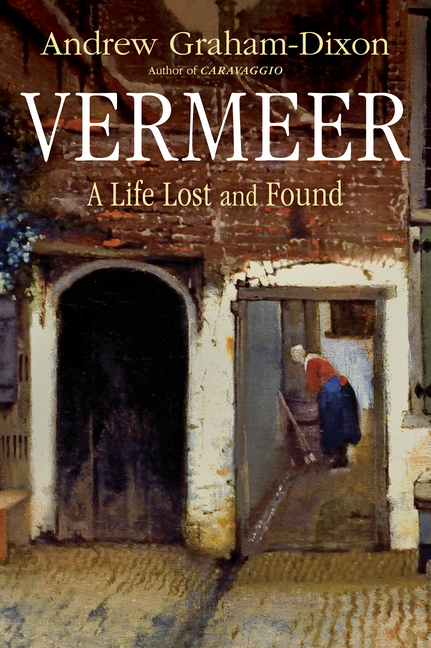
A new interpretation of most, though not all, of Vermeer’s work ... It’s hard to predict how readers of the book will respond to these readings of the art. They are delivered with a confident brio, though the author is careful to enter caveats ... Amen to that—and, indeed, to the arguments that are sustained throughout Vermeer: A Life Lost and Found. You may disagree with them, fiercely so, but they could not be more persuasively put, and they rescue Vermeer from the shelf, as it were, on which we have placed him for our convenience ... Graham-Dixon’s task, as it was in his biography of Caravaggio, is to resacralize an art that the current age consigns to the realms of the secular ... Andrew Graham-Dixon may be on a mission, but so, he believes, was Vermeer.
In his densely researched and highly original book, Andrew Graham-Dixon aims to account for that strange suffusion in Vermeer’s painting through the artist’s contexts, contacts and religious affiliations ... This book is an extraordinary portrait, flooded with light and colour, and a splendid unfolding of the pressure of meaning in everyday life; in other words, it emulates the special charge of Vermeer’s paintings. But it does not exhaust them, or guarantee their final meaning. The paintings retain their mysterious absorption, with an immanent charge we can still feel.
A whopping great study ... This is impressive detective work ... For all the historical heavy-handedness, Graham-Dixon still contrives to give us the deepest and most rounded portrait of Vermeer we are ever likely to have ... What’s oddest about Graham-Dixon’s readings is that he feels the need to make them ... Looking for meaning in these pictures is like looking for significance in the fact of your being alive ... I am being hard on this book because parts of it are so impressive ... In the end though, Vermeer: A Life Lost and Found is no truer to its subject than Tracy Chevalier’s high-end period-piece potboiler Girl with a Pearl Earring. Case dismissed.