Follows the turbulent friendship between two composite characters, the narrator and the theorist, self-identified sisters struggling to define their wounded histories and their shared but separate lives. During college, they invent a game of collapse: Every time they see each other, they have to stop and fall to the ground. As their kinship continues off and on for decades, “collapse” takes on new meanings that are seen and felt in the violence of their pasts, artworks depicting couches where someone might ease their exhaustion, the ongoing devastation in Gaza, and the antagonism of their conversation and their love for each other.
Colorfully, referentially, and intellectually dynamic ... A glossy-paged, art exhibition catalog-worthy book ... Though the narrative’s ending verges on negative abstraction, Rankine clearly demands that we confront our failure to prioritize Gazans and reckon the massive resultant losses, personal, ethical, and human alike.
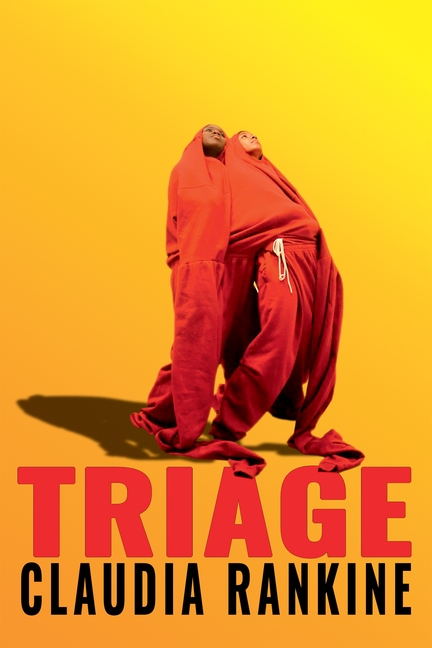
Most of the book follows Rankine’s narrator as she reflects on her life ... She tries to make sense of her privileged yet vulnerable status in the world ... There is, however, disappointingly little discussion of the apt artistic metaphor on the cover, a photograph from Autumn Knight’s brilliant performance piece 'La Querelle des Monstres,' in which Knight and a collaborator are bound into a conjoined sweatsuit. Imagine Rankine, or her narrator, yoked in solidarity to the theorist ... The culminating conversation between the two is so elaborate, involved and painstakingly transcribed that I wondered if it was an act of autofiction. Their dialogue, even more than the nuggets of daily observations and art criticism, is reason enough to read the book.
It didn’t work. That is the howl of grief at the core of Claudia Rankine’s new book ... Reads like a dispatch from a routed army ... Rankine arrives at the opening of Triage having turned 60, buried her mother, and lost a sustaining belief in the future that she thought she was in the vanguard of creating. In the face of such conditions, she writes, 'nothing else functions but one’s grief.' I think this line captures how a lot of Americans feel right now ... But Triage does have a moment in which an ember of the old cruel optimism flickers. Rankine and her friend study a picture of Ketanji Brown Jackson’s daughter. They see, in her innocent eyes, 'finally, the person for whom centuries of survival was for.'