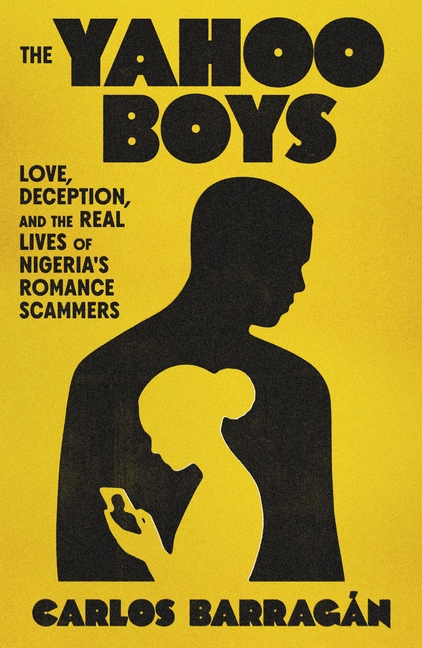
When his mother started emailing with a handsome American soldier who promised to send gold bars to her Madrid apartment, the journalist Carlos Barragán came face to face with the human toll of online romance fraud. After tracing the emails to an IP address in Nigeria, he set off on a journey to Lagos to find his mother’s scammer, where he stumbled on a much bigger story. In the midst of Africa’s largest city, he encountered thousands of young men engaged in romance scamming. They call themselves “Yahoo Boys,” and each year they catfish millions of dollars from lonely victims overseas, building a dizzying local economy from their phones.
Barragán brings a surprising depth and empathy to The Yahoo Boys, to the tin roofs and traffic jams of Lagos, the SIM cards and Apple IDs that buttress this edifice of deceit. He’s gone rappelling into the bottomless pit that surrounds desire. The result is a compassionate, elegant, unsettling book about some extremely shabby people. At least they’re still people, though.
The journalist Carlos Barragán skillfully navigates this history in his debut, The Yahoo Boys, which humanizes both the perpetrators and their victims ... Puts the lie to our image of technology as a realm of inevitable progress ... Barragán’s characters are vivid; they inspire sympathy and plumb the depths of wickedness.
More than crime reportage ... Mr. Barragán’s achievement is to make this world intelligible without making excuses for it. He has a reporter’s gift for proximity. He lets the scammers talk—at length, often hilariously—but not hide inside their own mythology. ... Mr. Barragán shows us young men who are morally hollow without pretending that they are not also human. That only makes the damage harder to look away from ... If the book has a weakness, it is that these tech platforms that make the scams scalable remain more backdrop than subject. Mr. Barragán offers no easy answers.