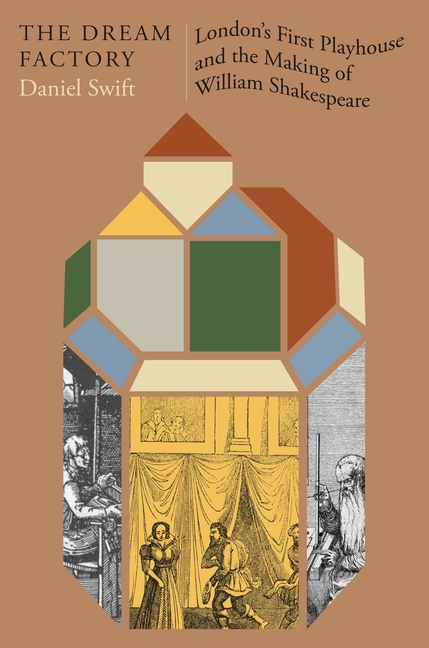
How Shakespeare became Shakespeare: a riveting tale of London's first playhouse and the people—actors, writers, builders, investors—who built the Theatre.
Something as mundane as oysters and hazelnuts revealed a theater from the greatest age of English drama, what the scholar Daniel Swift describes in his brilliant new book, The Dream Factory: London’s First Playhouse and the Making of William Shakespeare, as effectively 'the remnants of 16th-century popcorn' ... An estimably material interpretation of literary history, this book places Shakespeare in a fascinating economic context, whereby the Theater is the workshop (or studio) where he learns his trade ... The Dream Factory is an indispensable account of a chaotic and creative period in which feudalism was transitioning into capitalism, with the entertainment industry one of the salient harbingers of that shift.
Swift’s contribution, and it’s a valuable one, is to tell the story of a building ... Swift’s bemused account of the Burbage-Brayne partnership is one of several aspects of the book that erase the distance between 16th-century Shoreditch and 21st-century Broadway. The conniving producers, stagestruck backers, formidable labor organizations and long hours in grim conditions show that Shakespeare really is our contemporary.
Although some perhapsing and mythmaking inevitably find their way into The Dream Factory, Swift is...diligent about the factual record ... [Not] as vivid a storyteller.