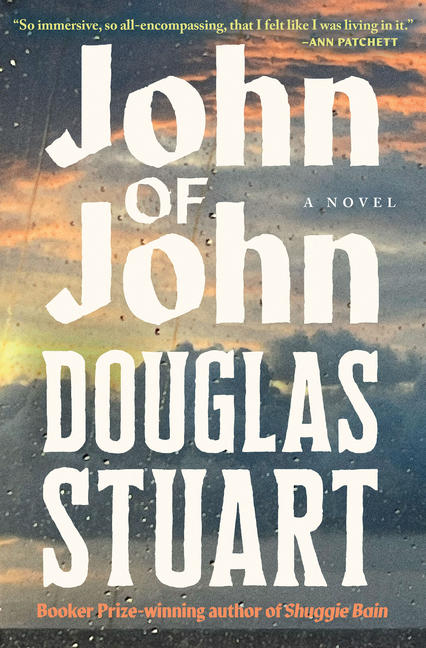
Out of money and with little to show for his art school education, John-Calum Macleod takes the ferry back home to the Isle of Harris in the Outer Hebrides to find that little has changed except for him. He returns to the windswept croft and the two pillars of his childhood: his father John, a sheep farmer, tweed weaver, and lay preacher in the local Presbyterian church, and his maternal grandmother Ella, a profanity-loving Glaswegian whose steady warmth helped Cal weather the sudden departure of his mother. Cal privately wonders if any lonely men might be found on the barren hillsides of home, while John is dismayed by his son's long hair, strange clothes, and seeming unwillingness to be Saved. But Cal isn't the only one in the croft house who is keeping secrets. As lambing season turns to shearing season, the threads holding together the community together become increasingly frayed, and nothing will remain as it was before.
A muscular narrative with scrupulous technique. It’s his finest work yet ... Stuart’s prose is gorgeous and his plotting strategic; nothing is lost. A throwaway item in an early chapter loops back like a boomerang hundreds of pages later ... [A] nuanced tapestry ... [A] generational talent.
Moving, suspenseful, completely-worth-your-time ... John of John is a stick of dynamite waiting to go off in your hand ... One of the biggest surprises in a novel full of them is that Stuart is not particularly interested in telling either a coming-home or a coming-of-age story...he uses that architecture to build something different, stranger and far more original ... Stuart is not just a very good writer but an immensely skilled storyteller who is more than up to the extraordinarily challenging task he sets himself.
Stuart’s protagonists are growing up, and his writing — particularly his depiction of the vicissitudes of queer life — is maturing right alongside them ... Changes tack dramatically toward a sprawling, emotionally rich saga that extends Stuart’s investigation into masculinity while sketching a world in which his gay characters come fully, finally alive. It’s his best yet ... Stuart finds a fantastic canvas for continuing his exploration of masculinity. Men are John’s central characters, but the women (Cal’s mother and grandmother) are as lovingly drawn.