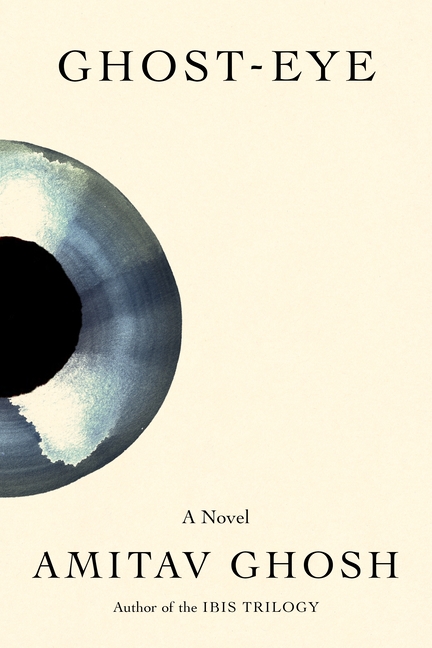
Varsha Gupta wants fish for lunch. Her family is shocked; the three-year-old has never tasted fish in her life. The Guptas are strict vegetarians and don’t allow it inside their Calcutta mansion. But Varsha claims she can remember another life, in a mud house by a river where she caught and cooked fish with a different mother. Perplexed, the Guptas turn to Dr. Shoma Bose, a psychologist who has been investigating what are known as "cases of the reincarnation type" for years. But her understanding of the world is changed forever by Varsha's revelations.
Strikingly, Ghost-Eye has none of the eerie mood of a Gothic novel or ghost story. This is because the book treats reincarnation not as an ambiguous phenomenon but an empirical fact. ... The strangeness of Ghost-Eye will keep readers on their toes, but the book’s earnest, scientific framework makes it seem like an elaborate exercise in wishful thinking.
Transnational and translingual, with a planet-spanning curiosity, Ghosh is a synthesist of the highest order, able to weave big, genre-bending ideas, vast sweeps of History and nuanced characterizations into compulsively readable narratives ... A trim 322 pages. No one will ever accuse Ghosh of a lack of audacity ... It kills me, however, to report that Ghost-Eye is the weakest entry in the trilogy and the end of Ghosh’s history-making streak ... Ghost-Eye attempts way too much with too little ... I understand what Ghosh is trying here, reminding us that the complexity of our endless worlds will always trouble that simplifying fiction we call causality, but he needed more room and time to make his case compelling on a literary level ... I’ve laid out my problems here, but even so Ghost-Eye is still a novel that I would enthusiastically recommend. The truth is that there are more insights and pleasures to be had from a flawed Ghosh than from the countless vapid mid-hits that inundate our bookstores and crowd our cognosphere.
Amitav Ghosh believes that climate change requires rethinking the novel. His new work of fiction fails that standard ... Ghost-Eye is at its best when Ghosh remains in this intimate mode, following lives that persist in the face of political and ecological disruption. Yet this is the lesser part of the novelist’s plan ... Character gives way to contrivance, and Ghost-Eye collapses under the strain ... We might be dealing instead with a lack of artistic imagination, an inability or an unwillingness to adapt the form of the novel to suit the subject. In this respect, Ghost-Eye is more the norm than the exception. But where Ghosh has failed, others might succeed.