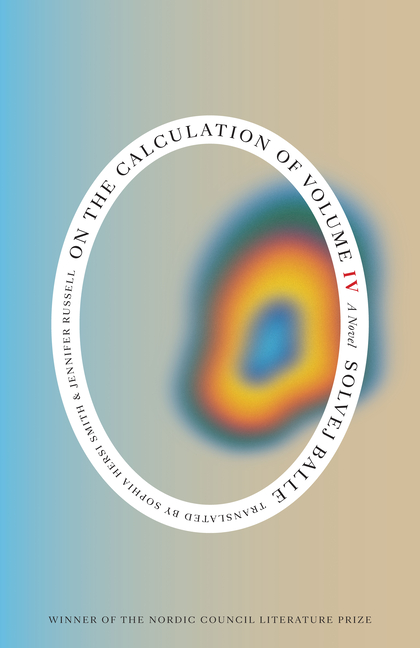
A current of grief and longing runs through the series ... The provisional nature of this society mirrors an improvisatory quality in the books, with their changing casts of characters and fluid metaphors. Balle’s protean impulse—her constant rewiring of thematic attachments—makes our reading experience varied and rich ... It’s a philosophical experiment illuminated by a novelist’s sensuous and humane way of looking.
Read as a whole, On the Calculation of Volume — the third volume of which recently appeared in English — may be the great modern novel of depression ... As in the first two books, Balle’s sentences have the swelling, mournful plangency of a Max Richter elegy ... In this extraordinary novel, as in our own shattered world, connection alone may be the one thing that endures.
Throughout the novel, Balle manages to destabilize even the reader’s sense of time ... Balle has proved remarkably adept at filling both her characters’ 'container of time'...and her readers’. Her novel of repetition reveals not a deadening monotony but rather the remarkable richness of each moment. Her spare, attentive prose demonstrates the way careful attention can transform seemingly familiar silences into a lushly textured masterwork of sound.
[The] seeming lack of character development can be a bit frustrating, but is likely at least partially a consequence of assessing the seven-part novel before it is even halfway finished ... Existential ... Fixing the past is hardly a groundbreaking concept for a time-loop story, but the scale being discussed by Balle’s protagonists at the end of Book III seems much larger than most such tales.
Balle seems uninterested in developing tension, or other conventional aspects of the novel, like character or plot. Instead, she treats her speculative framework like a petri dish—another container—wherein she can experiment with new lines of inquiry in clipped, plain language, without ever intending to arrive at an absolute solution or a unifying theory ... It is an experience of reading that is synergetic and thrilling ... Allows you to arrive as a participant to a series of moments that are at once past and present; moments in which you are superlatively, actually awake.
This is still only the third of seven planned volumes, and thus more of a chapter in a continuing and evolving story rather than stand-alone novel, coming complete with yet another cliffhanger of sorts; certainly, this is not the place to start in on the series, but it's a solid continuation of the previous installments, adding new dimensions (as well as characters), as engrossing as what preceded it—and making one curious about what is to come.
This Time puzzle has created a new kind of community. What that community will offer the world is something we, ironically, must wait until April to learn.
Volume III is more digressive than its predecessors, more freighted with history and philosophy. It is also looser, opening its sealed spaces to more air and light ... Balle’s piercing attentiveness and her forensic curiosity continue to render 18 November endlessly interesting.
There’s always depth to the pattern, layers to peel back ... We might look at the novel as its own container ... After three novels of inquiry, Tara’s subjectivity gives way to a collective. Suddenly, the container has expanded into a chorus of anxiety.