RaveThe New York Times Book ReviewThere is a strain of the exile novel that mistakes vacancy for depth, drift for destiny. Hannah Lillith Assadi understands that temptation and resists it. Paradiso 17, her third work of fiction, is quiet and alert; it is a study in inheritance, in the afterlife of ideology, in the way history seeps into every curated idyll. The novel deepens its primary note, the toll of human displacement, until it has an operatic resonance ... The title’s invocation of Dante promises ascent and descent, but the novel offers something closer to suspension, mostly of judgment ... Assadi’s prose is controlled, tensile and patient. She has an ear for the humiliations that create intimacy between strangers ... There are moments when Assadi’s lyricism skews sentimental or clichéd ... Still, it is refreshing to read a novel, in this era of distant cool, that risks sentimentality. Assadi, born in 1986 to a Jewish mother and a Palestinian father, is reckoning with the problem of her generation: how to feel when you’ve been trained primarily to observe, how to render the absurdity of devastation without irony. Paradiso 17 is suffused with tenderness ... Assadi refuses easy answers. If there is irony here, it is muted, almost mournful. The author is after something slower: the way history settles into you, day by day. Modernity is both an escape from history and a stage on which its contradictions become unbearable.
Leo Vardiashvili
MixedThe New York Times Book ReviewContrivances abound in this first novel — both in plot and in language ... Reclamation skews romantic through the overuse of aphorism ... When the story is propelled by political cynicism, by cigarettes and vodka, one can see streaks of Emmanuel Carrère and Jean-Patrick Manchette in the writing. Cunning and unstinting, humanist and self-aware, Vardiashvili nears noir excellence. Even more exquisite are the descriptions of Tbilisi, written as though the author was long at sea and is now desperately grasping for connection ... The most memorable passages in evoke a thorough understanding of war, escape and violence; in one, old gravestones have been effaced of their names by the rain. In these moments, this novel becomes a palimpsest, reflecting the cyclical nature of familial death and individual reconstitution. The unstable way we return home.
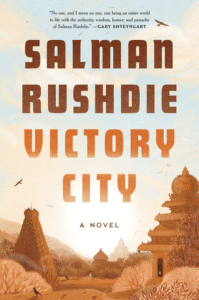
Salman Rushdie
PanDrift MagWarmed-over and didactic ... Victory City is, in many and the worst ways, classic Rushdie ... It is difficult not to read Victory City as a rehabilitative feminist fable, especially coming from a writer whose women have been criticized as reductions: sexless ice queens, villainous crones, fast-talking trollops ... My hope was that Victory City, an Indian novel through and through, would mark the return of Rushdie’s critical and creative faculties. No such luck. He has forgone the potent nebulousness of colonialism, displacement, and exile for mannerist expressions of his own prosaic wisdom ... If Victory City is any indication, late Rushdie is issuing an insouciant response to writers today: anything you can do, I can do more gratingly.