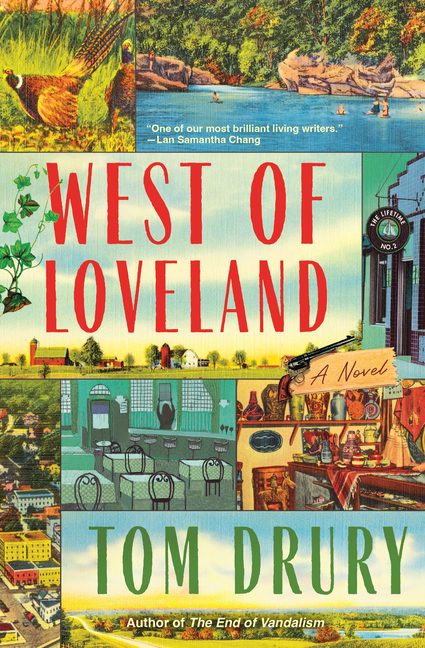
Tom Drury returns to the Midwestern county he's chronicled over four decades for a tale of fate, found families, and the revolutionary possibilities of love
While readers of his three earlier Grouse County novels will certainly feel the pleasure of encountering old friends, West of Loveland can be read satisfyingly on its own. The characters feel quickly familiar. The novel attends to their quiet conversations, their modest meals, their everyday work, whether caring for the sick, staffing a thrift shop or demolishing a silo ... Even his many felicitous turns of phrase — and there are many — are so unassuming that it takes some time to realize how powerful or clever they are ... The dialogue is crisp and often very funny. I suspect that some readers, drawn to the central mystery promised by the gun, will find themselves expecting more of a sensational turn, or the possibility of more dramatic violence. But while Chekhov’s rule is indeed satisfied (the gun, or a gun, goes off), I think such expectations miss the complexity of Drury’s project.
Drury is one of the great regionalists of American fiction, which is another way of saying that his novels are universal ... Drury deals in the quiet comedy of everyday screw-ups and hopeful irrationality ... Expansive ... You can easily enjoy it without having read the others, but those who know the novels will savor the sensation of reacquaintance. Mr. Drury’s steadfast characters are now entering old age, and there is an elegiac feel to the proceedings ... The novel moves at an unhurried pace, yet it builds to a surprisingly explosive climax ... A spacious, patient and endearingly attentive book that seems to operate on its own system of time, one regulated by personal transformations rather than the pressures of the wider world. You’d be tempted to move there, if only you could find it on the map.
Richly imagined ... The novel’s measured pacing and cumulative power yield a deeply humane meditation on fate, belonging, and the unseen threads that connect seemingly ordinary lives.