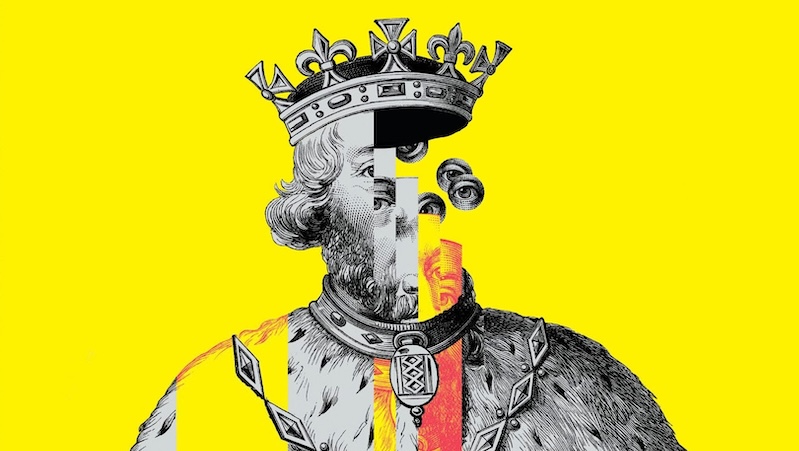
Our smorgasbord of sumptuous reviews this week includes Megan Nolan on Jon Ronson’s The Castle, Kasia Boddy on William Kennedy’s Albany Trilogy, Jonathan Dee on Kurt Andersen’s The Breakup, Johanna Thomas-Corr on Meg Mason’s Sophie, Standing There, and Ali Winston on Gil Durán’s The Nerd Reich.
*
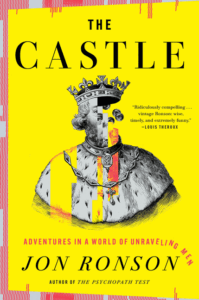
“Many of the very odd characters Ronson has documented previously have been men who desire or assume positions—whether an Islamic fundamentalist or an army Colonel—which seem inextricably linked to their ideas of maleness. Now, we have in Ronson’s new book, The Castle, a far deeper investigation of masculinity and its fallibilities. He is looking at the stories of men who find themselves somehow displaced: left reeling, they are doing exceptionally strange things in response.
There has already been plenty written on ‘What’s Gone Wrong for Men’; about the lost generation of boys underachieving in school, supposedly abused by a flippant misandrist culture, turning to nasty, nihilistic iterations of masculinity a la Andrew Tate. But Ronson is not grappling with the manosphere (luckily, as I don’t think that I can read another word about it as long as I live). Instead, The Castle contains a series of riveting portraits of very different men who, he believes, are unravelling because of the same condition: acute purposelessness caused by a rapidly changing society.
…
“The Linehan chapter is brilliant: insightful, candid and moving. I’m still not convinced that any broader crisis of masculinity or male purpose had much to do with Linehan’s downfall, though. He wasn’t at a loss or empty of purpose when he began his campaign. He didn’t turn to vitriol because he didn’t have anything else to do. His case is, if anything, notable for involving a man with an enviable life and abundant success throwing it away for reasons that to many in the outside world may seem obscure or deranged.
…
“It will be up to the reader to decide whether the various narratives in The Castle coalesce convincingly to support the notion that we live in a ‘a world of unravelling men.’ For me, they don’t, simply because each case is so idiosyncratic. But it doesn’t matter: this is an unmissable piece of work. It speaks highly of a book’s page-by-page value when I haven’t even got room to discuss Ronson’s encounter with disgraced cannibal-fetish movie star Armie Hammer. Ronson’s nose for squirreling out a strange, compelling fellow is unparalleled, but his careful consideration of them is an even bigger gift. Rare indeed to find a real reporter who is also a real thinker. And the bastard’s funny, too.”
–Megan Nolan on Jon Ronson’s The Castle: Adventures in the World of Unraveling Men (The Observer)
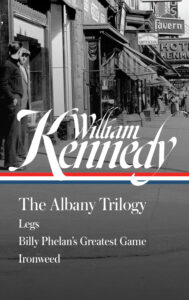
“Three of Kennedy’s novels—Legs (1975), Billy Phelan’s Greatest Game (1978), and Ironweed (1983)—have recently been collected by the Library of America as The Albany Trilogy. These novels exemplify what’s best and most distinctive in his work. Kennedy never stopped believing in the power of the novel to provoke and challenge, but journalism taught him that the form worked best when grounded in the telling naturalistic detail, the vivacious rhythm of everyday talk, and a bracing dose of humor. The result is an unruly, delightful hybrid: the modernist novel as written from the metro desk.
…
“Kennedy was now thinking of writing ‘the big Albany novel.’ He envisioned something along the lines of Ulysses, the portrait of Dublin that James Joyce wanted to be ‘so complete that if the city one day suddenly disappeared from the earth it could be reconstructed’ from its pages. But instead of a single day, Kennedy’s Albany version would encompass two centuries, depicting the Civil War, the growth of capitalism, immigration, Prohibition, the Great Depression, and much else. He imagined a cast of historical figures mingling with ‘a vast crowd of priests, nuns, gamblers, gangsters, mothers, whores, and laboring men, including my father’—all ‘eternally living out their destinies, over and over again.’ This Albany would be a ‘magical place’ making the national as well as the local story ‘visible.’ He made a note to himself: ‘Commit a decade to the creation of this book.’
…
“The time frame of Ironweed overlaps with that of Billy Phelan, and though it retains some of the exuberant malarkey of the earlier novel, it’s a much more somber and lyrical piece of writing. It also steps more confidently into magical realism. Ironweed opens with Francis visiting the graves of his family in St. Agnes Cemetery, unaware that the dead are trying to talk to him. Among them is his baby son, who rests in ‘infantile sublimity, exuding a high gloss induced by early death…. He was neither beautiful nor perfect … but rather an ineffably fabulous presence.’ Francis weeps and prays, then looks up at the sky, where ‘a vast stand of white fleece, brutally bright, moved south to north in the eastern vault of the heavens, a rush of splendid wool to warm the day.’ But the mood doesn’t last. A few chapters on, we see Francis in a friend’s bathroom, smelling his ‘fetid crotch’ and reaching for soap with which to wash his ‘encrusted orifices, crevices, and secret folds.’ Is this the same book? In true Joycean fashion, Ironweed wants both symbolism and naturalism, the elevated language of heaven’s vaults alongside the unadorned details of bodily filth.”
…
“How many readers will complete the cycle? Don’t most of us pick and choose in Balzac, Zola, and Faulkner? And does it matter whether we think of the first three novels as a trilogy or, as Kennedy described them, simply as a ‘trio’ within his larger project? In some ways, there is a strange kind of unity to these three—all are set during the Depression, all feature stylish renegades. In Billy Phelan, the McCall brothers form ‘Albany’s own Trinity,’ while Martin makes a ‘three-horse parlay’ and asks a source who gives him two unprintable statements, ‘Shall we try for three?’ Ironweed has an epigraph from Dante, and its action spans three days, during which Francis reflects on the three women he loved. He was once a professional third baseman, and recalling those days, he thinks of the ‘Trinitarian talisman’ of ‘a hand, a glove, a ball.’ And so on. On the other hand, one of the more frequent recurring insights of these novels is that to be human is to be incomplete.”
–Kasia Boddy on William Kennedy’s Albany Trilogy (Harper’s)
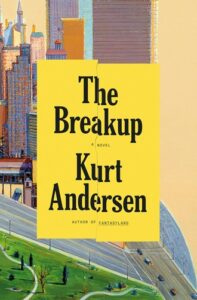
“Novels set in the future aren’t exclusively the province of science fiction; anxious times tend to generate anxious, cautionary literary dystopias, and when was the last time you can remember not feeling anxious? The 20th century in particular abounded in such visions, some of which—The Handmaid’s Tale, or Brave New World, published in 1932 and getting spookier every day—have proved more prophetic than others. They’re best understood, though, not as genuine bets on our future, but as dreamlike unleashings of present-day fear over the blind volatility of the moment. Kurt Andersen, in his new novel The Breakup, does something few such books do (Jon Raymond’s excellent 2022 climate-disaster novel, Denial, comes to mind); he sets his stage not in some distant century when our own problems are the stuff of history, but a mere 19 years from now, when most of his readers are still likely to be around.
…
“It’s a good setup. What’s puzzling is that more than 300 pages of the novel go by before the engine of the Zimbalist family car, and thus of the novel’s plot, finally turns over, and the much-touted road trip begins. Before that comes a vast and dramatically static stretch of what speculative-fiction circles often call ‘world-building’— a full, inventive, elaborately detailed portrait of Andersen’s vision of the next 19 years of American history. It’s fun to read, particularly since it involves the imagined fates of a great many present-day famous people. (Among the many dozens of such cameos, surely one spoiler won’t hurt: Elon Musk dies of an overdose en route to Mars.)
As a novelist, Andersen—whose works of nonfiction include Fantasyland: How America Went Haywire and Evil Geniuses: The Unmaking of America— is more philosopher than plot maker. The will-they-or-won’t-they domestic drama of the Zimbalists, when it finally gets out of the driveway, is less than suspenseful; it is very much like spending a week in a car with three people laughing at a series of inside jokes and then explaining to you why those jokes are funny.
But so what? Domestic dramas are already thick on the ground in American fiction. What readers of The Breakup will come for, in this moment of what seems like unsustainable polarization and anger and wanton trampling of American civic institutions and ideals, is a vision of our near-term future that is violent and admonitory and cathartically terrible and yet somehow still survivable. On that score, Andersen delivers the dopamine hit that has made his previous work best sellers. In his 2045, there’s still a new Sally Rooney novel (one with a very funny title), and the government even offers tax credits to book publishers who hire human beings as copy editors instead of just letting A.I. do it. How dystopian can things be?”
–Jonathan Dee on Kurt Andersen’s The Breakup (The New York Times Book Review)
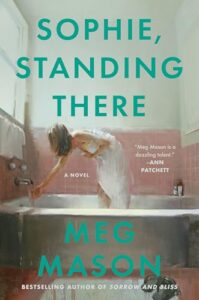
“When Meg Mason’s Sorrow and Bliss was published in 2021, it seemed to infect the reading public. The New Zealander’s third novel—following other works that had slipped into the world without making any noise—sold hundreds of thousands of copies, gathering prize nominations, a screen deal and a tribe of A-list fans. Central to its success was the protagonist Martha Friel, a clever, beautiful and nettlesome British journalist systematically dismantling her marriage on her 40th birthday. The novel was sharply observed, balancing mid-life regret with an unromanticized portrayal of enduring mental illness. Mason managed the high-wire act of rendering clinical depression legible and domestic ruin funny. By Christmas it had been canonized as the pinnacle of ‘sad girl lit’ with Martha taking her place in that post-Fleabag lineage of fractured female characters.
Sorrow and Bliss catapulted Mason…into publishing royalty. But this status must have condemned her to a relentless cycle of literary festivals, given that her new semi-autobiographical novel displays a microscopic interest in their inner workings. It is a bold, if mystifying, artistic choice to spotlight the administrative purgatory of soundchecks, microphone clips and green rooms.
…
“The narrative runs almost entirely on the fumes of over-weighted trivialities. Pages are devoted to cheese sandwich-level dilemmas. You know: should the protagonist get ham or cheese? When and where should she refill her water bottle? For how many seconds should she microwave porridge? Does she have enough phone battery charge? Water bottles, smartphones and microwaves are intended as totems of modern isolation, but Mason lingers over them until they become padding. Where Sorrow and Bliss felt bracingly direct, Sophie, Standing There is an exercise in pedestrian sentiment. Sophie is a wet cardigan of a protagonist—drippy, colorless and so devoid of personality that most of her exchanges with her best friend concern an actual lost cardigan. Readers of Sorrow and Bliss will remember how Martha’s dark history gave her despair a compelling logic. Here, we simply discover that a dull girl is dull for a reason. The long-trauma tease, lurking like a storm cloud over a drought-stricken landscape, drizzles across a few late pages, leaving thirsty readers scrambling for nourishment.
…
“I found myself torn between despair for a publishing industry that ushered this into print, and a strange, euphoric relief at encountering a book so authentically, humanly gauche that it can’t possibly have been written by AI.”
–Johanna Thomas-Corr on Meg Mason’s Sophie, Standing There (The Times)
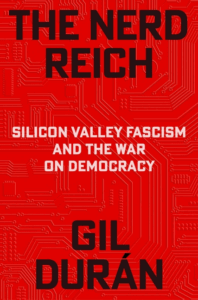
“Unlike most contemporary accounts of Silicon Valley, The Nerd Reich is not a biography, an inquest into a particular business, or a ‘true crime’ accounting; it is an urgent intellectual history of a seemingly inchoate political moment. His project, which connects the rapacious search for profits with the quest for total control over our political, economic, and social lives, reveals that the fever dreams of our tech overlords are borne of a eugenics-friendly, totalitarian current that has long run underneath the surface in the high technology sector. The difference today is that the nerds are done pretending they are beholden to, or accountable to, anyone other than themselves.
…
“What truly binds together this movement is a desire for freedom from, if not total control over, nation-states; a belief in the superiority, either innate or engineered, of a superior class of elite coders and engineers; and a complete rejection of any conception of social responsibility or equality under the law. ‘For many years, these ideas—that nations would collapse, that democracy would become obsolete, that a tech-powered elite would rule through technology—seemed like fringe science fiction fantasy to most observers,’ Durán writes. ‘But they have now become the operating principles of some of the wealthiest and most powerful men in the world and have spawned a movement promoted by a rotating cast of venture capitalists, fringe philosophers, and political operatives who took these ideas from obscure blogs to the halls of power.’
…
“When it comes to the Pentagon, readers may be shocked at the degree to which the government has handed over the reins to the AI companies: Durán details the create of ‘Detachment 201’ in June 2025, which resulted in four executives from Meta, Palantir and OpenAI being inducted into the United States Army reserve at the rank of colonel. These firms are now essentially in charge of crafting American defense policy on artificial intelligence software, autonomous weaponry, and the future of warfare. The fox is truly in the henhouse.
…
“What does work to the book’s advantage is Durán’s methodical approach and consistency of perspective: he does not fall into the all-too-familiar trap of favoring access over accountability, a pitfall that has ensnared countless journalists down the years. Tech reporters are, even at this late stage, still vulnerable to this kind of starry-eyed boosterism, epitomized by Kara Swisher’s decades of gullible, industry-friendly copy and Jonathan Weber’s book-length insider account of the Valley, City on the Edge. The latter, published earlier this year, could have been a useful account of Silicon Valley’s radicalization over the past quarter-century that have turned it into a wealthier, crueler place. Instead, Weber’s fondness for recounting business deals, media inside baseball and the chummy elements of San Francisco’s famously incestuous and cutthroat politics leaves knowledgeable readers scratching their heads at the gaping holes in his account. That’s not the case with The Nerd Reich, which elucidates the higher-level architecture of what motivates the region’s wealthiest power players—and the grave stakes of the moment.”
–Ali Winston on Gil Durán’s The Nerd Reich: Silicon Valley Fascism and the War on Democracy (The Baffler)

If you buy books linked on our site, Lit Hub may earn a commission from Bookshop.org, whose fees support independent bookstores.