Our favorite criticism of the week includes Sadie Stein on Agnieszka Szpila’s Hexes of the Deadwood Forest, Erin Somers on Jay McInerney’s See You on the Other Side, Kristen Roupenian on Marie NDiaye’s The Witch, Ginny Hogan on Caro Claire Burke’s Yesteryear, and Dwight Garner on Nancy Lemann’s The Oyster Diaries.
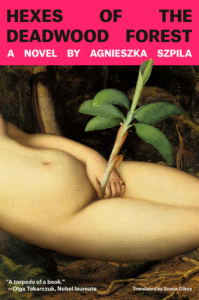
“Let’s start with the content warnings. Hexes of the Deadwood Forest, the best-selling Polish author Agnieszka Szpila’s first book to be translated into English, includes the following: adult themes, adult content, adult language, violence, suicide, sexual assault, torture, murder, genocide, bestiality, cruelty to children, sex with moss, sex with grass, sex with mushrooms, sex with lichens, sex with feathers, sex with rotten vegetables and sex with frozen dirt.
Your final warning? All this gets weirdly tedious.
…
Hexes of the Deadwood Forest, which might be described as a post-porn fever dream of Eastern European magic realism crossed with a plant-based Joy of Sex, was a hit in Poland, where it was published in 2022, and was successfully adapted into a stage production.
But despite an inventive translation from Scotia Gilroy that skips nimbly between registers — and comes up with an astonishing array of ways to describe a vagina — the world Szpila conjures is improbably bloodless (for a book so steeped in bodily fluids), if hallucinatory.
…
At its most ingenious moments, the work lands as not just calumny, but also satire; the high-wire act of its unreliability is occasionally thrilling — and you can’t forget its sheer audacity. As much as an institutional critique, Szpila has given us a parable on the dangers of fanaticism and the necessity of radicalism, and the obvious parallel between the rigidity of belief systems. But often the experience of getting there is more oak bark than calamus rhizome.”
–Sadie Stein on Agnieszka Szpila’s Hexes of the Deadwood Forest (The New York Times Book Review)
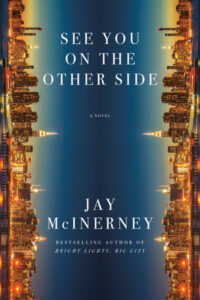
“Plenty of writers spend their careers circling the same preoccupations, the same geographical locations, the same set of human problems. But it is rare to find the novelist who has done so on such a hyper-specific level. At least four of McInerney’s nine novels involve the same neon-lit patch of ground on West Broadway and Thomas Street.
See You on the Other Side is the fourth, and likely the last, in McInerney’s Calloway series, which follows the Manhattan “golden couple” Russell and Corrine Calloway over the course of a long marriage. Reading it, I wondered how McInerney could possibly wring any new observations out of the same neighborhood, social milieu, and marriage. Could he perform a miracle and hit us with something new and profound about the Odeon’s mahogany bar and legendary bathroom, about staying married in spite of Manhattan’s many hazards, about going out in New York and growing old there?
…
After a slow-burn beginning—there is a lot of wondering about whether Covid will arrive—the book rushes to an ending, which deals with the death of a major character. A somewhat lackluster look at how the virus impacted well-heeled Manhattanites who mostly live by the scent of dark roast coffee and expensive bottles of white wine, See You on the Other Side doesn’t appear to offer much besides providing a conclusion for the series, a compulsory finish to what McInerney started more than three decades ago. We see how his golden couple live, but without knowing why.
…
Does See You on the Other Side work on a stand-alone basis? Mostly not … Those readers following the series from the beginning will get some satisfaction in finding out how everyone ends up … But overall, the final book can’t compare to McInerney’s very best work, which is probably Bright Lights, Big City, and it can’t compare even to Brightness Falls. I mourned the softening of his once keen satirical eye. I kept thinking of Patricia Lockwood on John Updike’s oeuvre. ‘I read on and on,’ she wrote, ‘waiting for him to become as good as he had been as a boy.'”
–Erin Somers on Jay McInerney’s See You on the Other Side (The Nation)
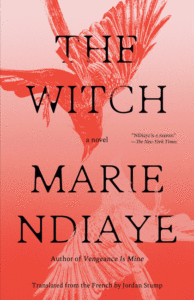
“One of NDiaye’s great strengths is her ability to establish an initial set of circumstances with such authority that the reader is almost powerless to question them. The terms of the story are fixed from the outset, and everything that follows must unfold within the ironclad limits they impose … Opening an NDiaye novel is a little like coming to in the middle of a party after a blackout: the setting may be unfamiliar, but the action is under way, and all you can do is join in.
…
If the story sounds bleak, it isn’t. For all the praise NDiaye has received, I’ve seen little mention, at least in English, of how funny she is … Her work plainly belongs to this lineage of witchy writers, women whose deliciously corrupted scenes of home and hearth produce fear and wild laughter at once.
…
The result is work that asks questions without presenting them as puzzles to be solved. There is no hint of condescension in her writing, which is part of its difficulty and its power. She seems to envision the relationship between reader and writer as an encounter of equals—not demanding that the reader labor toward an answer that the writer already possesses, the way a classroom teacher might, but inviting us to join her on a harrowing journey as she searches for the answers she herself desperately needs. You sense that it’s because the stakes are so high that she can’t afford to pause, to laugh, to grieve, or to explain.
So what is the mystery at the heart of The Witch? What burning question prompted such a headlong pursuit? I finished the novel feeling sure I’d glimpsed it. Clearly, it had something to do with a terrible loss looming over all of us.”
–Kristen Roupenian on Marie NDiaye’s The Witch (The New Yorker)
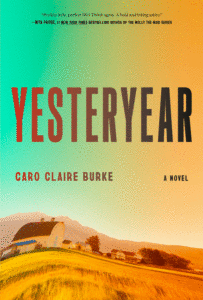
“Online, tradwives show us exactly what they want us to see: the symmetrical sourdough, the candlelit births, the children who play outside all day and yet still have clean hands. Just enough to make us feel as if we’re intimates. But we’re not. There are tradwives whose cows I could name from memory, but I still don’t know how they actually feel about their husbands. Perhaps that’s why Caro Claire Burke’s Yesteryear is so appealing. Her fictionalized account of a famous tradwife might be the closest we’ll get inside a tradwife’s real and imperfect mind.
…
Yesteryear keeps us in Natalie’s head for decades, following two timelines: one in which she mysteriously wakes up in the early 1800s and one in which she ends up the modern face of traditional femininity. Natalie’s voice changes as she grows older. Initially, she’s angry about her humble origins but open to her future. As the book goes on, she becomes more and more jaded … The result of this style is a fully realized character. A girl who thinks she’s better than her hometown but soon learns the rest of the world isn’t so perfect either. A woman who thought marrying into money meant all her problems were solved forever but slowly realizes she has to solve them herself.
And because we know her, there’s no single decision Natalie makes that feels completely unhinged or ill-intentioned. If anything, the events that lead her down a life of anti-feminist advocacy are almost quotidian. She becomes more reactionary when she struggles socially among the liberal elites. (This is also cited as the origin of J.D. Vance’s MAGA turn.) And then, like many millions of women before her, her options swiftly contract for one simple reason: She gets pregnant too young.
By contrast, the real-life tradwives would never let us see what compromises they’ve made. That would defy the whole project: to project an image of quiet assuredness, to assert that their lives are aligned with the natural order of things. So they regale their followers with upbeat stories of why they chose to abandon college in search of an SSRI-free life. The tradwives never express any regrets. There’s never an acknowledgment that they’re cosplaying Betty Draper because they have no other choice, because other doors had shut behind them. They can’t. The whole enterprise would fall apart if they did.”
–Ginny Hogan on Caro Claire Burke’s Yesteryear (The Cut)
“These are books for the misanthropes, the anti-socialites, those with negative self-regard. (You know who you are.) They’ll put you in mind of writers such as Lorrie Moore, Lydia Davis, Mary Robison and Fran Lebowitz, the four horsewomen of the anarchapocalypse. Women who take no bull hockey from anyone.
We’re not used to seeing this sort of voice set free in New Orleans, and that fact is part of Lemann’s considerable charms.
…
In Lemann’s books, as in Joan Didion’s, the whole edifice is always beginning to crumble.
Delery ruminates on her wastrel youth. This novel includes a welcome appearance by an old flame named Claude Collier … Claude has figured in some of Lemann’s earlier novels. His scenes remind you what a fine observer of men Lemann is. He appears to resemble a young Walker Evans and was once the missing link, somehow, between everything that had happened to Delery and everything that might happen.
The Oyster Diaries works, on a surface level, because Lemann is full of shrewd observations about things like bumpy, storm-tossed landings at Louis Armstrong Airport, the naming of hurricanes and why Black women make the best judges.
…
Below and beyond this surface chop, The Oyster Diaries is remorseful and melancholy, and it leaves a wide wake. It’s also a bit scattered and hectic, not Lemann’s best. Yet it’s wide awake. It’s an epic of disgruntlement that’s in touch with life’s little moments of grace. It reminds you that Lemann isn’t just a shining New Orleans writer. She’s a shining American one.”
–Dwight Garner on Nancy Lemann’s The Oyster Diaries (The New York Times)

If you buy books linked on our site, Lit Hub may earn a commission from Bookshop.org, whose fees support independent bookstores.