Our basket of brilliant reviews this week includes, Katy Waldman on Maggie O’Farrell’s Land, Hamilton Cain on Josh Weil’s What Came West, Adam Gopnik on Thomas W. Laqueur’s The Dog’s Gaze: A Visual History, Emmett Rensin on Zayd Ayers Dohrn’s Dangerous, Dirty, Violent, & Young, and José Sanchez on Deborah Baker’s Charlottesville: An American Story.
*
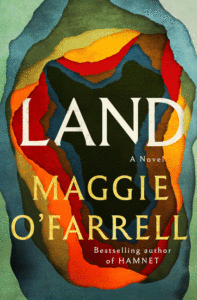
“Why substitute art for life? To put a finer point on it, why write historical fiction—or, at least, this brand of it, crowd-pleasing and immersive in the tradition of Patrick O’Brian or Hilary Mantel—when there is actual history? Maybe, O’Farrell seems to suggest, because it’s fun. If Tomás, in Land, is grimly burdened by responsibility, O’Farrell is expansive, full of vigor; her characters may die of plague or starve in famines, but she appears to be enjoying herself. The book, which spans Rome, Calcutta, and the ‘beleaguered dog-shaped country’ of Ireland, features tart, nurturing mothers, feisty elder sisters, younger sisters of uncommon beauty, telepathic changelings, farseeing Druids, pompous and hypocritical priests, and steadfast hounds. The passions are big and unembarrassed. Characters rush out to sea, assume new identities, push their enemies off cliffs, kiss in alleyways, pull treasure out of the earth.
Historical novelists are often charged with disrespect and unseriousness, of ransacking the archives for sensational scenery to hang behind their conventional family sagas and love stories. Some critics’ squeamishness seems aimed at the act of invention itself, the florid dreaming in the face of reality. The very details that make the genre come alive—the archaic syntax, the outfits, the feelings—are the ones that haven’t survived into the present day or that the writer made up. A historical novel’s most evocative aspects, in other words, tend to be the least real.
…
“Land is less interested in how fantasy may be exchanged for reality than in how the two are complementary. Through its characters, the book stages an argument about the virtues of various types of maps—those that are measured, those that are recollected, those that are dreamed. Some of these approaches require meticulous scholarship and technical proficiency; others, an attunement to the invisible realms of feeling and folklore. The characters’ distinct perspectives overlap to build the world that is the novel. All are useful, all are partial, and none reverse the country’s losses. Rather, the facts ground the fiction, the fiction enlivens the facts, and both work together to suggest that the pursuit of resurrecting the past and the pursuit of telling a good story can, in some cases, be one and the same.”
–Katy Waldman on Maggie O’Farrell’s Land (The New Yorker)
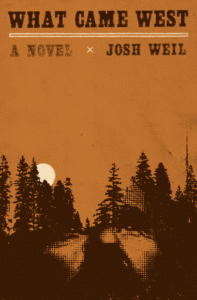
“While literary westerns are full of clichéd outsiders, I don’t believe I’ve met this particular lone wolf before, shut off but startlingly vibrant in his mind. Weil, the author of three previous books, alternates between a lengthy letter Silas scribbles to his son, Elisha, a teenager still in Pennsylvania, and a gory reckoning (narrated in the third person) among peaks and gorges during the autumn of 1849. Lured by gleams in mountain creeks, white settlers are pouring into the West and stirring Silas’s Native neighbors, the Nisenan, to action.
…
“Whose destinies manifest here? Weil suggests that the peoples of America melded (or failed to meld) within a cauldron of suffering, their collective history a saga of bondage and dispossession. That saga includes ecological ruin, such as the hunting of billions of passenger pigeons to extinction in just five decades, the disappearance of bison from ranges and valleys, the clogging of rivers by prospectors panning for gold. Yet sparks of kinship also shape Silas’s tale; he relies on the kindness of strangers and the counsel of his friend, the savvy chief No Rope.
…
“Weil’s divided narrative reflects a divided self, a country divided on the cusp of a cataclysmic civil war, inflamed by slavery and conquest of Indigenous lands. In our 250th anniversary year he steers clear of grandiose pronouncements, allowing Silas’s singular imagination to carry the larger epic. Weil homes in on a parent’s love and desire for a better future: ‘Elisha, do you ever still feel me waiting? Outside your door? My ear to the wood, listening?’ In that moment of waiting—a pause, a catch of breath—lingers the fate of a nation cobbled together by wonder and woe.”
–Hamilton Cain on Josh Weil’s What Came West (The New York Times Book Review)
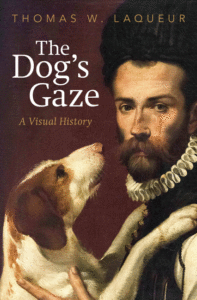
“A dog’s death is like no other. Not worse than any other, of course. But unlike any other, inasmuch as the disparity between the loss and the profound grief it provokes is so bewildering to outsiders and even to those who feel it. When our family Havanese, Butterscotch, died a while ago, after thirteen years of a happy-go-lucky, charming, loving, and greedy existence, I could scarcely walk through Central Park without shutting my eyes, since tears flooded them when I saw other dogs running and playing freely, as she had done for so long. Dog grief somehow passes beyond ‘appropriate’ sadness into unfathomable feeling.
…
“Then, there’s the fact that the dog does not know death until it happens. We understand death as a part of life, and it is our knowledge of mortality that shapes our understanding and makes us human. They don’t. I’m still haunted by our ailing, elderly dog’s large, trusting, liquid eyes looking out at us in the moments before her death: Hey, this is all right, right? We’re just here at this crazy doctor place we go to like always, and then we’re going home? That was what broke my heart. Butterscotch trusted us absolutely, and we were about to kill her. For her own good, because she was suffering so, because her once rich and bounding life had been reduced to a painful daily struggle, all of that. But she was alive and then she wasn’t, and she didn’t understand it and we had done it to her.
That gaze is one I will never forget, and I turned to a new book on that very subject, Thomas W. Laqueur’s wonderful The Dog’s Gaze: A Visual History, with shivering gratitude. ‘Gaze’ has become a loaded word of late, modified in sinister ways by ‘male’ or ‘white,’ with the implication that to gaze is to possess or, more likely, to prey upon. Laqueur’s use is benign: dogs have been bred over millennia to meet our eyes with their own, offering a gaze of gratitude rather than one of appetite or fear. Laqueur takes this simple proposition and shows how it has been institutionalized in art, chiefly in paintings of the highest order but also in posters, photographs, and marginal illustrations. His is a work of immensely humane scholarship.”
–Adam Gopnik on Thomas W. Laqueur’s The Dog’s Gaze: A Visual History (The New Yorker)

“‘If you truly believe human beings everywhere are just as important as those closest to you, then global injustice might start to feel unbearable,’ he writes early on. ‘You may even become willing to sacrifice yourself—or your family—to help people on the other side of the world.’ As the subject of that sacrifice, Ayers Dohrn is trapped between two possibilities: the first is that none of it was worth it, that his parents were monsters who defaced his childhood for nothing. The second is that it was all worth it, that his birth did not herald the beginning of his parents’ world, and that his life was not the central fact of theirs. Of course both possibilities are unbearable. Thus his ambivalence. It is also a good deal easier to sell a sympathetic book about the Weather Underground if you reassure your readers every 30 or 40 pages that of course political violence is wrong.
…
The author’s unresolved and irresolvable Freudian psychodrama aside—despite being billed as a kind of a memoir, Ayers Dohrn’s childhood “in the revolutionary underground” mainly haunts the periphery of what is otherwise a very accomplished biography of his parents—Dangerous, Dirty, Violent, and Young arrives just as the specter of political violence (by which we always mean vaguely left-wing political violence) once again haunts American editorial boards.
…
“Zayd Ayers Dohrn’s book arrives just in time: not as an occasion to seriously entertain the question of whether or not the Weather Underground engaged in justifiable revolutionary struggle against the government of the United States—come on—but to grope once again for a reflexive answer, the obvious answer, the grown-up answer, the answer you yourself may have summoned the moment you suspected this review might find its way around to defending Bill Ayers and Bernardine Dohrn. I will bet the modest but not totally insubstantial sum I’ve been paid to write this review that every mainstream assessment of Dangerous, Dirty, Violent, and Young will find its way around to telling you how dangerous and misguided the Weathermen were before suggesting—sometimes slyly, sometimes explicitly—that there’s a lesson in all of that about our own uncertain times.
They may be right. But there’s something suspicious in any automatic answer. Set aside the need to say no, of course it was all very bad. We’re here anyway. Put down the sense that it is dangerous to ask—worse, that it is unserious, unadult, vaguely embarrassing to ask—for a moment. It’s just a little essay. It’ll be okay. Consider: Did the Weather Underground have a point? Then? Now? Were they a cautionary tale? If so, what is that tale about? Whither the caution? What, precisely, is the lesson here? Was it worth it?
…
“It is possible, of course, to object to any kind of lawlessness and violence, to say that every bomb and bullet carries an unbearable moral hazard, no matter the conditions of the world. But almost nobody is so totalizing in their pacifism. What is particularly obnoxious about the moral case against the Weather Underground is the implication that their limited recourse to violence constituted some unique and inconceivable evil, that Bernardine Dohrn and Bill Ayers crossed lines unimaginable to Henry Kissinger.”
–Emmett Rensin on Zayd Ayers Dohrn’s Dangerous, Dirty, Violent, & Young (Los Angeles Review of Books)
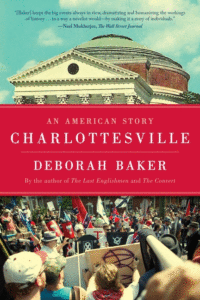
“Deborah Baker’s Charlottesville: An American Story is an in-depth, forensic, and panoramic view of the long road to the Unite the Right rally. Through meticulous detective work and journalistic narrative, Baker shows us that the effort to unite the right goes back decades, incubated alongside Charlottesville’s history of harboring anti-Black reactionaries. After all, looming over the town is Monticello, the estate of the University of Virginia’s founder, Thomas Jefferson. Jefferson, who spoke loftily about liberal ideals like reason and liberty, also (as we all ought to know at this point) owned enslaved Black people and, through rape, fathered children by an enslaved woman named Sally Hemings. Baker looks at the self-satisfying glow of Monticello and the politesse it casts on the city below, revealing the sordid underbelly of the city’s legacy of racial hatred, segregation, and subjugation.
There is something all too American, Baker argues, about believing that bucolic scenery and bourgeois pretensions can keep the repressed and foundational histories of this country’s utmost oppressions at bay. Though often weighed down by their encyclopedic density, the book’s numerous character studies untangle seemingly everything about Charlottesville through the four centuries of its existence, from the town’s colonial-era settlement, founded in racial enslavement, to 20th-century UVA professors espousing eugenics, to the small-town activists who violently fought against court-mandated desegregation orders. By doing so, Baker makes it clear that no one should be surprised that this town was the same place a murderous right-wing rally took place in the 21st century.
…
“Despite being markedly unpopular on nearly every issue, from kleptocratic malfeasance to a metastasizing cost-of-living crisis, MAGA has faced no real opposition. Like the Democratic officials in Charlottesville who repeatedly ignored the threat from violent right-wing reactionaries, the Democratic Party establishment is proving itself to be just as ineffective. Asleep at the congressional wheel, the likes of Hakeem Jeffries and Charles Schumer prefer to scapegoat and castigate the party’s left flank or participate in photo ops with Benjamin Netanyahu, who is carrying out the ultimate goal of far rightists the world over: illiberal attacks on representative and judicial institutions, ethnic cleansing, and, finally, genocide. If Biden truly reckoned with the legacy of Charlottesville, how can we explain all the mass carnage he permitted in Gaza? Liberals and centrists, from 2017 till now, from Charlottesville’s local government to the upper echelons of the Democratic Party, have stumbled and fallen over their commitments to moderation—misapprehending the threat of authoritarianism and enabling its growing strength. And because of liberalism’s failures, Charlottesville has come to the Oval Office.”
–José Sanchez on Deborah Baker’s Charlottesville: An American Story (The Nation)

If you buy books linked on our site, Lit Hub may earn a commission from Bookshop.org, whose fees support independent bookstores.