Our quintet of quality reviews this week includes Hannah Gold on Missouri Williams’ The Vivisectors, Rand Richards Cooper on Joyce Carol Oates’ The Frenzy, Jenessa Abrams on Emily LaBarge’s Dog Days, Lauretta Charlton on Elizabeth Stordeur Pryor’s Something We Said, and Joanna Biggs on Makenna Goodman’s Helen of Nowhere.
*
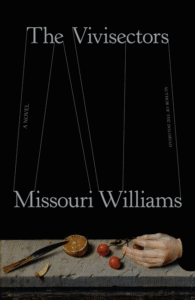
“Could the character of Agathe be intended as satirical? A sly sendup of a power-tripping 4chan-poster type, a lady gooner getting off on resentful fantasies of her innate superiority and heightened intelligence? Given her compulsive contrarianism, and the absence of characters who are significantly different from her, it’s tricky to gauge the novel’s level of self-awareness. The world of the novel, as far as we know, matches Agathe’s description of it perfectly. It is presented in earnest, and never more so than when it broods upon the subject of Adam, a troubled and aggressive young man who enjoys discussing the importance of aqueducts to ancient civilizations.
…
“In a piece for The Drift in 2022, Williams wrote with approval that the novelists she was reading were eschewing ‘content’ for form and ‘the internet’ for ‘higher things.’ Citing Pure Colour, by Sheila Heti, and Checkout 19, by Claire-Louise Bennett, as successful case studies, she argued that ‘reading the internet is less important than reading God’s book, also known as the world.’ One can imagine that some of this same intent lies behind Williams’s creation of Agathe, who excoriates the noisy proliferation of opinions at the university and venerates nature for its mute surfaces and stubborn, occult power.
…
“And yet The Vivisectors still feels unhelpfully caught in the crosshairs of the internet, and not only because of the many trollish remarks that appear in its pages. One of the narrator’s complaints about literature is ‘that books had emptied along with the world that contained them because now almost everything that mattered to us took place inside our devices, on the abstract territories of the internet.’ Is The Vivisectors disparaging this sort of ’emptied’ novel, or attempting to give it newfound spiritual relevance? I tend to think it’s the latter. Either way, abstraction wins out.
“Williams may have meant for Agathe’s romantic entanglement with Adam to represent emotional growth, but the ending, arriving as it does after all that prolific hating, feels tacked on, and doesn’t overcome the novel’s predominant style, a calculated avoidance that manifests as faces that can’t quite be made out, voices that can’t quite be heard, plots and personalities shot through with holes. The Vivisectors quashes substance in its search for higher things. And yet it has a redemptive streak: its search for a language of spirituality, as opposed to intellect, is an intriguing and ambitious one. One hopes that in the future this literary impulse will take root and flourish.”
–Hannah Gold on Missouri Williams’ The Vivisectors (The New Yorker)
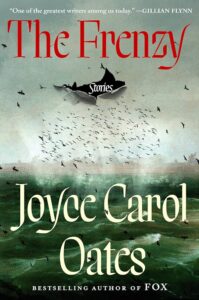
“Whether looming in dark gothic tales or permeating what might seem a sunny suburban world, dread stalks the fiction of Joyce Carol Oates—a writer who ‘can’t ever get enough of fear and loathing in familiar surroundings,’ as her fan John Updike once said. So it is with the nine narratives in The Frenzy, the 49th story collection (along with more than 60 novels!) published by this freakishly prolific author.
…
“Halfway through the collection, I found myself longing for a plot in which violence and harm play no role. But Oates is implacable. One narrative offers an excruciating description of damage done to a girl in a car crash. Another inspects the cruelty that cancer inflicts on the face of a child (‘a face that might have been broken into two asymmetrical halves, then forced together again, like broken crockery.’) Oates is a highly cinematic writer, and we navigate these passages feeling the urge to cover our eyes.
…
“Oates’s prose comes with certain quirks: abbreviated sentences that lend an odd, breathless quality; parenthetical authorial elaborations; multiple choice options conveyed via ‘if/when’; liberal sprinklings of exclamation points; and a curious habit of seemingly random italicization (‘Juliet knew they were not twins. In fact they were not even sisters but something called cousins’). There are wholly unexpected swerves: A third of the way through one story, the protagonist suddenly dies, only to continue as a ghost. Oates sometimes seems like a writer improvising as she goes, as if she simply gets in the car of her narrative and drives off, with no road map.
Yet these stories are nothing if not engaging. Like the dire predicaments they unfurl, they are spurred by a dark, relentless force. You want to keep reading. Even with eyes half covered.”
–Rand Richards Cooper on Joyce Carol Oates’ The Frenzy (The New York Times Book Review)
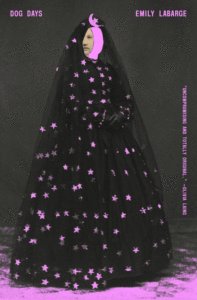
“The reader is given neither context for nor emotional access to the happening, later known as ‘The Event,’ before becoming immersed in its pervasive occupation of LaBarge’s mind and body. This at once disorienting and commanding narrative choice foreshadows the book’s formal construction: a kaleidoscope of memoir, literary analysis, etymology, psychological and philosophical examination, and film criticism.
…
“Experiencing trauma, then living as its constant companion, is much like being left in a room you can’t remember entering, a room whose exit is unreachable, a room where you have the distinct sensation of being watched while simultaneously feeling completely alone. Trauma’s intensity and unknowable nature are perhaps what gives us the imperative to try to communicate it. In the act of telling, there is the potential for transmutation, the often (but not always) false promise of healing.
The fragmentation of traumatic experience and of the psyche of the trauma survivor (though the term ‘survivor’ is itself embedded in a false hierarchy) is mirrored in Dog Days’ experimental form. LaBarge frequently interrupts the telling to braid her narrative so tautly with those of others that their language blurs together, quotation marks vanishing, lines of demarcation eroding. At one moment, we are in the midst of a line-level analysis of a Lorrie Moore short story, and then we are meditating on the sensation that ‘something undefinable is missing, has been lost, in which there is some shapeless hole to be filled,’ both within Moore’s story and within LaBarge’s mind and body. Then we are thrust into the dueling psychoanalytic philosophies of Sigmund Freud and Bessel van der Kolk on whether it is therapeutic to share one’s trauma with others.
…
LaBarge’s narrative contradicts itself with great frequency and intentionality, calling attention to the fallibility of memory in the face of trauma. It can feel impossible to be certain what one has experienced, as opposed to what one has imagined, when instances of otherworldly violence disrupt our understanding of reason, sense, and order.
…
“Who is coming to dissolve the narrative of LaBarge’s trauma? To release it? Dog Days is at once a profoundly personal account and an utterly political one in its implications for our many current global crises of human violation. How we speak of them. To whom. Using what language.”
–Jenessa Abrams on Emily LaBarge’s Dog Days (Los Angeles Review of Books)
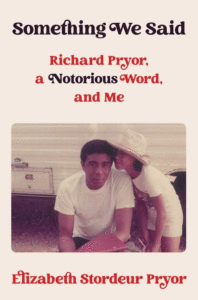
“On its surface, Something We Said is a family memoir written by Elizabeth Stordeur Pryor, the daughter of the comedian Richard Pryor. But it is probably better described as a book about who can and can’t say the n-word. (The word does not appear in the book.) I would like to tell you it is a book about language and the ways in which language evolves and how it is important not to think of a single word as though it were trapped in amber, its meaning unchanged despite all evidence to the contrary. Instead, I’ll describe the book that I read.
…
“But the citation of a TED Talk as a crowning achievement isn’t what saddens me most about this trim and at times courageous memoir. It is the yearning in Pryor’s voice as she writes of her attempts to better understand her father and thus herself through the prism of race and racism. Growing up mixed race in Nixon’s America, she was privileged and sheltered and confused. She frequently describes how she would suck her thumb to comfort herself in difficult situations, even as a preteen. She recalls telling white students in prep school that they should call her ‘n***er. Or n*g.’
What struck me as the most telling part of Something We Said was not an exchange that Pryor had with her father or her peers, but one she had with her mother. During an argument, her mother called her the n-word, a moment that Pryor writes would ‘stay with me forever.’ And yet, she doesn’t dwell on it in the book, choosing to focus on the relationship she had with her father, who eventually vowed to stop using the n-word in his comedy after a 1979 trip to Kenya.
Failing to closely examine the word being wielded like a dagger by one’s own white mother is a shame and a disappointment. Perhaps Pryor was looking in all the wrong places on her quest to self-discovery and the ultimate understanding of all things n-word. As James Baldwin said, it’s not the job of Black people to explain why white people invented and are in such a hurry to use the n-word. That’s for white people to figure out.”
–Lauretta Charlton on Elizabeth Stordeur Pryor’s Something We Said: Richard Pryor, a Notorious Word, and Me (The New York Times)
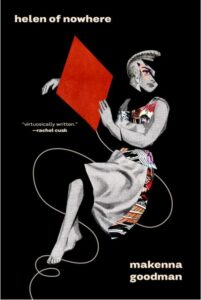
“Makenna Goodman’s new novel Helen of Nowhere has been called ‘the perfect fairytale for our times,’ but an age like ours needs myths more than fairy tales. The outsize failings of the men in power demand a grand reimagining of the consequences of those failings, and Helen of Nowhere offers up, exhilaratingly and naughtily, a myth for the man who needs to be shuffled offstage one way or another. Goodman has said that the novel took shape in her mind after the murder of George Floyd, when she was working at a boarding school in rural Vermont and students were asking to be taught new ideas by new faculty. But what to do with the teachers who had fallen behind the times? Could they change? What would good change even look like? The myth Goodman has chosen to ironize isn’t Greek at all but American: the good life of reading, walking, and thinking in a cabin by a pond; the lure of the fresh start, the virgin soil, nature divine. A man flees the city for the country, like Thoreau. Will he manage to leave his troubles behind him?
…
“It’s no coincidence that Goodman has also given Helen of Nowhere the apparatus of a play. Before the man even speaks, we are provided with a dramatis personae: along with Man, we will meet Realtor, Helen, and Wife. Then we are given a list of acts, which alerts us that we won’t hear from Wife until Act Five; Act Six, we learn, will feature Man and Wife together. Like the assignment by the man’s most brilliant student or the Oedipus trilogy, which was performed in Athens’s outdoor theaters in the fifth century BCE, Helen of Nowhere will end up transforming the man at its center beyond his imagining.
…
“In a play such as David Mamet’s Oleanna (1992), about a conflict between a successful male professor and a struggling female student, the man might be confronted more directly onstage. But Helen of Nowhere owes more to the closet drama, a play meant for reading rather than performing. The structure works to subdue the man’s speech by pushing other characters into the limelight even as he remains onstage, reminding the reader that we know only what these other characters are saying, not what they’re thinking. It’s as if the man believes this were a novel about him and the tragic, misunderstood end to his career, but the novel knows that it is a multivocal drama about the problem of change. Goodman’s prose is clear rather than complex, and carefully calibrated to each of her characters; the book’s form corrals the natural speed of her sentences into act-length shapes that one moves around in one’s head like puzzle pieces. In reading Helen of Nowhere, I had thoughts in the back of my mind that more usually come up in the theater: Who hasn’t yet spoken to whom? How on earth is this going to end?
…
“Perhaps Goodman’s novel is saying that the only way for a disgraced man to be returned to society would be for him to experience being at the bottom of the pile first. (Or is Goodman cheekily saying that perhaps women would be happier sharing their beds with dogs—as Celeste does on Instagram and as the wife will now do—rather than men?) Perhaps we simply cannot yet imagine a man who would be willing to listen to those around him and attempt, however imperfectly, to change the way he loves by willingly engaging in a struggle between two equals.”
–Joanna Biggs on Makenna Goodman’s Helen of Nowhere (New York Review of Books)

If you buy books linked on our site, Lit Hub may earn a commission from Bookshop.org, whose fees support independent bookstores.