Our feast of fabulous reviews this week includes Jessica Bennett on MJ Corey’s Dekonstructing the Kardashians, Lily Meyer on Karen Tei Yamashita’s Questions 27 & 28, Ron Charles on Maggie O’Farrell’s Land, Stephanie Wambugu on Vigdis Hjorth’s Repetition, and Fatima Bhutto on Meena Kandasamy’s Fieldwork as a Sex Object.
*
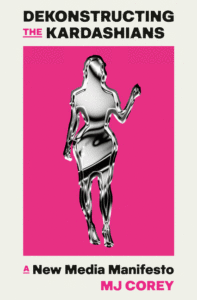
“As Corey knows, the Kardashians don’t just reflect the zeitgeist, they create it, influencing the ways we spend our money, think about our bodies and understand online identity. Yet, Corey writes, there remains a kind of cultural condescension when it comes to studying their appeal. ‘We should probably try a little harder to understand exactly how and why they’ve managed to pull this off—and question what it says about us.’
The book is Corey’s attempt to do that, interweaving memes and lore with the philosophies of theorists like Walter Benjamin, Marshall McLuhan and Thorstein Veblen. These names, and a litany of others, are a through line of the book, as Corey aims to show how the Kardashians, and especially Kim, function as a ‘blueprint’ for ‘postmodern iconicity’; their rise ‘a composite of historical touch points, media tropes and shifting identities’ that can be reproduced and recycled and remixed on command.
…
“There is, at times, a kind of punishing density to this approach—a layering of theory on top of theory that can feel like graduate school homework. But if you can push through, there is also real insight. One particularly compelling framework plays on the idea of the family—again, especially Kim, as cultural shape-shifters.
…
“It is tricky to translate years of short-form video content into readable book form. And while Corey’s ambition is undeniable—there’s a chapter that draws connections between Disney, the gulf war and the way Kim presents her ethnicity—and her meta-analysis often genuinely persuasive, it can be easy to get lost in a dizzying amount of scholarship, blended with a sometimes fragmented structure. Too often, the book can feel like intellectual over-performance, without the conversational tone or playfulness of the original Kolloquium. One wonders if Corey felt the need to prove something on the page, and in that sense maybe she has succeeded—to insist, to all those detractors, that the Kardashians really are worth taking seriously.”
–Jessica Bennett on MJ Corey’s Dekonstructing the Kardashians (The New York Times Book Review)
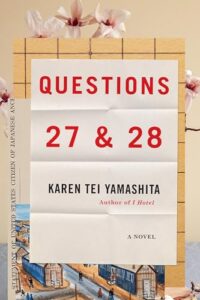
“The novel roves through time, space, and literary styles to tell stories of many Japanese immigrants and their descendants in the United States. She brings to life nearly 100 people who were interned—or their ancestors were, or their children, or their legal clients, or a wide range of other connections. All of these stories merge into a sprawling exploration of what it was like to have to answer the loyalty questions, and how those questions echo through American history to this day.
…
“Questions 27 & 28 doesn’t take a side in the arguments it brings to life, though it does, unsurprisingly, take a clear stance against the “damned questionnaire” and the pain it caused. What seems to interest Yamashita most is the awful experience of guessing how to answer the questions. In fact, guesswork is core to both the plot of Questions 27 & 28 and the experience of reading it. Yamashita’s mixture of archival material and original fiction can be disorienting, and so can the book’s cacophony of voices. They require an alert audience. So does her strategy of releasing information in covert drips, often not revealing facts until the reader has likely figured them out. Even the questionnaire itself doesn’t appear until long after characters start to discuss it.
In the realm of historical fiction, these tactics are highly unusual. By and large, novels that dig into the past charge their readers to learn and remember rather than analyze. But with Questions 27 & 28, Yamashita is not just seeking to interpret the loyalty debate, and perhaps the experience of internment, by writing fiction about it. She is also challenging her readers to do the interpreting themselves—to join her in deciphering history.
…
“She also rejects the prospect of a single, stable story about the loyalty questions. Instead, she challenges her readers to join in the reconstruction of a debate, and a moment of the U.S.’s past, too complicated to understand or remember entirely. By compelling her audience to try alongside her, she shares the frustration of the attempt, but she also shares her own determination. In order to read Questions 27 & 28, you have to commit, if only for the length of the novel, to the messy project of American history.”
–Lily Meyer on Karen Tei Yamashita’s Questions 27 & 28 (The Atlantic)
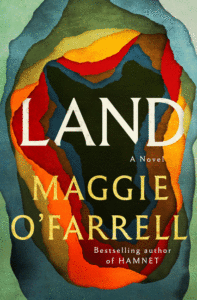
“As she demonstrated in Hamnet, her magnificent novel about the death of Shakespeare’s only son, O’Farrell once again opens up the past like she’s cracking a geode. Suddenly, the undulating fields are sparkling in the moist air, redolent with the incongruous scents of peat and political oppression.
…
“Readers of Land will experience that same mystical transportation. Like a skylark periodically wheeling from its path, this story sometimes flies into other timelines, past and future, here and around the world. (In fact, for several pages deep in the novel, O’Farrell switches to a bird’s perspective.) And in the most historically distant section, we see the lives of ancient people who sacrificed their loved ones, seeding this land with passions that still seep up through the boggy soil. There’s more than a touch here of Daniel Mason’s 2023 novel, North Woods, which observed a plot of western Massachusetts for 400 years.
…
“O’Farrell is not just telling a 19th-century story, she’s tilling the fields of those great Victorian novelists who understood that the only thing that redeems the contrivance of an unlikely coincidence is the pleasurable shock it gives us. When Jane Eyre collapses near the home of her cousins or when Tess slips her confession under Angel’s carpet, incredulity is instantly swallowed up in the relief or despair that readers of Land will experience at a chance meeting or—no, no, no—a missed one. It’s no wonder Liza Marshall, the producer of Hamnet, has already secured the film rights.
This, after all, is the novelist’s mapping, what Liam later thinks of as the ‘peculiar mix of science and storytelling, mathematics and artistry.’ By the end of Land, no matter what your ancestry, these are your people. ‘When we die, we surrender our bodies to the earth and we become earth,’ Tomás says. ‘It is the end of one story but the beginning of another.’ O’Farrell has tenderly gathered them up.”
–Ron Charles on Maggie O’Farrell’s Land (Ron Charles Substack)
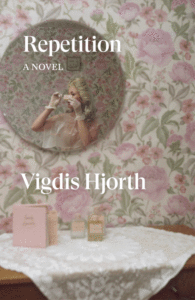
“There is such a glut of unhinged female narrators in contemporary fiction that a recognizable microgenre is emerging around these often self-infantilized madwomen. My Year of Rest and Relaxation and its many imitators treat the instability and anhedonia of women as a source of self-deprecating comedy and little else. However enfeebled they have been made by their childhoods, their lovesickness, or their inability to cope with the social role they have been slotted into, Vigdis Hjorth’s protagonists face their problems—existential, psychological, or material—as adult women with a plausible mix of agency and unrestraint. Today, that is an exceptional quality.
…
“We come to understand literary characters by the choices they make, or fail to make. Volition is the most important element of a story, of a life. In an interview, Hjorth recalls reading Kierkegaard while taking a flight during a personal breakdown, on the brink of a divorce. Both Hjorth’s Long Live the Post Horn! and Repetition borrow their titles from Kierkegaard, and through his work she has come to understand that ‘being an ordinary human being is an enormous task,’ which is to be taken up with ‘complete sincerity and utmost responsibility.’ This insight permeates Hjorth’s novels. One understands, through her characters’ ruminations, that these women are struggling to face the challenge of being alive.
…
“Across Hjorth’s novels, characters utter a variation of the sentence ‘It isn’t easy being human.’ It is most forceful when delivered by the father in Repetition, after he opens his daughter’s diary and finds a fabricated account of her losing her virginity. He reads it with the knowledge that he has sexually assaulted his daughter, a fact that was unavailable and buried in the recesses of her mind when she wrote the entry. In the imagined sexual encounter she crafts to express her vivid inner life, we see the early stirrings of the writer the girl will one day become. Assuming that the account in her journal is true, her father goes out and drinks himself into a ‘paralytic’ state. He returns home, repeating ‘it isn’t easy being human.’ The line is also spoken by a bereaved coworker named Rolf in Long Live the Post Horn! but coming from the drunk and guilty patriarch, it has a heightened force. It is positioned somewhere between an intoxicated confession, a cry for absolution, and a desperate defense. Hjorth offers no explicit interpretation. The novelist-narrator of Repetition, who is in her sixties, reflects on hearing these words and concludes that they are ‘perfectly true and the most beautiful I ever heard him say.’ That she puts this declaration in the mouth of a parent who has committed the most heinous offense one can against a child, other than maybe infanticide, and celebrates the truthfulness of the utterance is a sign of Hjorth’s powerful ability to regard all people as capable of depravity and also worthy of a kind of transcendent grace. It is one thing for a victim in fiction to be permitted to disclose the horrors he has experienced; it is another to allow an aggressor to disclose the horrors he has perpetrated. In her fiction, the categories of victim and aggressor are not mutually exclusive.”
–Stephanie Wambugu on Vigdis Hjorth’s Repetition (Bookforum)
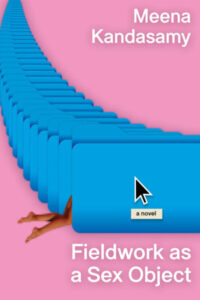
“We can all agree that the internet today, especially two particular platforms owned by the world’s greatest megalomaniacs, is a hellscape. But if you think X and Facebook are purgatories of friendless trolls endlessly posting hate and bullying women, each other and minorities under the guise of free speech, wait till you experience the Indian version of that netherworld, as captured by novelist and poet Meena Kandasamy. Take the worst algorithms in the world, add a billion-and-a-half people, mix in a far-right government with advanced internet skills and bring on the ‘burning ghats of Indian politics’ that include caste and misogyny as well as roiling ethnic and religious antagonisms, and the western version of X begins to look like a children’s playground.
…
“Kandasamy is one of India’s most exciting writers precisely because she doesn’t pull any punches—on the contrary, she really packs them in. ‘What do you label a closet Andrew Tate who worships Modi and only talks about “India Hindu again”?’ Amy asks, knowing full well the answer. You’d call him an incel. But he’d have to be white in order to be pathologized in such a neat and tidy way. While India’s media landscape has largely retreated in the face of the Hindu right’s fascism, Kandasamy is one of the few consistently at the barricades. The novel could have done with less Marxist praxis schmraxis—I’m not sure deepfakes need a dialectic—and there was a lot of internet language, which perhaps we are a little oversaturated with already, iykyk, imo. Otherwise, the personal and the political are blended in all their twisted forms, and I know that I am among many fans who can’t wait to see what Kandasamy does next.”
–Fatima Bhutto on Meena Kandasamy’s Fieldwork as a Sex Object (The Guardian)

If you buy books linked on our site, Lit Hub may earn a commission from Bookshop.org, whose fees support independent bookstores.