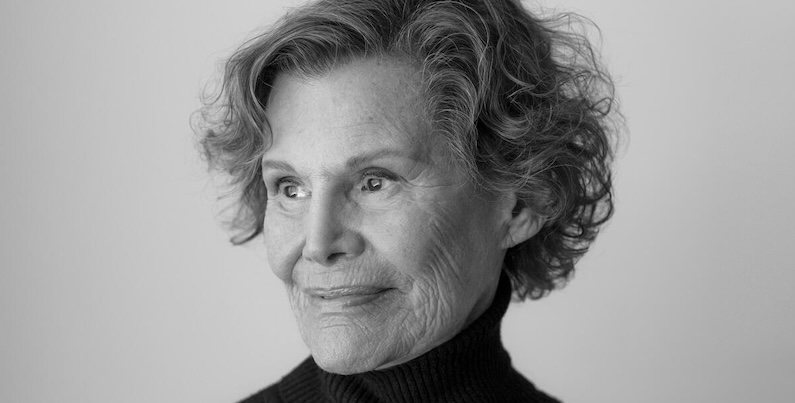
Our favorite criticism of the week includes Katy Waldman on Mark Oppenheimer’s Judy Blume: A Life, Dwight Garner on Mieko Kawakami’s Sisters in Yellow, George Packer on Noam Scheiber’s Mutiny, Priscilla Gilman on Louise Erdich’s Python’s Kiss, and Raphael Cormack on Hannah Lillith Assadi’s Paradiso 17.
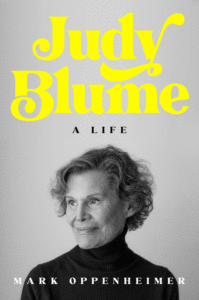
“In 2022, Blume agreed to let [Oppenheimer] write her biography—not an authorized one, exactly, but one fed by extensive interviews with her and her circle as well as by notes that she’d compiled for her own scrapped memoir. On March 8th, two days before the book’s release, the Times reported that Blume and Oppenheimer had fallen out over Judy Blume: A Life, which Blume is not promoting … Blume might have probed this kind of opaque friendship breakup in one of her novels. But fans of schoolyard intrigue (and thus literary scandal) will be disappointed by the biography’s respectful sense of duty toward its subject. If anything, Oppenheimer can be overly besotted.
…
If the biography has a critical failing, it’s that it brushes aside this critique of Blume’s work: that she was not boundary-pushing enough, content to redefine what counted as a regular childhood, shift its borders around, but not abolish it. Oppenheimer lauds Blume for offering readers an unadorned image of themselves and their lives, but Blume didn’t become America’s mom, as she’s been dubbed—a guiding figure for Molly Ringwald, Lena Dunham, Jenna Bush Hager, and tens of millions of girls and women—by representing the facts of childhood and adolescence with a grown-up ambiguity. She did it by portraying those facts—from underarm hair to girls being teased about their weight—as reassuringly typical.
…
The biography’s admiring stance toward its subject doesn’t preclude material that Blume herself might have bristled at: there are candid discussions of the two abortions she had while married to her second husband, Tom Kitchens … There are discrepancies between Blume’s and others’ accounts of delicate situations, such as the erotically exploratory all-girl sleepovers she went on as a kid, and whether she encouraged her seventh-grade clique to ostracize her friend Ronne, the one with the snobbish mother.
…
But it’s hard to pin the breach on any one thing. None of the revelations feels especially explosive. Easier, maybe, to imagine Blume rejecting the general proposition of an author biography, which seeks to root a subject’s work in their specific experiences, dislodging them from a supposedly neutral or unmarked position. If a writer’s novels present the parts of her that she is willing to show, a biographer’s job is to recover what has been swept out of sight: those vivid, occasionally unsettling details that isolate and define her, and that risk placing her beyond the pale. A family is always a bit of a fantasy, requiring some realist puncturing. Every good biographer, then, is a problem child.”
–Katy Waldman on Mark Oppenheimer’s Judy Blume: A Life (The New Yorker)
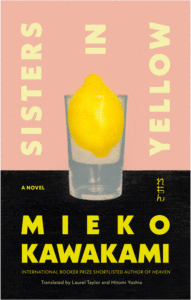
“Sisters in Yellow, translated by Laurel Taylor and Hitomi Yoshio, is about Hana, mostly, but it’s also about several other young women like her. They grew up poor; they have few friends and only distant family; they work in bars or as the ‘compensated daters’ of much older men. They’re floaters, tough-stemmed flowers, often without official papers. They exist along society’s margins.
Kawakami defines them in part by the convenience-store food they eat. There are more scenes in McDonald’s in this book, I think, than in any other novel I’ve read. Chicken McNuggets have rarely sounded more appetizing, more familiar and reassuring. Hana and some friends turn to crime (credit card scams) and the pressure on them keeps mounting.
…
Kawakami’s novels are not unlike Theodore Dreiser’s in their realism, and at 429 pages, Sisters in Yellow is Dreiserian in its sprawl. The book displays a gift for confident, if rambling, storytelling, and the details pile up convincingly.
Yet the novel refused to come alive in my hands. I never felt lucky to be reading it — the ultimate test of a novel, I suppose. Kawakami’s work, at least in translation, does not have much to offer on a sentence level. Texture, depth and grainy intellection are absent. The sentences swim and skim like surface bugs.
The dialogue frequently reads as if it’s been taken from an updated version of the Nancy Drew books (I preferred them to the Hardy Boys) I read as a child.
…
Despite my mixed feelings about Sisters in Yellow, I have a feeling I won’t forget Hana, perpetually running up life’s down escalator, willing to try anything to scrape together a little happiness.”
–Dwight Garner on Mieko Kawakami’s Sisters in Yellow (The New York Times)
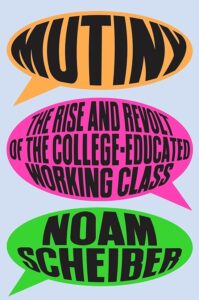
“What is life like for someone born in the 21st century? Your everyday reality is disorienting change—but not the kind that freed Lippmann and his generation to shape their era. Instead, your overwhelming feeling is that the game is rigged against you. You see the old as at best indifferent, if not outright predatory, and lacking the ability or the desire to solve the problems they’ve inflicted on you.
…
A college-educated working class sounds like an oxymoron because socioeconomic status is generally defined by education and believed to rise with each academic degree. In recent years, a college education has become one of the most reliable indicators of both economic well-being and voting behavior.
…
Scheiber’s main interest is the development of a radical political consciousness in a generation of phone addicts and Netflix junkies … This new awareness, whether or not it qualifies them as bona fide members of the working class, leads them to join union-organizing drives, publicize corporate abuses, go on strike, and gradually find more purpose in labor activism than in their thwarted professional ambitions.
…
The radicalization of college-educated Americans who have begun to live the unpleasant realities of their less privileged compatriots—who can hardly afford rent, much less to buy a house and start a family—is an encouraging turn. They could form part of a broader social movement that finally addresses our deepest problems instead of dissolving them in electronic bile.”
–George Packer on Noam Scheiber’s Mutiny (The Atlantic)
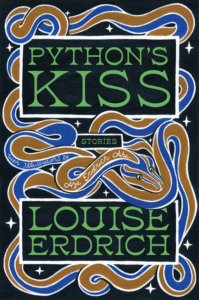
“Erdrich’s new collection of stories written over 20 years, testifies to the intrepidity of her explorations and her commitment to blurring boundaries and unsettling conventional oppositions in thrilling ways.
The titular story, from the perspective of a woman looking back at an epochal few weeks when she was 8 years old, unsettles boundaries of gender and the human-animal divide in ways that set the tone for the entire collection.
…
Erdrich cares for them all; her enormous heart has room for all aspects of creation, all creatures great and small, from the mother to the murderer. The intricate yet vast tapestry of her work’s implications emerges from the near contradiction of her perspective and her mode. The steady, unwavering empathy of her gaze encompasses a universe of tiny, interlaced incidents in which the zany entwines the plaintive, or the tragic the comic. Ouroboros-like, Erdrich is in continual, self-devouring motion and thus presents a kind of constancy of transmutation — identity itself becomes a variable in the endless calculation of renewal. This is storytelling as wisdom magic: These are wonders to be cherished and pondered.”
–Priscilla Gilman on Louise Erdich’s Python’s Kiss (The Boston Globe)
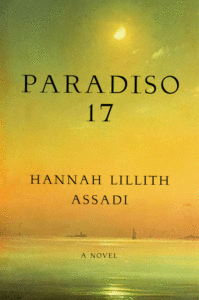
“This is a novel about exile – that ghostly state full of contradictions. Exile is easy to romanticise: it can be beautiful, intellectually productive, even liberating. Some of the greatest works of literature and thought ever produced were made by exiles … The unique relationship to the world brought about by displacement – never ‘here’ nor ‘there’ – defines the life of an exile. Some prosper and some suffer. None are unmarked.
…
Assadi’s writing is excellent – the kind that is often described as ‘lyrical’ or ‘haunting’. It asks for some work on the part the reader but never too much and, though it is not heavily plot-driven, we never get bogged down in turgid prose that goes nowhere. Palestinian, Arabic and Italian drift in and out of English, sometimes with little or no explanation, but, stylistically, the text sits firmly within the conventions of 21st-century English prose.
…
If this all sounds like a depressing book, well, it is. But not relentlessly. Paradiso 17 isn’t funny but there are moments of levity and of beauty. There is hope and connection through the generations. There is even, occasionally, love. Yet all of these things are experienced through the fog of exile, leaving them changed and oddly unidentifiable.”
–Raphael Cormack on Hannah Lillith Assadi’s Paradiso 17 (The New Statesman)

If you buy books linked on our site, Lit Hub may earn a commission from Bookshop.org, whose fees support independent bookstores.