Our basket of brilliant reviews this week includes Alexandra Jacobs on Lauren Groff’s Brawler, Ed Burmila on Gavin Newsom’s Young Man in a Hurry, Alex Shephard on Danny Funt’s Everybody Loses, Anahid Nersessian on Peter E. Gordon’s Walter Benjamin: The Pearl Diver, and Michael Greenberg on Mario Vargas Llosa’s I Give You My Silence.
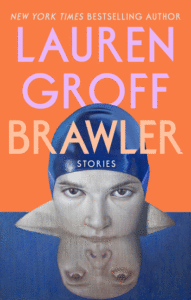
“Some practitioners of the short story, a form in flux that’s suffered since the erosion of magazines, are praised for their polish and compactness. Lauren Groff produces rough beasts that slouch off in unexpected directions and spawn. There’s often a little story within the story, a joey in a marsupial pouch.
…
“Brawler is her third collection of stories. There are nine of them, like the ‘Nine Stories’ volumes published by both Nabokov and Salinger. Most of hers, like Salinger’s, were first published in The New Yorker; they seem like a homecoming, and honestly, something of a relief. If they have a shared theme, it is how the bedrock of family crumbles, and its members are forced to shift into new formations, occasionally tectonic.
The stories are folksy, a little retro and sensual, with multiple dips into earthy, furtive lesbian lust: the buzz-cut gardening instructor who teaches a depressed perimenopausal wife about compost, and flirts; the mother named Anais who escaped domestic abuse, mainlines turmeric and leans in for a smelly kiss; teenage fumblings on a green shag carpet.
…
“The most haunting story—while we’re handing out yearbook superlatives—is ‘To Sunland,’ set in the 1950s, about a sister dropping off her intellectually disabled older brother at an institution before she heads to college. Their mother has died recently, and the siblings are perceiving and grieving this differently, but there’s continuity as we encounter a thief, a sexual opportunist and the women in white who seem to the brother like they could be emissaries from heaven.”The stories in Brawler are, again, rough, in all senses of the word. Upsetting; uneven. But ‘no writer worth his salt is even, or can be,’ Eudora Welty wrote, reviewing Salinger’s lonely nine in these pages. And Groff is spilling so much salt right now, Morton should give her a jingle.”
–Alexandra Jacobs on Lauren Groff’s Brawler: Stories (The New York Times)
“If you’ve ever enjoyed the lark of visiting a museum dedicated to a single company—say, the Spam Museum (Austin, Minnesota; five stars), the Dr. Pepper Museum and Free Enterprise Institute (Waco, Texas; not recommended), or World of Coca-Cola (Atlanta)—you know well the slight embarrassment of having paid to be propagandized. You surrender the cost of entry, and in return you are shown what amounts to corporate P.R., a well-crafted version of the American success story emphasizing the genius of The Founder, the hard work that led the company to the top, and its generous sense of social responsibility. You take it in knowing exactly the kind of details that might have been left out: the government subsidies, the labor abuses, the environmental carelessness that preceded the more recent Going Green initiative, and so on. The experience must be entertaining and pleasant because, by definition, it cannot be truly informative.
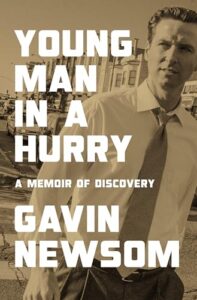
That’s political memoir as a genre, minus the entertainment, and Gavin Newsom’s Young Man in a Hurry: A Memoir of Discovery is no exception. There is a place, perhaps, for reflections at the tail end of a long and accomplished career. But as a midlife and midcareer component of a relentless climb toward the top, it cannot but disappoint. No matter how good the writing, the fact that the reader has parted with the cost of a hardcover book to read what amounts to a self-serving press release from the ambitious leaves, at best, the same I-fell-for-it feeling imparted by the threshold of the gift shop at the Caterpillar Visitors Center (Peoria, Illinois; for tractor enthusiasts only).
…
“With political accomplishments in hand and greater ones in his possible future, this memoir is supposed to set the record straight. It tries to do so in the most puzzling and counterproductive way, with a bizarre mélange of attempts at Everyman credentials (he attended public schools; his mom took in lodgers and juggled multiple jobs alongside parenting) followed by an anecdote from the rarefied world of privilege on almost every page.
…
“If, as with most books by political figures, the goal is simply to generate press and signal his eligibility for a run for higher office, perhaps it will work. But nobody who reads the words between the covers and thinks about them is likely to come away believing that Gavin Newsom is indeed a good old regular fella, that he believes in anything at all except his own greatness and ambition, or that his political instincts are any better than poor. He no doubt believes that his résumé full of achievements demonstrates that those instincts are great, but people born on third base often want us to believe they just hit a triple.”
–Ed Burmila on Gavin Newsom’s Young Man in a Hurry: A Memoir of Discovery (The New Republic)
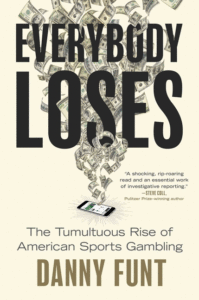
“Over the hours I spent reading Danny Funt’s Everybody Loses: The Tumultuous Rise of American Sports Gambling, I tracked the number of ads I encountered for FanDuel, DraftKings and numerous other legal sports books when I momentarily stopped to scroll social media or glance at a game on television. I counted 17, all during brief breaks in concentration—if I had counted moments when I wasn’t reading the book, the number would have been exponentially higher.
…
“The results are invariably bleak: Addiction—particularly among young men—is skyrocketing; trust in the legitimacy of sports is falling precipitously. Funt begins with a simple question: ‘What do we stand to gain, and what are we willing to lose?’ By the end of the book, the answer is clear. People, sports and society are all worse off because of legal gambling, which benefits only a handful of sports books that have rigged the system in their favor and are raking in cash. That’s the trade-off, if you can call it that.
…
“…the greatest strength of Everybody Loses is its breadth—Funt takes the reader inside every level of the seedy, corrupt, dispiriting world of sports gambling. This is a twisted travelogue of sorts, each chapter devoted to a circle of hell populated by one group of sports gambling’s myriad losers. The addicts and athletes; college students burdened by crushing debt; families destroyed by secret addiction; ‘successful’ gamblers eking out a living by devoting every second of their lives to finding an edge; media organizations and leagues that lose more credibility with every gambling promotion; and the vampiric sports books themselves. Those sports books offer a promise familiar and integral to American history: easy money. (In many cases, they start new users off with some free money.) But Funt’s writing about sports gambling’s ‘winners’ is almost as depressing as the look at its losers.
…
“Almost without realizing it, we have stumbled into a world where each pitch, each free throw, each field goal is monetized. Gambling on sports makes you the protagonist, instead of whatever athlete or team you’re watching; your success, not theirs, is what really matters. It also leads to atomization and alienation. Sports stop being something to enjoy or share or connect you to your community, and become just another way to passively spend (and occasionally earn) money. The result is that sports are cheapened, perhaps irredeemably. The only winners are a handful of sports books that are making billions.”
–Alex Shephard on Danny Funt’s Everybody Loses: The Tumultuous Rise of American Sports Gambling(The Washington Post)
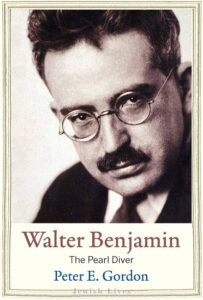
“Given the circumstances of his death, Benjamin, who was raised in a mostly secular Jewish household, might easily be made a symbol of ‘the long and troubled history of German Jewry,’ Peter E. Gordon writes—a cautionary tale of failed assimilation and bookish naïveté. But, in Walter Benjamin: The Pearl Diver, a short, serene volume published in Yale University Press’s Jewish Lives series, Gordon avoids treating his subject in such allegorical terms, in part because Benjamin always resisted conscription into a story larger than his own. Despite being a Marxist, he never joined the Communist Party, and, though he described himself as a person who ‘sees Jewish values everywhere and works for them,’ he consistently rejected political Zionism and its nation-building ambitions. He was, as Hannah Arendt put it in this magazine, in 1968, stubbornly ‘sui generis.’
The Benjamin who emerges from Gordon’s book is a sympathetic but often aggravating figure, the quintessential absent-minded professor who fumbles his romances, never works a real job, and, though he clearly recognizes the existential threat of Nazism, buries his head in his books as everything falls down around him. For all his apparent unworldliness, he was a stunningly prescient theorist of popular media, not to mention a prose stylist of exceptional beauty and vigor, whose name has attained a cult status on university campuses. (When I was in graduate school, a professor once asked a group of us doctoral students if we knew we were allowed to read things not written by Walter Benjamin.) Though he remained obscure in his own lifetime, those who knew his work recognized its power. On hearing of Benjamin’s death, Bertolt Brecht reportedly declared it the first real loss Hitler had dealt to German literature.
…
“It was under Brecht’s influence, Gordon suggests, that Benjamin found himself drawn decisively toward Marxist thought, and to the belief that ‘in a society riven by class conflict, art must be enlisted in the struggle for liberation.’ The proof is Benjamin’s best-known piece of writing, an essay called ‘The Work of Art in the Age of Mechanical Reproduction’ (or, more pontifically, ‘The Work of Art in the Age of Its Technological Reproducibility,’ a closer translation of its German title). Drafted around 1935 and revised several times before Benjamin’s death, it is a monumental and dizzyingly prophetic analysis of the fate of art once it has become an infinitely replicable mass-media product.
…
“Arendt ruefully described Benjamin, her old friend from Berlin, as having ‘a sleepwalker’s precision,’ ever bumbling into trouble and misfortune. It was, she suggests, just like him to achieve fame only posthumously, when it would be both ‘uncommercial and unprofitable.’ It was also like him to embody the sort of tragic idealism that would lead a person, physically weak and on the run from a genocidal regime, to risk his safety and comfort for a manuscript. And yet, it is this very combination of stubbornness and fragility, melancholy and valor that has turned Benjamin into a secular saint, enhancing his reputation no less than his vast and beautifully heterogeneous body of work, which is itself its own Parisian arcade, bearing up with elegance under ruin and despair.”
–Anahid Nersessian on Peter E. Gordon’s Walter Benjamin: The Pearl Diver (The New Yorker)
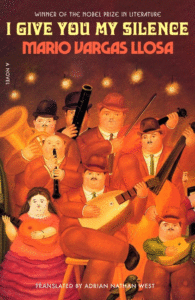
“Mario Vargas Llosa, who died last April at 89, received the Nobel Prize in Literature in 2010 for his searing fiction about politics, power and social desperation across the Spanish-speaking world and beyond. His final novel, I Give You My Silence, is his last word on Peru, his own inscrutable country, whose mysteries he spent a lifetime trying to untangle.
The novel has now been published in English, its precise, largehearted prose wonderfully translated by Adrian Nathan West. It is, in part, a paean to Peru’s homegrown music, especially the vals, a folk rhythm inspired by the European waltz. Peruvians made it a native form every bit as expressive as the Argentine tango, which, like the vals, flourished in the early 20th century. The genre emerged from the narrow, covered, disease-ridden alleyways of Lima’s poorest barrios, some of which date back to colonial times.
…
“Vargas Llosa creeps into the darker realms of Toño’s obsessions. He is almost as fragile as Lalo, with a phobia of rats and a manic need to add to his book until it encompasses the entire history of Peru, from before the Spanish conquest to the present. He succumbs to an illusion that has afflicted many ambitious writers: the belief that everything is relevant to their story and even the most peripheral events radiate toward its center, demanding inclusion.
…
“Vargas Llosa has written with brutality, humor, sarcasm and hardened empathy about Peru and Latin America. With I Give You My Silence he adds a moving tenderness. Both erudite and raw, the novel was completed in 2022, when the author knew he had a terminal illness. Like most of his late fiction it is written plainly, yet it is shot through with passages that recall his most passionate work.
During Vargas Llosa’s lifetime, his political beliefs underwent extreme changes, from supporting Castro’s revolutionary Communism to championing traditional European liberalism, which included an adamantine belief in unregulated markets. He might have become president of Peru when he ran in 1990, if not for his visible alliance with his country’s white upper class. But he always believed in the power of a rooted culture, and as a writer, at least, he was anything but a snob.”
–Michael Greenberg on Mario Vargas Llosa’s I Give You My Silence (The New York Times Book Review)

If you buy books linked on our site, Lit Hub may earn a commission from Bookshop.org, whose fees support independent bookstores.