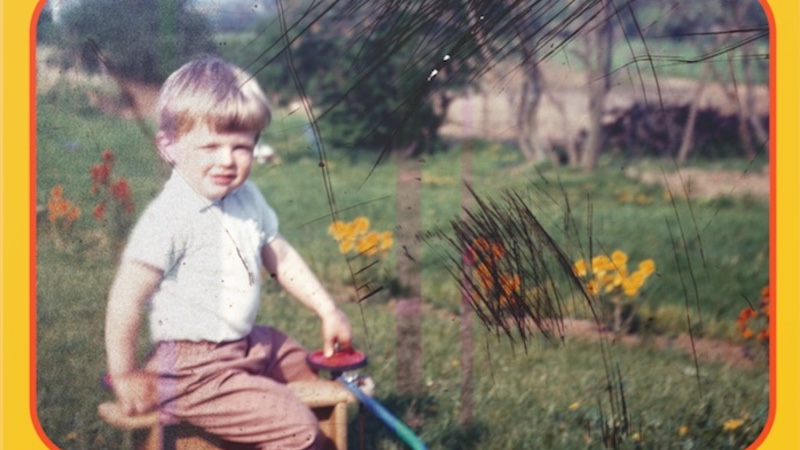
Our quintet of quality reviews this week includes Jeanette Winterson on Mark Haddon’s Leaving Home, Larry Rohter on José Donoso’s The Obscene Bird of Night, Ron Charles on Mohammed Hanif’s Rebel English Academy, Wesley Morris on Namwali Serpell’s On Morrison, and Sjón on Halldór Laxness’ A Parish Chronicle.
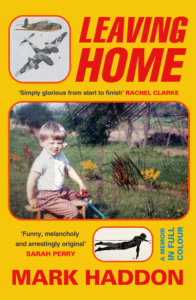
“Reading this memoir is like sitting on the floor in a room with a friend who spreads over the carpet their dog-eared, yellowing, predigital photo albums and spills out a box-file marked ‘The Past.’ It’s an immersive experience.
…
“The narrative flow is more like blood pumping around the branching arteries of the body than water channeled in a rill. I like this method because it is closer to reality. Our minds are not linear. Each of us moves in a past/present/future simultaneously. Memories don’t sit side by side in chronological order, like diary entries. Time’s arrow is not how we remember. Haddon’s writing more faithfully tracks the truth of our minds, which see time in the round.
…
“Mark’s parents die. His children grow up. His books are a success. He fields phone calls as a volunteer at a Samaritans help line in Oxford, where he lives…He struggles with the Hard Problem. He can’t bring himself to believe that humans are spiritual jam in a material doughnut, but he does continually discover, as if always new, that ‘writing lives on that boundary between consciousness of two worlds.’
This is an uplifting book, funny and sad and hopeful. It’s a collaborative book, too. Haddon’s gentle, curious voice asks us questions about his life, and ours, shares his difficulties, speaks aloud those doubts he believes he will never settle.
And before the Hard Problem comes something else, equally important for these troubled times. ‘The question is not “Is anyone in there?” but “What exists between us?”‘ he writes. ‘Our humanity is not an individual quality that can be measured and traded and celebrated and ignored, but an activity, a thing human beings do together.’”
–Jeanette Winterson on Mark Haddon’s Leaving Home: A Memoir in Full Colour (The New York Times Book Review)
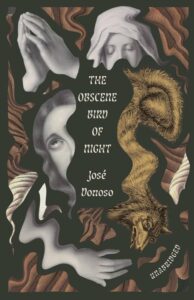
“At the time of its initial publication in Spanish, José Donoso’s extravagantly grotesque novel The Obscene Bird of Night seemed to lend itself to a primarily political interpretation. It was 1970, and his native Chile was in the throes of the election campaign that resulted that September in the victory of Salvador Allende, the country’s first socialist president, and a sweeping effort to reorder its social and economic structures. Donoso’s novel read easily then as a deliberately outlandish allegory of the centuries of exploitation and oppression that were fueling Allende’s rise, and by the time the book appeared in English in 1973, the situation in Chile had cemented that impression: Allende and the transformation he sought were being besieged by the forces of reaction, and General Augusto Pinochet was soon to launch his bloody coup.
A half-century on, in a translation newly revised by Megan McDowell and with material excised from previous American editions now restored, Donoso’s novel registers very differently. A political interpretation is still possible, should one choose to lean in that direction, but The Obscene Bird of Night is too rich, deep, and complex to be confined to that single, limited view. In a time replete with manifold political monsters every bit as awful as those Donoso imagined, his novel also seems prescient in its presentation of gender, religion, and, above all, the anomie that results from the breakdown of the ties binding the individual and the community.
…
“Stylistically, Donoso stands somewhat apart from other Latin American writers of his generation. Absent from The Obscene Bird of Night is the exuberant Caribbean playfulness of Gabriel García Márquez or Guillermo Cabrera Infante, as well as the strain of social realism found in early works of Mario Vargas Llosa and Carlos Fuentes. In this respect, Donoso’s friendship with Buñuel may be relevant, and not just because of their shared tendency toward anticlericalism: in their distinctive ways, each can be considered an heir of Francisco Goya, especially the bleak canvases of the late Black Paintings (such as Saturn Devouring His Son or Two Oldsters Eating Soup) and the earlier Los Caprichos prints, two series featuring crones and witches who bear a striking resemblance to the inhabitants of La Casa. Of all the great novels of ‘the hypothetical Boom,’ and there are many, The Obscene Bird of Night is the most unrelentingly dark and pessimistic.”
–Larry Rohter on José Donoso’s The Obscene Bird of Night (The New York Review of Books)
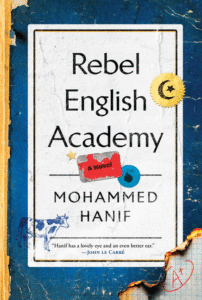
“Mohammed Hanif’s incendiary comic novel, Rebel English Academy, makes strong demands on American readers—and rewards them. Among its many pleasures is the refreshing, if disorienting, sense of landing in an unfamiliar place: a provincial town two hours outside Lahore, Pakistan. It’s a world untraveled by most Westerners and untrammeled by the sentimental gaze of PBS costume dramas. In these pages, Hanif’s satirical wit sears a political history many of us remember only dimly—and he couldn’t care less about making any concessions for Western comfort … By page 3, the novel has already shifted into something richly absurd, with comedy quietly displacing tragedy the way embalming fluid drives blood from a body.
…
“What a promiscuously plotted novel Rebel English Academy is: a low-flame mystery wrapped inside a sex comedy tied around a political satire. Readers of Hanif’s celebrated debut, A Case of Exploding Mangoes, which was longlisted for the Booker Prize, will recognize his puckish blending of sweet and sour, silliness and viciousness. Scenes of torture, rape, and murder take place alongside passages of witty banter and heartfelt tenderness. Who else would dare use getting shot in the kneecaps for comic relief?
But there’s never anything out of Hanif’s control. We may laugh nervously, but he never does. Humor and cruelty form a rare amalgam in these chapters. As the great Soviet and Chinese satirists knew, casting atrocities as absurdities is a deft response to state terror. And like the American writer Paul Beatty, Hanif uses comedy not to relieve but to destabilize, to scrape beneath the crust of political reverence and make contact with the lunacy of life under tyranny.”
–Ron Charles on Mohammed Hanif’s Rebel English Academy (Ron Charles Substack)
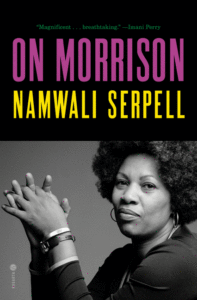
“The stratosphere is a kind of in-between space for an artist. Maybe you’ve achieved the celestial, but then all you’ve got is everybody gazing up at you, existing under you, loving the idea of you, the light of you, the gas of you, your myth. The question becomes: Who’s touching you? Often not much criticism, not rigorous criticism. I get it. The stratosphere is all the way up there. Upon arrival, who would know they were even there? It’s perilous. The air—wait, what air?
Toni Morrison is stratospheric. The legend of her seems to speak for itself. The novels, the Nobel, the lectures, the former students, the decades of university syllabuses (although still not enough), the famous inner and still-more-inner circle, the known unknown of her, the unknown known, the many of her raised eyebrows, literarily sucked teeth and that radiological intellectual gaze: Who’s touching any of that?
Well, who’s deploying criticism to touch it? Some of us have been waiting for an astronaut to suit up and head out there, for not even a debunking, let alone a dethroning, but just a great, big reminder that this woman is no less ensorcelling when experienced right here on Earth under the guidance of a writer with a magnifying glass, a scalpel and maybe an ashtray.
Evidently, Namwali Serpell, the novelist and, in the pages of The New Yorker and The New York Review of Books, an absorbingly surgical critic, has been one of us waiting people. The difference is that she’s done what we haven’t: hopped on a rocket and touched the Tonisphere, with her mind. This is an aptly Toni Morrison thing to do, write the book you’ve been dying to read. What Serpell’s written, devised, built is On Morrison, a novel-by-novel treatise on, inspection of, spelunking into, playing with Morrisonian philosophy, aesthetics, craft; and she might be having the time of her life.”
–Wesley Morris on Namwali Serpell’s On Morrison (The New York Times Book Review)
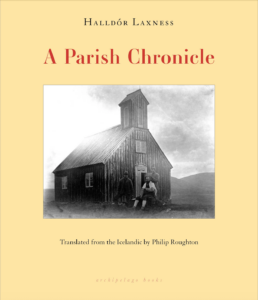
“At the age of fifty-three, Laxness himself stood before a Nordic king, King Gustaf VI Adolf of Sweden, and received his own skáldalaun (‘Poet’s Reward’): the golden Nobel Prize medal and a calligraphed diploma, while the reward money of the richest literary prize in history was being transferred to his bank account as they stood there face-to-face: King and Poet. In that moment, Laxness must have felt that he had truly followed in the footsteps of the Icelandic court poets of old; that he had arrived in literary history and been shown to his place on that famed bench.
Now, that brings us to the aftermath of receiving a major literary prize. It comes with well-known complications. When the hazy days of the ceremony and celebrations, interviews and travels have passed, back at home the prizewinner is left alone with the prize. Resting on laurels offers only so much comfort; they always feel prickly in the end. It is from such a situation that Innansveitarkrónika (A Parish Chronicle, 1970) was born.
…
“It is to be applauded that A Parish Chronicle is finally available in English from Archipelago. Philip Roughton’s translation looks as good to my Icelandic eyes as his other translations of Laxness’s later works. He delivers the pleasures found in the twists and turns of the narrative, keeping its tone while wisely refraining from competing with the idiosyncrasies of the original text, where Laxness revels in obscure words and homemade spelling. The laugh-out-loud moments are all there.
The book is filled with some of the strangest characters Laxness ever gave us (and there are many, believe me), and with events that on the surface are so mundane that they would normally not demand attention, let alone be written about. Yet Laxness’s able hand pushes the pen until they are infused with tender mystery that makes us care for them all.
…
“Laxness is one of the great fabulists of modern letters. Buried in A Parish Chronicle is his metaphorical skull, looking back at us from beneath the text, reminding us that the seeds of culture and humanity are carried across generations by the hands of ordinary people. For human culture is their rightful inheritance. It was people like themselves who made it—often against all odds—just as they keep making it now. And no authority will stop them.”
–Sjón on Halldór Laxness’ A Parish Chronicle (4Columns)

If you buy books linked on our site, Lit Hub may earn a commission from Bookshop.org, whose fees support independent bookstores.