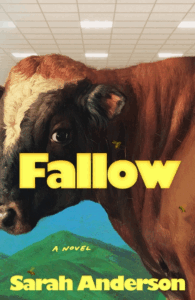
This genre is fertile ground for feminist writers, perhaps because it doesn’t take much more than checking out the latest proposals coming out of, say, the Texas Statehouse, to send the imagination spiraling into worst-case scenarios. For women who have benefited most from centuries of progress—the college-educated women writing in rooms of their own—and feel viscerally how much they have to lose, the not-quite-sci-fi novel is a place to work out those fears.
…
“By doing away with some of the disparities that traditionally loom over both fictional and real-life surrogacy narratives, Anderson heads off common criticisms of surrogacy and the skewed power dynamics between gestational carriers and intended parents. Instead she focuses on surrogacy as just one type of job in America’s already exploitative labor market, and poses a stark question: If surrogacy exploits women, then who, exactly, is doing the exploiting?
…
“There is a reason that forced gestation is a feature of many feminist dystopian novels; for many women, this job would be nothing less than a nightmare come true. But Natalie is the kind of exception that undoes attempts at making rules. In a 2022 paper in the International Journal of Comparative Sociology, four scholars argued for the plural term ‘surrogacies,’ rather than surrogacy in the singular, to acknowledge the many versions of surrogacy and the wide variation in circumstances around each pregnancy and family. Fallow’s plot twists and turns, and the relationships and friendships Natalie eventually develops, demonstrate how the ethics of surrogacy are not reducible to any one of these narratives, but depend instead on the power relations that define each case. Natalie’s relationship to surrogacy itself evolves as the power dynamic evolves, from one of exploitation to one of respect and consent. Moreover, her entire approach to work shifts as her relationship to other people shifts: She learns to take pleasure in work when it becomes an act of interdependence rather than a mode of capitalist accumulation.
Feminists have long argued for wages for housework. They were asking for compensation for the unpaid work of social reproduction, or what one scholar calls ‘life-making’: birthing and raising and caring for generations new and old, cooking and cleaning and mending and all-around sustaining that has been, and overwhelmingly still is, done by women, ostensibly for love and not money. In its withering critique of work in all its more banal forms, Fallow suggests that unscrupulous bosses and our economy’s callous disregard for workers, not Natalie’s choice of labor, are the far more pressing problems.”
–Anna Louie Sussman on Sarah Anderson’s Fallow (The New Republic)
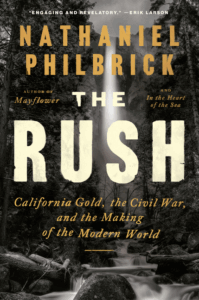
“The Rush is a sprawling book, characters and stories spilling out everywhere, as dense with claims as the goldfields it describes. Of these, two emerge as dominant. The first, which is woven throughout the book—albeit in the strict sense that it keeps appearing and disappearing—is that the discovery of gold in California set off a mad scramble for wealth, land, labor, and power that contributed to the onset of the Civil War and then helped determine its outcome. The second is that what mattered most about the gold rush was not the gold but the rush. The headlong haste with which those Nantucket whalers picked up their lives and went West was representative, Philbrick argues, of a new and distinctly American appetite for speed, novelty, and transformation, one that has defined our character and shaped our future from the time of the forty-niners to the planned Anthropic I.P.O.
The Rush is not particularly convincing about either of these claims. This is partly because both are a little rickety and partly because they are too different to comfortably coexist in a single book: one is about history and causality, the other is about psychology and culture. Mostly, though, it is because Philbrick keeps veering off into a larger, messier, less instrumentalized account of the gold rush and its aftermath. A better title for his book would be ‘A History of California, 1848-1878.’ Lest that strike you as dull, consider that those are three of the most thrilling, harrowing, and action-packed decades since the founding of our nation. In a sense, then, the tacit question The Rush asks is not about the history it covers but about history in general: Does the past need to explain the present to be worthy of our attention?
…
“It is a pleasure to meet these people in The Rush, but not every character makes an equally strong case for belonging there. Primary sources are a necessary and wonderful tool for historians, but they can have a fun-house-mirror effect, making some aspects of the past bulge and others narrow. To his credit, Philbrick is sensitive to those parts which we usually see inaccurately or not at all. He tells us, for example, that, although more than ten thousand Chinese workers helped build the transcontinental railroad, not a single diary or letter from one of them has ever been found, leaving a vast lacuna where their own California story should be. Still, The Rush is ultimately more hamstrung by what it contains than by what it does not.
…
“In Philbrick’s framing, the root cause of this crisis was the discovery of gold in California nearly two centuries ago. ‘This is the world in which we live today,’ he writes earlier in the book, ‘jammed into jets on our frantic way to the next new thing—a world created in 1849 by the California Gold Rush.’ But did the gold rush create our contemporary world, or do the two just resemble each other? It’s true that many features of eighteen-fifties California are also visible in the current A.I. boom, from the benefits of arriving early and the outlandish profit to be made in infrastructure—whether picks and shovels or microchips and data centers—to political instability, environmental destruction, and wild inequality. But resemblance is just a surface relationship, and nothing in Philbrick’s book makes the gold rush seem like a motive force behind the breakneck, and maybe break-everything, boom of today. Nor does anything in it make avaricious urgency seem specifically American; how could it be, when all those Aussies and Frenchmen and Chinese and Chileans likewise dropped everything and sped to California?
The more plausible explanation is this: put any group of people within striking distance of a potential source of spectacular wealth, and many of them will behave in similar ways, including moving toward it, competing for it, cheating over it, exaggerating about it, inventing new ways to extract it, creating rules to manage access to it, breaking those rules, and generally using all available means, legal and otherwise, to dominate and profit from it. The Rush is at its best when it simply shows us this mayhem as it unfolded in a specific place and period, instigated, abetted, opposed, documented, and occasionally averted by marvellously specific human beings. One sympathizes, in these dark and confusing times, with the desire for the past to illuminate the present. But the past is its own kind of gold—abundant, difficult to access, inordinately valuable—and sometimes it is enough to let it shine.”
–Kathryn Schulz on Nathaniel Philbrick’s The Rush: California Gold, the Civil War, and the Making of the Modern World (The New Yorker)