
Our quintet of quality reviews this week includes Joanna Scutts on Shawn Gude’s American Socialist, Dwight Garner on Barbara Trapido’s Brother of the More Famous Jack, Rhian Sasseen on Meghan O’Gieblyn’s Will and Attention, Lily Meyer on Madeline ffitch’s Avalon, Rise, and Max Callimanopulos on Tom McCarthy’s The Rhyl Poster.
*

“What can the history of American socialism tell us about the present and future of democratic politics? The last decade has seen a resurgence of interest in socialism, from Bernie Sanders’s runs for president to the rise of Alexandria Ocasio-Cortez, and recently the election of Zohran Mamdani as New York mayor. Each of these figures has had to face the long-standing assumption in American politics that socialists just can’t find traction in the United States. American Socialist: The Life and Legacy of Eugene V. Debs, by former Jacobin editor Shawn Gude, offers an important corrective, illuminating the forces that shaped America’s foremost socialist evangelist, and the exceptional efforts of his opponents to crush him and his movement. Along the way, the book reveals a deeper truth: that in the United States, the story of socialism is really the story of opposition to socialism.
…
“As Gude describes it, Debs’s rhetoric fused nationalist and Christian mythology with Marxism, evoking the spirit of Christ and the fire of the abolitionists. It was a brew that appealed to crowds wherever he spoke. The era of political oratory made stars of the unlikeliest speakers, whose photographs or transcripts can barely convey what felt to audiences like an electrical current. Eugene Debs would spend the rest of his life spreading the gospel of this new political religion, and critics and followers alike would frequently compare him to Jesus Christ.
…
“The international socialists who inspired Debs at the start of his conversion were wildly excited at the prospects for American labor. How far might a nation go that had no kings to depose, no entrenched hierarchies to uproot, a country so young and iconoclastic and resource-rich? It was a disillusion as brutal as the mines and the mills, to see how powerful the pushback would be. The promise of American socialism is still unfulfilled, but this is a country in which almost anything can be resisted, rethought, and reinvented. Even politics. Even capitalism. Perhaps the story of Eugene Debs, told as meticulously as this, shows us that reinvention will not come from a single leader, no matter how inspiring, but from the collective resistance, and joyful community, of ordinary people.”
–Joanna Scutts on Shawn Gude’s American Socialist: The Life and Legacy of Eugene Debs (The New Republic)
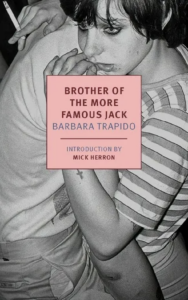
“…the shuckling on display is so good—so literate, funny, cruel and eccentric—that I slothed with this endearing novel immediately and was chagrined to have to climb out. This book is ideally short, yet one wants to live inside it, in the charmed parenthesis it opens inside the daily grind.
…
“Its awkward and hard-to-remember title—it’s an allusion to William Butler Yeats’s brother, Jack, a talented painter—may have kept the book from developing the audience it deserves. But it’s here again now. We should have been talking about Barbara Trapido all along.
I have a special fondness for novels about young people who grow up in narrow cultural circumstances, with few books in the house or paintings on the walls, who sense there is another way of living and find it by being befriended, or nearly adopted, by unconventional and urbane others. It’s my own story, in a way, and it’s why One of Ours is my favorite Willa Cather novel, instead of My Ántonia. Brother of the More Famous Jack is an ornament to this genre.
…
“The dialogue is Stoppard-level. If these characters were dogs, they would be constantly lifting their legs at one another. But hassling, most of the time, is how they express their love.
Brother of the More Famous Jack (I’m tired of even typing the title) strikes me as a pocket classic, a book that takes life seriously, earns its emotions and befriends the reader without getting all gooey about anything at all.”
–Dwight Garner on Barbara Trapido’s Brother of the More Famous Jack (The New York Times)
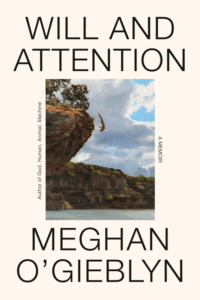
“The human soul: an old-fashioned term, sworling with the patina and shine of an antique. To take such a thing seriously in this age of nihilism and disenchantment betrays a person as potentially unserious, someone committed to abstraction, to feeling over logic and material reality. And this is an era of binaries, in which the very instruments of our daily lives—the computers we type on, the phones on which we scroll—are reliant on a series of zeroes and ones.
But in the American writer Meghan O’Gieblyn’s latest book, the memoir Will and Attention, the soul, and the vast human consciousness and humanistic intellectual tradition for which this word functions as a shorthand, is not something so easily dismissed. Set mostly around the time of the pandemic, the book traces O’Gieblyn’s abrupt, frightening relapse into alcoholism, paired alongside her unexpected flirtation with Catholicism years after she renounced religion and became an atheist. In this sense, it is a book about obliteration in one form or another: the blotting out of the self that occurs when substance abuse obscures a person’s life from themselves, like an indistinct reflection in a mirror; the destruction of the individual when confronted with the divine.
…
“O’Gieblyn, in the span of its pages, successfully manages to turn the authorial gaze fully on herself and the twinned problems introduced in its title: will, as in the idea of free will and to will to change our lives, and the attention we pay to self-examination and the world around us. Drawing on the French philosopher Simone Weil, the German philosopher Arthur Schopenhauer, Catholic theology, and more, O’Gieblyn produces an addiction memoir that transcends the form, and offers a salient exploration of what varieties of care and attention we owe ourselves and others.
…
“This is an irony that O’Gieblyn is aware of in Will and Attention: that once some kind of equilibrium has been reached in a life, once some kind of happiness—a steady relationship, a thriving career, travel—has been achieved, boredom will set in. And from that boredom, a different kind of will, the willfulness that accompanies a need to destroy that happiness. Sometimes when I read books about alcoholism and addiction, I worry about my own reaction as the child of an alcoholic, a knee-jerk judgement toward the writer for the hurt they’ve undoubtedly caused their loved ones. This is unfair, I know; it’s not logical. Addiction itself isn’t logical; why this need to blot oneself out, to destroy oneself from within? The expansive quality of Will and Attention, the focus that it pays to this long history of human consideration toward this very question, allows it to sidestep the pitfalls of viewing addiction merely through the lens of disease or choice.”
–Rhian Sasseen on Meghan O’Gieblyn’s Will and Attention (The Baffler)
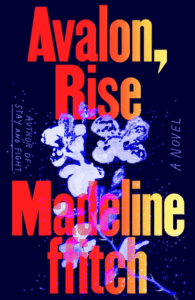
“Avalon, Rise is a sophisticated novel, intellectually complex and slyly funny at every turn. Like Abiyoyo, it is also a very direct story about facing evil with courage. Avalon, Rise makes the case on nearly every page that opposing the Big Bad is necessary. But that basic principle, the book suggests, does not make standing up to those who would destroy a community easy. Indeed, the ever-shifting balance between clarity and complication is central to the novel.
ffitch is able to maintain this balance largely because she seems to have little interest in demonstrating purity—either her own or that of her characters. Avalon, Rise doesn’t care if its characters do the precisely correct thing. As a result, it achieves the rare feat of having a distinct sense of right and wrong, without ever becoming preachy or heavy-handed. It becomes an exploration of how confusing and hard it is to be good.
…
“By braiding these stories, and many more, into the tale of Avalon defeating its giant, ffitch tells a layered, sophisticated story that expresses a clear, ethical point of view without hammering readers on the head. Not many novels for adults do this successfully, but in children’s literature, it is one of the standards for a great book. ffitch includes many in Avalon, Rise: Abiyoyo but also Frog and Toad, Herschel and the Hanukkah Goblins, The Dead Bird. Each of these books demands that its characters face their situation with courage; each one takes something that seems simple—burying a bird, celebrating Hanukkah, all sorts of mundane tasks in Frog and Toad—and surrounds it with not just emotional complication but also mischief, humor, and delight.
So, too, with Avalon, Rise, as it demonstrates that white supremacists are unwelcome in town. What Avalon, Rise understands as well as the classics of children’s literature is that when you’re a small, fallible, confused person, everything is exciting but almost nothing is easy. What it understands as well as any great adult novel is how hard it is to get people to work together, no matter how high the stakes. In bringing these two clear yet complicated pieces of knowledge together, ffitch has written a remarkable book.”
–Lily Meyer on Madeline ffitch’s Avalon, Rise (The Atlantic)
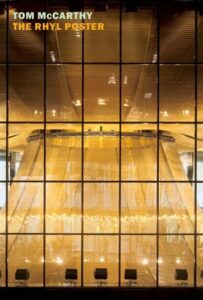
“Some writers tend toward inarticulacy as they get older—by the end of his career, Beckett was trading in lonely phrases and flinty little fragments. McCarthy is going the other way. A geeky tang that first announced itself in The Making of Incarnation (2021)—with its Feynman diagrams and Fisher kernels, Prandtl tunnels and hyper-converged-infrastructure systems—has forcefully asserted itself over McCarthy’s prose. The Rhyl Poster is full of references to ‘networks and spreads,’ ‘channels of association and disclosure,’ avenues and angles, vectors, eddies, and ‘contrafluvial vectors.’ We’re adrift here, having basically learned that the European legal system is big and complicated, and that McCarthy has a great many words for saying so.
…
“Squint and you might see the bones of a legal thriller—a John Grisham paperback written by Georges Perec. Look a little closer, however, and you’ll realize that The Rhyl Poster is nearly identical to McCarthy’s last two novels…Repetition and reënactment might be the twin engines of McCarthy’s fiction, but it’s slightly disheartening to read about these men and their fruitless attempts to construct ‘some kind of infrastructural master-meaning’ out of their times.
…
“As I plodded through The Rhyl Poster, I had the irritating sense that McCarthy was hovering somewhere over my shoulder, chuckling at my dutiful annotations and frequently exasperated comments. His novels have a way of preëmpting criticism (‘Events! If you want those, you’d best stop reading now,’ he writes at the start of the largely eventless Satin Island), but The Rhyl Poster went beyond those usual impulses: it seemed designed to deflect any of the pleasures I associated with reading. The sentences, packed with jargon, beat me down with their elaborate banality. The plot, recycled wholesale from Satin Island, seemed at once frantically busy and totally empty. If the experience of reading Remainder was like stepping into the cool and quiet of a gallery, then reading The Rhyl Poster reminded me of stumbling into a junk shop, cluttered and overflowing with the bits and bobs McCarthy has collected throughout his career. I made it to the end and put the book aside. Only then, oddly, did it start to grow on me.
…
“…at some point a writer so committed to a single method has to wonder what’s left to do with it. Stanton, reflecting on his document-smuggling, decides that it constitutes ‘a topographic, not a spiritual, drama.’ The phrase might well describe McCarthy’s entire career. He’s never had much interest in how or what his characters feel, but in The Rhyl Poster’s last chapters, he seems to be attempting to escape them altogether..He might never again write a novel as clean and spare—or plainly enjoyable—as Remainder. But the novelist who once found his inspiration in the art world’s curated spaces seems, in these moments, to be finding his way toward another kind of book: one that stops trying to X-ray bureaucracies and institutions and starts, more simply, looking at the world.”
–Max Callimanopulos on Tom McCarthy’s The Rhyl Poster (The New Yorker)

If you buy books linked on our site, Lit Hub may earn a commission from Bookshop.org, whose fees support independent bookstores.