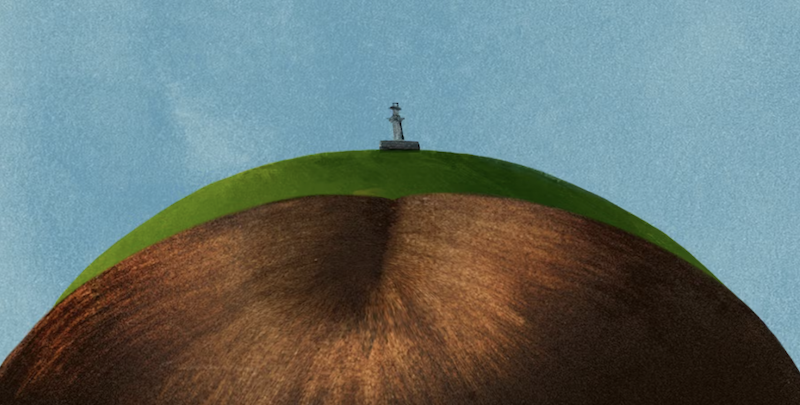
Our favorite criticism of the week includes James Wood on Harriet Clark’s The Hill, Laura Miller on James Lasdun’s The Family Man, Sam Worley on Douglas Stuart’s John of John, Colin Grant on Kimberlé Williams Crenshaw’s Backtalker, and Adam Begley on Elizabeth Strout’s The Things We Never Say.
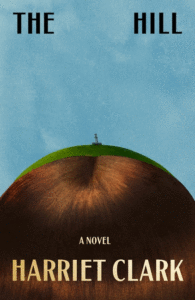
“Harriet Clark’s superb first novel, The Hill…is narrated by Suzanna, who lives with her grandparents in New York City. Nearly every weekend—first with her grandfather, then with a nun named Sister Claudine, and, finally, once she’s nearly a teen-ager, on her own—Suzanna makes a trip out of town to visit her mother in a hilltop prison. Only gradually does it emerge that her mother is serving a very long sentence for her role in a bank robbery that resulted in the death of a security guard. Clark’s novel is a brilliantly deprived bildungsroman. It has the form and emphasis of a coming-of-age story but is devoid of the usual content.
…
[Marilynne] Robinson seems to have shown Clark how to write about a girl whose mother is absent…but whose fate rests with elders so absorbed in their own intricate dramas of departure that their young charge feels abandoned twice over, by two generations of absconding guardians … Like Robinson, Clark gets some comedy out of the morbid whimsy (so it seems to Suzanna) of the very old. For one thing, the old have an inconvenient habit of dying.
…
With the exception of the punitive visit to the bank, Suzanna’s grandmother does not discuss her daughter’s crime or her reasons for committing it. ‘What your mother did’ is Sylvie’s smothering précis; ‘your mother took it too far’ is her grandfather’s milder version. This may well echo the kind of rationed discourse that the author heard when she was growing up with her own grandparents. But it is also a canny novelistic strategy to keep this autobiographical novel from being flooded with autobiography. Harriet Clark, born in 1980, is the daughter of the Weather Underground activist Judy Clark, who took part in the robbery of a Brink’s truck in Nanuet, New York, in 1981, an incident that left three people dead. Judy was found guilty of murder in 1983, and served thirty-eight years, mostly in Bedford Hills Correctional Facility. Harriet was thirty-eight when her mother was released, in 2019. In the book’s acknowledgments, she says that she has been working on this novel for “a very, very long time.” One can barely imagine the intolerable weight of this family inheritance—its singularity at once tempting and difficult for a novel, irresistible for so many years yet the only thing one wants to escape, with the novelist daughter always mentally at work, like Penelope at her shroud, on a project that she is simultaneously unwriting.”
–James Wood on Harriet Clark’s The Hill (The New Yorker)
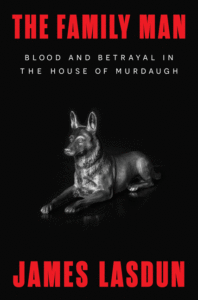
“The Family Man is the Truman Capote version of the Murdaugh story, a thoughtful, well-researched, and beautifully written inquiry into how and why a person comes to commit such an appalling crime. Although, unlike Capote, Lasdun was denied interviews with the perpetrator, he is able to draw from other resources, namely, the products of consumer technologies undreamt of in the mid-1960s, when Capote wrote In Cold Blood: texts, smartphone photos, videos, and social media posts. He also interviewed Alex’s friends, colleagues, and attorneys who worked on the murder trial and other Murdaugh-related lawsuits.
…
The best true-crime writing always illustrates how a particular place and social environment made that crime possible. Even if Alex Murdaugh is a monster, how did South Carolina’s Low Country, with its good-ol’-boy networks and slipshod, glad-handing business practices, allow his monstrosity to flourish? In this inquiry, Lasdun has the advantages of an outsider. An Englishman who lives in New York, he responds to the Low Country’s culture with bemused and often appalled wonder. He’s most shocked by the number of guns the Murdaughs possessed and how carelessly they handled them.
…
Ultimately, Lasdun finds a way to imagine how Alex committed those two murders, and the result, in the final chapter of The Family Man, is a masterful description of moral equivocation, the accumulation of little lies and diversions and excuses that people who do bad things…use to jimmy themselves into a course of action without fully owning their decisions. He concludes that Alex was some kind of psychopath who conforms to the patterns of other ‘family annihilators’ who can’t bear the thought of their loved ones learning the truth about them. That Alex was able to so convincingly perform the compassion and warmth of genuine human feeling is certainly consistent with that psychopathology, but in the Low Country it was also all around him all the time. You could say he learned it from the best.”
–Laura Miller on James Lasdun’s The Family Man (Slate)
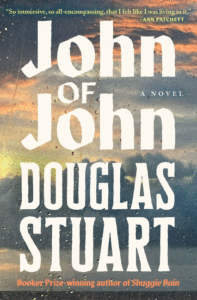
“Stuart’s protagonists are growing up, and his writing — particularly his depiction of the vicissitudes of queer life — is maturing right alongside them … Stuart is a gay writer in the old-fashioned sense of the term in that his plots center on men who are attracted to men. No postmodern flash here: He favors lengthy, lyrical novels that are ambitious in the breadth of their sociological detail, each transpiring within the confines of a Scottish community that exists at some remove from the rest of the world.
…
‘Gay,’ though, is a label that fits loosely here because Stuart’s ambit is broader than sexuality. He’s interested in masculinity, especially where it intersects with poverty … John of John changes tack dramatically toward a sprawling, emotionally rich saga that extends Stuart’s investigation into masculinity while sketching a world in which his gay characters come fully, finally alive. It’s his best yet.
…
Color…plays a vital narrative role as a kind of language that helps bridge the distance between father and son. It’s not their only mode of connection. John and Cal sing Psalms where they can’t converse. They speak to each other in Scottish Gaelic, which — ironically and sweetly — is both the language of tradition and the language of queerness in this book, used almost exclusively by Cal, John, and Innes. (It’s usually rendered in English, indicated by italicized text.) If Stuart’s novels describe worlds in which queerness remains verboten, here it finds a few more avenues of expression, even if they’re subtle, indirect. We see people trying to work it out, struggling to confront and articulate who they are in relation to their own desires and the impositions of the community that surrounds them.”
–Sam Worley on Douglas Stuart’s John of John (Vulture)
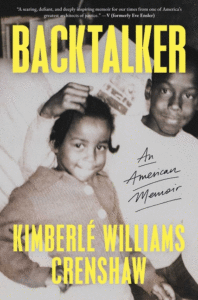
Backtalker charts Crenshaw’s extraordinary journey from precocious child to renowned public intellectual. Today, she is a Columbia University law professor who is closely associated with a set of ideas about inequality known as critical race theory. She is also the architect of one of the theory’s chief pillars, intersectionality, a term she coined in 1989 to urge us to consider the ways that bigotries rooted in gender, race and class overlap.
…
Looking back, Crenshaw suggests that her traumatic childhood inspired her compassion for marginalized and invisible people. Even as we see the pall of sadness lift… the theme of repressed pain persists throughout her Ivy League education in the 1970s and ’80s … In these college chapters, the book’s velocity matches her quest for a language to challenge the calls for race and gender blindness that had become a popular solution to inequality in America. We see the earliest seeds of intersectionality as Crenshaw confronts a loophole in the legal system whereby courts denied Black women their standing to sue over gender discrimination.
…
That the precise prose of this account, and numerous other anecdotes, is written with the kind of titanic certainty that would sway a jury is expected; what’s surprising, however, is Crenshaw’s candor in revealing her vulnerability and disappointments.
…
Her memoir ends with the author finding strength in the sounds she remembers from her childhood — her father’s singing, her mother’s piano — and a rousing call to see the story of the future as one in which ‘the spirit of freedom was nurtured by talking back.'”
–Colin Grant on Kimberlé Williams Crenshaw’s Backtalker (The New York Times Book Review)
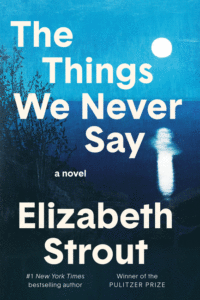
“How does she do it? Not just the neat trick of beguiling highbrow critics while at the same time pleasing millions of readers who don’t care about literary bona fides. The real feat is harpooning the reader artlessly (or so it seems), with language as plain as a Congregational church, a paucity of dramatic incident, and a cast of characters no more exotic than your neighbors. They aren’t exotic, her characters, but they’re quirky—some cantankerous, some bafflingly passive, all convincingly real … She’s not a minimalist, but Elizabeth Strout does more with less than any writer I can think of.
…
Is Strout one-dimensional? Though quiet (the clang of current events mostly muffled), her novels are complex and layered. She’s a keen dissector of American class structure. Whether she’s schmaltzy is trickier. More interested in virtue than vice, she likes to show what appears to be vice vanquished by the revelation of hidden virtue. Are you a schmaltzy writer if you shy away from depicting evil, if your baddies turn out to be merely misguided?
…
The tender side of Strout is her hopefulness—and that may be toughening up. In…early books, Strout seemed confident that good would eventually prevail, or at least persist. She never did happy endings, but in general her characters coped or grew or showed remorse; they endured, and the reader cheered them on.
…
The Things We Never Say … and yet, in two unmistakably political paragraphs in the novel’s epilogue, Strout makes a point of saying. She compiles a record of Artie’s distress during the first year of the new administration (deportations, arrests of student protesters, ‘Alligator Alcatraz’—he’s serially appalled). I suppose it could be mistaken for an anti-Trump rant: She certainly lets us know where she stands. Yet she’s neither preaching to the converted nor attempting to convince the misguided. Artie’s distress could be common ground, or not.”
–Adam Begley on Elizabeth Strout’s The Things We Never Say (The Atlantic)

If you buy books linked on our site, Lit Hub may earn a commission from Bookshop.org, whose fees support independent bookstores.