Our quintet of quality reviews this week includes Dina Nayeri on Erin Somers’ The Ten Year Affair, Leanne Ogasawara on Xiaolu Guo’s Call Me Ishmaelle, Ron Charles on Ben Markovits’ The Rest of Our Lives, Kevin Power on David Szalay’s Flesh, and Robert Rubsam on Helen DeWitt’s Your Name Here.
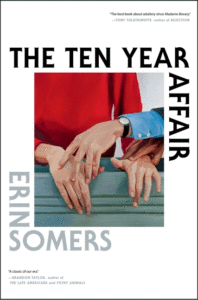
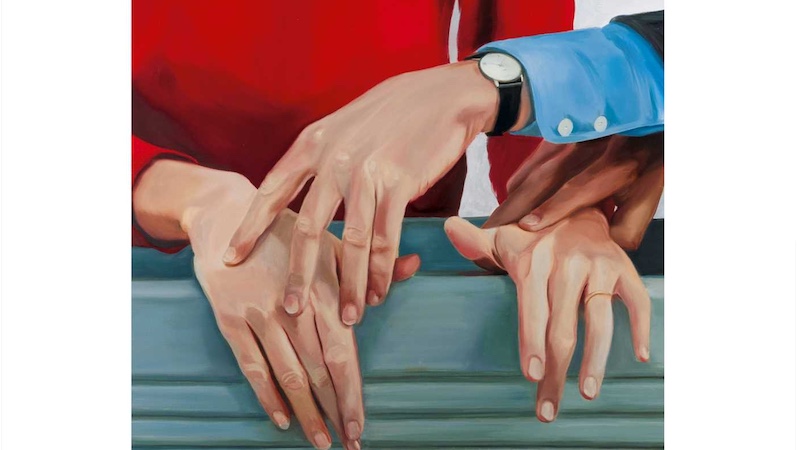
“In Erin Somers’s The Ten Year Affair, Cora, a millennial mother, craves a bygone kind of passion from a bygone kind of man. Unfortunately for her, morality in 2015 is rigid and cynical, and instead of having the affair, Cora spends 10 years overthinking it, fantasising about it and discussing it with her potential lover, Sam—a playgroup dad who is ‘chief storytelling officer’ at a mortgage start-up (yes, that’s his job title. They all have absurd jobs). The book presents itself as a comic take on the classic adultery novel and a send-up of a narrow, self-conscious group of downwardly mobile New Yorkers. I’d call it the midlife adultery story our entire generation deserves: a propulsive, witty takedown of insufferable hand-wringers who’ve managed to ruin even sex. Honestly, I couldn’t put it down.
…
“Beneath the story runs the subtle undercurrent of familiar middle-age questions: do our lives have meaning? Where do we go after death? These themes are more explicit in Cora’s imagined conversations. Reading these exchanges, I wondered what lesson Cora and her cynical lot would take from their disappointing dramas. Would Cora grow more open to life’s imperfect joys, its corny pleasures? When Eliot asks about her affair in the middle of a podcast about rope, Cora thinks ‘every serious exchange is undermined by its particulars.’ Some might say enhanced. But that’s not Cora, and Somers doesn’t give her character false epiphanies, or stretch her where she is unable to go.
I loved this razor-sharp, hilarious, finely observed novel, written with such withering exactitude. It is absolutely aware of itself, spare and brimming with subtext: a portrait of an anxious, loin-girding generation in middle age, chronically embarrassed at ourselves, at once afraid of and desperate for sensation. Or maybe that’s just the New Yorkers. Let’s say it is.”
–Dina Nayeri on Erin Somers’ The Ten Year Affair (The Guardian)
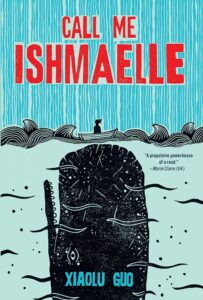
“This has been such a great few years for retellings of the classics—from Barbara Kingsolver’s updated David Copperfield to Salman Rushdie’s zany Don Quixote. And Percival Everett’s novel James, a retelling of Huckleberry Finn, took the lion’s share of the literary prizes in 2024, including the Pulitzer. There is so much pleasure to be had in rereading old favorites—and part of the joy is meeting beloved characters, who have been updated or somehow arrive in a new form to resist old tropes and types. Guo’s recasting of Ishmaelle is no exception. Orphaned as a teenager in an impoverished fishing village in Kent, Ishmaelle takes to the seas, disguising herself as a boy to do so.
…
“Nowadays people suggest that Ishmael was depressed—and maybe even suicidal—during that dark and drizzly November of his soul. But what if what Melville meant was more akin to how Guo interprets it? A person feels themselves trapped by what is demanded by society. In Ishmaelle’s case that meant toiling away in poverty for the rest of her life back in Kent. And what if the young woman had a curiosity to see the world? A desire to live big and have adventures?
…
“Cast into the world in disguise, she struggles to refashion herself aboard that ship as she strives to become true to the calling of exile and sailor. Traveling between worlds, like the author herself, she not only survives but thrives. But on board that ill-fated ship, it is in her friendship with the sage, as well as in her deepening connection to the whale and the wonders of the natural world that will transport readers back to Melville and his glorious Moby-Dick.”
–Leanne Ogasawara on Xiaolu Guo’s Call Me Ishmaelle (The Los Angeles Times)
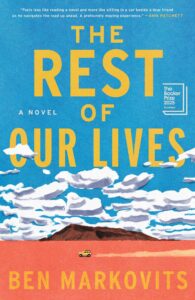
“The Brits got their hands on Ben Markovits’s new novel, The Rest of Our Lives, back in March. They raved. We eavesdropped. They shortlisted it for the Booker Prize. We checked international postage rates. Given that Markovits was born in the United States and that The Rest of Our Lives describes an American road trip, it hardly seems fair that just because he has lived in England for decades we had to wait nine extra months to read it. But sink into this wry, poignant story and all is forgiven.
…
“For middle-aged, passive-aggressive men playing out the clock in dismal marriages, reading The Rest of Our Lives may feel like performing open-heart surgery on themselves. But anyone willing to consider the thicket of fears, affections and recriminations that grows through the cracks of a long relationship will find in these pages an almost unbearable tenderness.
…
“The sense of déjà vu here can’t be accidental. Sixty-five years ago, Rabbit Angstrom, another once-promising basketball player, ran away from his wife without a map. In a nice touch, Tom’s abandoned PhD was focused on John Updike, and the same week The Rest of Our Lives was published in England, Markovits published an appreciation of Rabbit, Run in the Times of London.
…
“‘You don’t feel anything about anything,’ his wife tells him. ‘You don’t really care about anything.’ But no matter how maddening he may be to live with, that’s not true. He does feel; he does care. What’s so tragic about these two people—and so devastating about this novel—is that they still love each other but have no idea what to do in the years stretching ahead.”
–Ron Charles on Ben Markovits’ The Rest of Our Lives (The Washington Post)
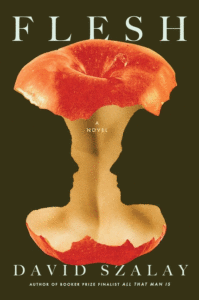
“David Szalay’s sixth book, Flesh, is partly about the encounter between a definitively unbookish mind and the intractable realities of experience. A male mind, crucially. And a hetero mind: this too is relevant. Unbookish straight men are a Szalay specialty. He writes with great formal rigor about the foot soldiers of contemporary blokedom.
…
“István isn’t what you’d call highly verbal. What he says, chiefly, is ‘Okay.’ The book contains 340 okays—roughly one per page. István is also prone to lighting cigarettes. I don’t remember the last time I read a novel in which people lit so many cigarettes. (When times change, he switches to a vape.) Lighting a lot of cigarettes, in fiction as in life, is something you do when you don’t know what else to do. István often doesn’t know what else to do. Does Szalay? Given that one of the very few books we ever see István reading voluntarily is a business guide called Playing to Win: How Strategy Really Works, we might not expect his life to be haunted by the poetry of Philip Larkin. But it is.
…
“All those okays, all those cigarettes, all those brief, affectless accounts of sex: István’s is a masculinity reduced by various kinds of violence—a huddled masculinity, diffident and uncertain even in its rages, its predations. The narrow compass of his interiority summons a narrow prose. Blunt one- or two-sentence paragraphs. A limited word hoard. (The novel is very easy to read.) Yet the implicit presence of ‘The Whitsun Weddings,’ the precise dating of István’s wall-punching to the Pentecost weekend—these things tell us that while the prose may be on starvation rations, the novel itself is not. Flesh is an attempt to write richly about a hollow man, in that hollow man’s own impoverished language.
…
“The achievement of Flesh is that it will withstand a lot of this kind of critical reflection. This is partly because a great deal of rigorous thinking about how to represent men’s minds and men’s bodies has been left implicit in the book, and partly because of the care with which Szalay has brought his angry, innocent, constricted hero to life. Szalay is an accumulative writer. This is the realist’s secret tactic, the realist’s secret wager: Add enough small instances of precision and the whole will, in the end, stand clear, will live. The short, bland sentences remorselessly add up, like life. István lives. Even if, in the end, he isn’t really okay.”
–Kevin Power on David Szalay’s Flesh (The New York Review of Books)
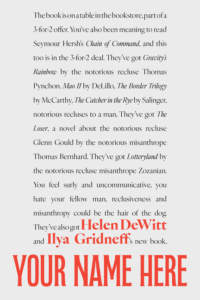
“It is a novel of permanent, persistent becoming, a story whose endings are multiple and essentially arbitrary, and it takes its own seeming unpublishability as a theme, or perhaps a promise. Reading it, you find yourself in the same position as the people writing it: a state of hovering uncertainty that does not dissipate, even on the final page.
…
“Pitching a book as abstruse as Your Name Here as a kind of cash grab is the novel’s wry joke. Yet it speaks sincerely to an obsession of DeWitt’s: She has long been consumed by the question of what contemporary society does and does not value, and both she and her characters have struggled with their bills. In the author’s note for her 2018 story collection, Some Trick, DeWitt includes a link that would allow the reader to buy her a cup of coffee; The Last Samurai’s Sibylla bemoans a world that monetizes everything but the strange, polymathic brilliance displayed by her son; in Your Name Here, DeWitt’s doppelgänger, Zozanian, laments all the hours she must spend working odd jobs to make rent.
…
“This sounds labyrinthine, but it isn’t, not really. DeWitt has constructed not a maze so much as a garden, where many kinds of writing can thrive side by side. The results can be anarchic, even confusing—I was never entirely clear on the precise relationship between DeWitt and Zozanian, or why the Berlin sections are told from one’s perspective and not the other’s—but they are never simple, blunt, or bland. Like the second-person narrators who pop up to gripe about the book’s use of Arabic or comment on its dissimilarity to the works of Anne Tyler, you will often find yourself wondering, What’s going on? Where is this going? And like them, if you keep reading, you will play a part in making it cohere.
Your Name Here does not treat readers like passive audience members to whom meaning is dictated. It demands work from them, and brazenly risks being misunderstood. This is a welcome development at a time when authors are starting to compete with the ultimate consumer-friendly writing: AI-generated poetry and prose.”
–Robert Rubsam on Helen DeWitt’s Your Name Here (The Atlantic)

If you buy books linked on our site, Lit Hub may earn a commission from Bookshop.org, whose fees support independent bookstores.